View this property on Akiya Japan
What Foreign Property Owners Need to Know
Japan's revised Civil Code, which took effect in April 2024, introduces the most significant changes to property inheritance and registration in decades. For the estimated 80,000+ foreigners who own real estate in Japan — and the thousands more buying each year — these changes carry serious implications that most English-language resources have barely covered.
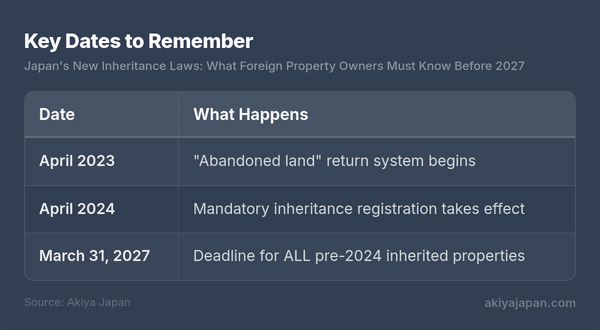
The headline change: all inherited properties must be registered within 3 years, with a hard retroactive deadline of March 31, 2027. Fines of up to ¥100,000 apply for non-compliance. But for foreign owners, the complications run much deeper than a registration deadline.
Why Japan Changed Its Inheritance Laws
The scale of the problem is staggering:
- 4.2 million properties have unknown or unclear ownership — an area larger than Kyushu island
- 9 million vacant houses (akiya) across the country, many tangled in unresolved inheritance
- Economic losses from unclear ownership estimated at ¥600 billion annually
- Municipal governments unable to demolish dangerous buildings or plan infrastructure because owners can't be found
Many of these "owner unknown" properties resulted from families inheriting land but never formally registering the transfer — sometimes across three or four generations. The new law makes registration mandatory, with teeth.
How This Directly Affects Foreign Property Owners
If You Own Property in Japan and Live Abroad
This is the scenario most foreign buyers will eventually face. When you pass away, your property in Japan doesn't simply transfer to your spouse or children. Under Japanese law:
- Japanese inheritance law applies to immovable property in Japan, regardless of your nationality or country of residence
- Your heirs have 3 years from the date they learn of the inheritance to register the ownership transfer
- If your heirs live outside Japan, they must still complete registration at a Japanese Legal Affairs Bureau
- A judicial scrivener (司法書士 (shihō shoshi)) in Japan is essentially mandatory for overseas heirs — they cannot easily appear in person
The Cross-Border Inheritance Problem
Here's where it gets complicated for foreign owners. When you die:
- Your home country's law determines who your heirs are (your will, or intestacy rules)
- Japanese law determines how the property transfers and what documents are required
- Your heirs need to produce documents that don't exist in most countries — Japanese inheritance requires a family register (戸籍謄本 (koseki tōhon)), which foreigners don't have
The workaround: your heirs must provide equivalent documentation from their home country — birth certificates, death certificates, marriage certificates, and a sworn affidavit — all apostilled or authenticated by a Japanese consulate, then translated into Japanese by a certified translator. This process alone can take 3–6 months.
If You Inherited Property from a Japanese Family Member
Foreign residents married to Japanese nationals, or those with Japanese heritage, may have inherited property years ago without completing formal registration. Under the new law:
- If you inherited before April 2024, you must register by March 31, 2027
- If you inherited after April 2024, you have 3 years from the date you became aware
- "Became aware" is interpreted strictly — attending a funeral or receiving notification from other heirs counts
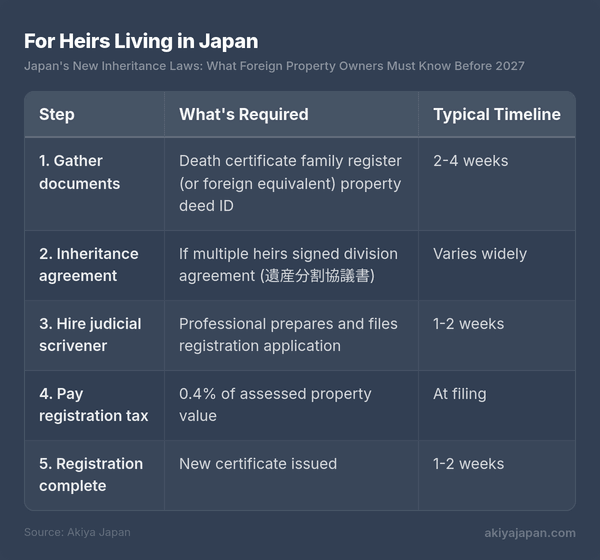
The Mandatory Registration Process
For Heirs Living in Japan
For Heirs Living Outside Japan (The Hard Part)
If you're inheriting Japanese property from abroad, add these steps:
- Appoint a tax representative in Japan (税務代理人) — required for inheritance tax filing if total estate exceeds ¥30 million + ¥6 million per heir
- Obtain apostilled documents from your home country — birth/death/marriage certificates proving family relationship
- Certified Japanese translations of all foreign documents
- Power of attorney for a judicial scrivener to act on your behalf
- Notarized signature certificate (since you don't have a Japanese seal/hanko)
Budget ¥200,000–500,000 (,300–,300 USD) for professional fees, depending on complexity. This may seem expensive, but attempting the process without professional help from overseas is essentially impossible.
What Happens If You Don't Register
The penalties are real, and for foreign owners, the consequences extend beyond fines:
- ¥100,000 fine for missing the registration deadline
- Cannot sell the property — no buyer or agent will proceed without clear title
- Cannot prove ownership in legal disputes (boundary issues, construction claims)
- Municipality may designate it as "specified akiya" under the Akiya Countermeasures Act, potentially leading to forced demolition at the owner's expense
- Property tax continues — municipalities will bill whoever they have on record, and unpaid taxes accrue penalties
- Your own heirs inherit the problem, compounded by another generation of unregistered transfer
Options If You Don't Want the Property
Option 1: Disclaim the Inheritance
You can formally disclaim within 3 months of learning about the inheritance. This must be filed at a Japanese Family Court. Warning: disclaiming is all-or-nothing under Japanese law — you cannot keep financial assets and disclaim only the property.
Option 2: The New "Abandoned Land" System (相続土地 (tochi)国庫帰属制度)
Since April 2023, heirs can return unwanted inherited land to the national government. However, the conditions are restrictive:
- Buildings must be demolished first (at your expense)
- Land must be free of soil contamination, boundary disputes, and liens
- You must pay a "management fee" of approximately ¥200,000 per parcel
- Only land qualifies — not buildings
In practice, the government has accepted only about 20% of applications so far. This option works best for rural vacant land, not for properties with buildings.
Option 3: Register and Sell
For many foreign heirs, the most practical path is to register the property and then sell it. Even deeply rural akiya often have some value, and listing platforms like Akiya Japan connect sellers with buyers specifically looking for affordable Japanese property.
Protecting Your Heirs: Planning Ahead
If you currently own property in Japan, the single most important thing you can do is plan ahead so your heirs aren't dealing with Japanese bureaucracy while grieving:
Essential Steps for Foreign Property Owners
- Create a Japanese will (遺言書) — A notarized will (公正証書遺言) at a Japanese notary's office is the gold standard. It clearly designates who inherits the property and dramatically simplifies registration.
- Keep a property file — Store together: property deed, registration certificate, most recent tax notice, your judicial scrivener's contact info, and any management company details.
- Tell your heirs — Many foreign owners buy property without telling family members. Your heirs need to know the property exists, where the documents are, and that Japanese law applies.
- Consider joint ownership carefully — Adding a co-owner while you're alive may seem helpful, but joint ownership creates its own complications under Japanese law, especially for inheritance tax.
- Establish a relationship with a judicial scrivener — Having a professional in Japan who already knows your situation saves your heirs weeks of searching and explaining.
The Opportunity for Buyers
For those looking to buy property in Japan, these inheritance reforms are creating opportunity. As the 2027 deadline approaches:
- More properties entering the market — Heirs who've been sitting on inherited properties for years are now motivated to register and sell rather than face fines
- Clearer titles — The new registration requirements mean fewer title surprises during purchase
- Municipal support — Local governments are offering subsidies and renovation grants to move inherited properties into active use
- Akiya bank listings expanding — Municipal akiya banks are seeing increased listings as registration deadlines motivate action
If you're considering buying, now is an excellent time to browse available properties — the supply of affordable homes is growing as these laws take effect.
Key Dates to Remember
Getting Professional Help
For foreign property owners, professional assistance isn't optional — it's essential. The professionals you may need:
- Judicial scrivener (司法書士 (shihō shoshi)) — handles property registration, the core requirement
- Tax accountant (税理士) — needed if the estate triggers inheritance tax obligations
- Lawyer (弁護士) — necessary only if there are disputes among heirs or complex cross-border legal issues
- Certified translator — for authenticating foreign documents
The Legal Affairs Bureau (法務局 (hōmu kyoku)) offers free consultations, and the Japan Federation of Judicial Scriveners maintains an online directory of certified professionals. Some scriveners advertise English-language services, though availability varies by region.
Sources & References
- Ministry of Justice — Revised Civil Code: Mandatory Inheritance Registration (Act No. 24 of 2021)
- Ministry of Land, Infrastructure, Transport and Tourism — Owner Unknown Land Survey (2023)
- Legal Affairs Bureau (法務局 (hōmu kyoku)) — Inheritance Registration Procedures and Guidelines
- Japan Federation of Shiho-Shoshi Lawyers — Cross-Border Inheritance Registration Requirements
- National Tax Agency — Inheritance Tax Guide for Non-Residents
- Cabinet Office — Akiya Countermeasures Special Measures Act (Revised 2023)