Every year, thousands of houses across Japan sit empty — abandoned by families who moved to cities, left behind by owners who passed away, or simply forgotten in villages where the population has dwindled to a handful of elderly residents. These vacant homes, known as akiya (空き家 (akiya)), represent one of the most unusual real estate opportunities in the developed world. For as little as the price of a used car, you can own a house in Japan. But the path from curiosity to keys in hand is more complicated than most English-language resources let on. This guide covers everything you need to know.
What Is an Akiya?
The word akiya (空き家 (akiya)) literally translates to "empty house." In everyday Japanese, it refers to any residential property that has been vacant for a prolonged period. Some akiya are charming wooden farmhouses in the countryside, structurally sound but cosmetically tired. Others are suburban homes abandoned when their owners moved into care facilities. And some, frankly, are on the verge of collapse — roofs caved in, floors rotted through, nature reclaiming what was once a family home.
The Japanese government's Housing and Land Survey, conducted every five years, provides the most reliable count. The 2023 survey recorded approximately 9 million vacant dwellings across the country, representing roughly 13.8% of all housing stock. That number has been climbing steadily for decades, and projections suggest it could reach 30% or more by 2040 if current trends continue.
Not all vacant properties are akiya in the colloquial sense. The government's figures include homes that are temporarily unoccupied, vacation properties, and units awaiting sale or rent through normal channels. The subset of genuinely abandoned or neglected homes — the ones people typically mean when they say "akiya" — is estimated at around 3.5 million. That is still an enormous number.
Types of Akiya
- Rural farmhouses (kominka / 古民家 (kominka)): Traditional post-and-beam construction, often with generous land. These are the dream for many buyers — thick wooden beams, tatami rooms, gardens. Ages range from 50 to over 150 years old.
- Suburban detached houses: Built during Japan's economic boom years (1960s–1980s), these are the most common type. Typically smaller lots, conventional construction, located in residential neighborhoods with reasonable access to stations.
- Former shops and mixed-use buildings: Properties in small towns that once served as shops on the ground floor with living quarters above. Can be interesting for those wanting to run a small business.
- Near-derelict structures: Properties where the building has deteriorated to the point that demolition is more practical than renovation. The value, if any, is in the land.
Why Are There So Many Empty Houses?
Japan's akiya problem is the result of several intersecting forces, none of which show signs of reversing.
Demographic Decline
Japan's population peaked at approximately 128 million in 2008 and has been declining since. The country's birth rate has fallen well below replacement level, and immigration, while increasing, remains modest by international standards. Fewer people means less demand for housing, particularly in areas outside major metropolitan centers.
The demographic shift is not evenly distributed. Tokyo, Osaka, and a handful of other cities continue to attract young workers and maintain relatively stable populations. But smaller cities, towns, and rural areas are experiencing dramatic depopulation. Villages that had 5,000 residents in the 1970s may have 800 today, most of them elderly.
Urban Migration
Japan's postwar economic miracle was powered by urbanization. Young people left farming communities for factory and office jobs in cities, and that pattern has never reversed. Each generation has been more urban than the last. The children and grandchildren of rural homeowners have built their lives in cities and have no intention of returning to the countryside — even when they inherit property there.
Inheritance Complications
When a property owner dies in Japan, the home often passes to children who already own homes elsewhere. Japanese inheritance law can result in a property being divided among multiple heirs, all of whom must agree on what to do with it. When heirs cannot agree, or when no one wants to take responsibility for the property, it simply sits empty. In some cases, the rightful heir is unknown or cannot be located, leaving the property in legal limbo.
There is also a cultural dimension. Unlike in many Western countries, old houses in Japan are not prized for their age. The conventional wisdom has long been that a house depreciates to zero value over 20–30 years, with only the land retaining worth. This mentality — combined with Japan's history of rebuilding frequently due to earthquake damage and evolving building codes — means there is little cultural attachment to preserving old homes.
The Cost of Demolition
Demolishing a house in Japan is not cheap. Depending on the size and location, demolition costs typically range from ¥1 million to ¥3 million (roughly $7,000–$20,000 USD). For heirs who inherited an unwanted property in a depopulated area, spending that kind of money to demolish a house on land that may be worth less than the demolition cost is an unappealing proposition.
Making matters worse, a quirk in Japan's tax code has historically penalized demolition. Residential land with a house on it receives a property tax reduction of up to one-sixth. Demolish the house and the land tax jumps significantly. This created a perverse incentive to leave deteriorating houses standing rather than clear the land. Recent legislative changes have begun to address this, but the effects of decades of this policy are still visible across the country.
Can Foreigners Buy Property in Japan?
Yes. This is one of the most remarkable aspects of Japan's property market: there are no restrictions on foreign ownership of real estate. You do not need to be a resident. You do not need a visa. You do not need to be a citizen. A person of any nationality can purchase land and buildings in Japan with the same rights as a Japanese citizen.
This is unusual globally. Many countries restrict or prohibit foreign land ownership, require reciprocity agreements, limit purchases to certain zones, or impose additional taxes on foreign buyers. Japan does none of these things. The right to own property is straightforward and has been stable for decades.
There are a few practical considerations, however:
- Financing: Getting a mortgage from a Japanese bank as a non-resident foreigner is extremely difficult, bordering on impossible for most buyers. Some banks offer loans to permanent residents or those with long-term visa status and stable employment in Japan, but the requirements are strict. Most foreign akiya buyers purchase with cash.
- Registration: Property ownership in Japan is recorded at the Legal Affairs Bureau (法務局 (hōmu kyoku) / hōmukyoku). Foreign buyers need to provide a notarized affidavit in lieu of a Japanese resident card for the registration process. This is manageable but requires some preparation.
- Reporting: Since 2022, foreign buyers who do not reside in Japan must report their property acquisition to the Bank of Japan within 20 days. This is a notification requirement, not an approval process — it does not affect your right to buy.
- Property management: If you do not live in Japan, you will need someone to look after your property. Unattended houses deteriorate quickly, especially in Japan's humid climate. Budget for a property management service or find a trusted local contact.
The Buying Process Step by Step
Buying property in Japan follows a well-defined process. While the details can vary, particularly for akiya bank transactions versus open market sales, the general sequence is consistent.
Step 1: Search and Identify Properties
The search phase is often the longest part of the process, particularly for foreign buyers who may have specific requirements about location, condition, and price. Properties can be found through several channels:
- Akiya banks (空き家 (akiya)バンク (akiya bank)): Municipal databases of vacant properties whose owners have registered them for sale. These are run by local governments and are often the source of the very cheapest properties. The catch: most akiya banks are Japanese-language only, and the properties listed tend to be in the most rural and depopulated areas.
- Real estate portals: Sites like SUUMO, Homes.co.jp, and At Home list properties from licensed agencies across Japan. These tend to be more conventional listings at market prices.
- Local real estate agents: In the area where you want to buy, a local agent (fudousan-ya) may know of properties that are not formally listed anywhere.
- Direct negotiation: In some cases, particularly in very rural areas, you may identify a vacant property and work through local government channels to contact the owner directly.
Step 2: Property Viewing
Once you have identified candidates, you need to visit them. This step is not optional, even if it requires an international flight. Photographs, and even video tours, cannot convey critical information about a property's condition, its surroundings, access roads, neighboring properties, local infrastructure, and the general feel of the area.
For akiya bank properties, viewing is typically coordinated through the municipality. For properties listed with agents, the listing agent will arrange viewings. It is wise to visit at least two or three properties in the same area to build a sense of local market conditions.
Step 3: Application and Offer (購入申込 / kōnyū mōshikomi)
When you find a property you want, you submit a purchase application. For akiya bank properties, this is usually a formal application form provided by the municipality, and the selection may involve a review process (some akiya banks prioritize buyers who plan to live in the property). For open market transactions, you make an offer through your agent, which the seller can accept, reject, or counter.
Price negotiation is common, particularly for akiya. Properties that have been listed for a long time, or whose owners are motivated to sell, may accept offers significantly below the listed price. However, for properties listed at extremely low prices (under ¥1 million), there may be little room for negotiation — the seller is already essentially giving the property away.
Step 4: Important Matters Explanation (重要事項説明 / jūyō jikō setsumei)
Before you sign the contract, a licensed real estate agent is legally required to provide a formal explanation of important matters regarding the property. This is a detailed document covering the property's legal status, zoning, building restrictions, infrastructure connections, known defects, and any other material facts. It is read aloud to the buyer by a qualified agent (takkenshi / 宅建士 (takkenshi)).
This is a critical consumer protection step and one of the most substantive parts of the process. Pay close attention, and if the explanation is conducted in Japanese, ensure you have a qualified interpreter present. Do not sign anything you do not fully understand.
Step 5: Contract Signing (売買契約 / baibai keiyaku)
The sale contract is signed by both buyer and seller. At this point, the buyer typically pays a deposit (手付金 / tetsukekin), usually 5–10% of the purchase price. This deposit serves as a commitment mechanism: if the buyer withdraws, they forfeit the deposit. If the seller withdraws, they must return double the deposit.
The contract will specify the closing date, conditions for completion, and allocation of responsibilities (for example, who pays for what portion of the fixed asset tax for the current year).
Step 6: Settlement and Registration (決済・登記 / kessai / tōki)
On the closing date, the remaining balance is paid, and the property is officially transferred. A judicial scrivener (shiho shoshi / 司法書士 (shihō shoshi)) handles the registration of the ownership transfer at the Legal Affairs Bureau. Once registration is complete, you are the legal owner of the property.
The entire process, from accepted offer to registration, typically takes one to three months. Akiya bank transactions may be faster for very low-value properties; complex transactions involving multiple heirs or boundary issues can take longer.
Key Players in the Transaction
Real Estate Agent (不動産 (fudōsan)屋 (fudōsan-ya) / fudousan-ya)
Licensed real estate agents facilitate most property transactions in Japan. They handle listings, viewings, negotiations, the important matters explanation, and contract preparation. An agent must hold a takkenshi license and be registered with the relevant prefectural governor's office.
In Japan, both buyer and seller typically have their own agents, though in some cases (particularly for akiya) one agent may represent both parties. The commission structure is regulated by law (more on this below).
For foreign buyers, finding an agent who speaks English — or at minimum, is willing to work with an interpreter — is highly advisable. Communication breakdowns during property transactions can be costly.
Judicial Scrivener (司法書士 (shihō shoshi) / shiho shoshi)
A judicial scrivener is a licensed legal professional who specializes in property registration and other filings with government offices. They are involved at closing to prepare and submit the registration documents. Their role is essential — property transfers must be registered to be legally effective against third parties.
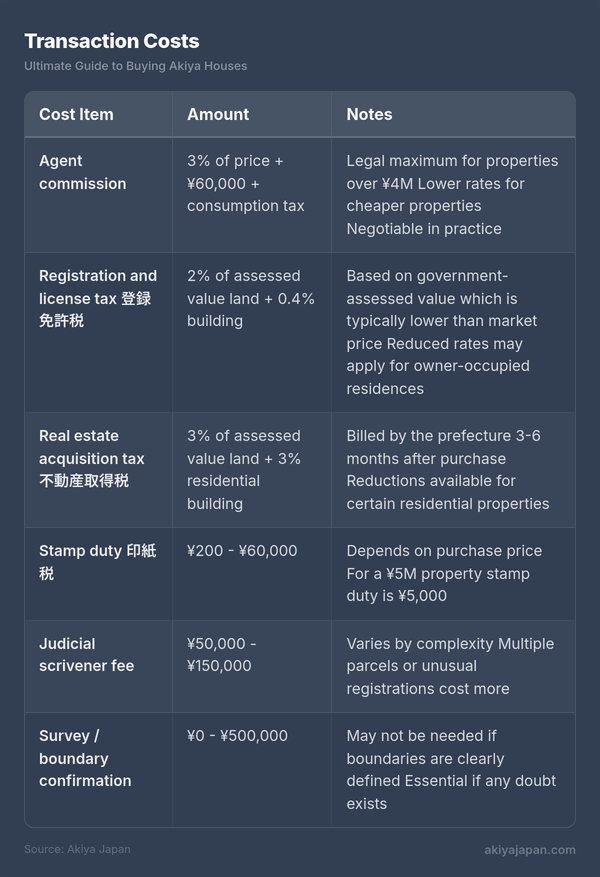
The judicial scrivener's fee is separate from the agent's commission and varies based on the complexity of the registration. Expect to pay ¥50,000–¥150,000 for a straightforward transfer.
Banks and Financing
As noted above, mortgage financing for non-resident foreigners is extremely limited. For those who do reside in Japan and qualify, the major banks (MUFG, SMBC, Mizuho) and regional banks offer standard mortgage products. Interest rates in Japan have been remarkably low for decades, though they have begun to inch upward from near-zero levels.
Several international lenders and specialized services have emerged that cater to foreign buyers, but their terms tend to be less favorable than domestic Japanese mortgages. Do your due diligence on any lender targeting foreign real estate buyers.
Costs Breakdown
The purchase price of the property is only part of the total cost. Understanding the full cost picture is essential for budgeting.
Transaction Costs
Agent Commission Details
Japan's agent commission structure is set by law as a maximum rate, calculated on a sliding scale:
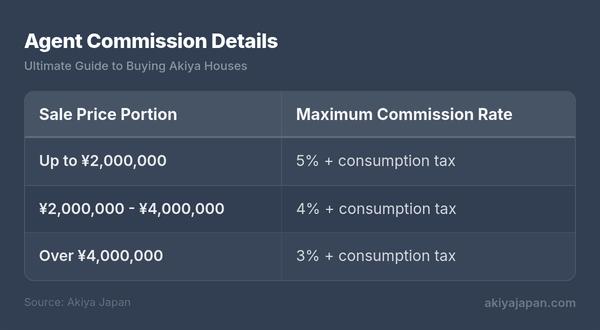
For properties over ¥4 million, the simplified formula is: (Price × 3% + ¥60,000) × 1.1 (the 1.1 accounts for 10% consumption tax). For a ¥10 million property, that works out to ¥396,000.
For very low-priced properties, a 2024 regulatory change allows agents to charge a minimum commission of up to ¥330,000 (including tax) on sales of ¥8 million or less, acknowledging that the work involved in a ¥1 million sale is essentially the same as for a ¥10 million sale.
Total Acquisition Cost Example
For a ¥5,000,000 akiya purchase, your total costs might look like this:
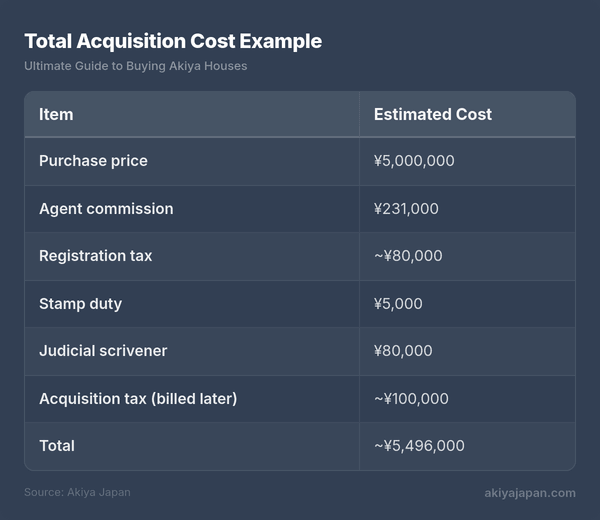
As a rule of thumb, budget an additional 6–10% on top of the purchase price for transaction costs.
Common Pitfalls
Akiya purchases carry risks that conventional real estate transactions do not. Understanding these pitfalls before you start looking will save you time, money, and heartache.
Structural Issues
Many akiya are old. A house built before 1981 was constructed under Japan's pre-revision earthquake resistance standards (旧耐震 (kyū taishin)基準 (kyū taishin kijun) / kyū taishin kijun). The 1981 building code revision significantly strengthened earthquake resistance requirements. Properties built before this date may need seismic retrofitting, which can cost ¥1 million to ¥3 million or more.
Beyond earthquake resistance, common structural issues in akiya include:
- Foundation problems: Settling, cracking, or moisture damage, particularly in older homes without modern damp-proofing.
- Roof damage: Missing or broken tiles, leaks, rot in the wooden structure underneath. Roof repairs are among the most expensive renovation items.
- Termite damage (シロアリ / shiroari): Extremely common in Japan's humid climate. Termites can silently destroy structural timbers over years. A professional inspection before purchase is strongly recommended.
- Mold and moisture: Japan's rainy season and high humidity create ideal conditions for mold growth, particularly in houses that have been closed up without ventilation for extended periods.
Japan does not have a standardized, mandatory home inspection process equivalent to what exists in some Western countries. You can — and should — hire a qualified building inspector (ホームインスペクター / hōmu insupekutā) to evaluate the property before committing. The cost is typically ¥50,000–¥100,000 and is money well spent.
Access Roads and Setback Requirements
Japanese building law requires that a building plot must front on a road that is at least 4 meters wide for a minimum of 2 meters of frontage (the so-called 接道義務 / setsudō gimu). Many older properties, particularly in rural areas, do not meet this requirement. If the road is narrower than 4 meters, you may be required to set back your building from the road centerline to create the required width — effectively losing usable land.
In extreme cases, a property may have no legal road access at all, meaning you cannot obtain a building permit. This does not prevent you from buying the property, but it means you cannot legally construct a new building on it if the existing structure is demolished or destroyed. This is a critical issue that must be investigated before purchase.
Leasehold vs. Freehold Land
Most property in Japan is sold freehold (所有権 (shoyūken) / shoyūken), meaning you own both the building and the land outright. However, some properties sit on leasehold land (借地権 (shakuchiken) / shakuchiken), where you own the building but lease the land from a separate landowner. Leasehold arrangements require ongoing ground rent payments and may restrict what you can do with the property. They also complicate resale.
Always confirm whether the property is freehold or leasehold before proceeding. This information is disclosed in the important matters explanation, but it is better to know earlier in the process.
Stigmatized Properties (事故物件 (jiko bukken) / jiko bukken)
In Japan, properties where certain events occurred — suicide, murder, unattended death, fire — are classified as stigmatized properties. Agents are legally required to disclose these events. While stigmatized properties sell at significant discounts (sometimes 20–50% below comparable properties), some buyers are uncomfortable with the history, and resale can be more difficult.
This is not merely a superstition concern. There can be practical issues as well: a property where an unattended death occurred may have odor or staining that requires specialized cleaning. Disclosures are mandatory, so you will be informed, but it is worth understanding this aspect of the Japanese market.
Boundary Disputes
In rural Japan, property boundaries may not have been formally surveyed in decades — or ever, in some cases. Boundaries may be defined by features that no longer exist ("the large pine tree" that was cut down twenty years ago) or by informal agreements between neighbors who are now deceased. A formal boundary survey (境界確定測量 / kyōkai kakutei sokuryō) resolves this but costs ¥300,000–¥500,000 or more and requires the cooperation of adjoining landowners.
For low-value akiya, the cost of a formal survey may exceed the property price. In these cases, you may need to accept some boundary ambiguity and negotiate a practical arrangement with neighbors.
Zoning and Land Use Restrictions
Japan's zoning system (用途地域 (yōto chiiki) / yōto chiiki) designates areas for specific uses: residential, commercial, industrial, agricultural, and so on. Properties in agricultural zones (農地 / nōchi) are subject to restrictions on sale and use — purchasing agricultural land requires approval from the local Agricultural Commission, and converting it to residential use involves an additional application process.
Some akiya sit on land designated as agricultural or within forest zones. Check the zoning status early in your research to avoid surprises.
Hidden Obligations
Some properties come with obligations that are not immediately obvious:
- Neighborhood association dues (自治会 (jichikai)費 / jichikai-hi): Many rural areas have active neighborhood associations that expect participation and dues (typically ¥500–¥3,000 per month).
- Shared infrastructure maintenance: Properties on private roads or with shared water systems may require cost-sharing for maintenance.
- Environmental cleanup: If the previous use involved chemicals or industrial processes, you may inherit cleanup responsibilities.
Renovation Considerations
Unless you are buying one of the rare akiya in move-in condition, renovation is unavoidable. Understanding what different budgets can achieve will help you plan realistically.
What ¥3 Million Gets You (~$20,000 USD)
This is a modest renovation budget, suitable for making a property habitable without major structural work:
- New water heater and basic plumbing repairs
- Electrical rewiring for safety (partial)
- Kitchen refresh: new countertops, sink, and basic appliances
- Bathroom cleaning and minor repairs (not a full rebuild)
- Tatami mat replacement (about ¥5,000–¥10,000 per mat)
- Interior painting or wallpaper
- Basic pest treatment
At this budget, you are working with the existing layout and systems. You are making the property safe and comfortable, not transforming it.
What ¥5 Million Gets You (~$33,000 USD)
A mid-range budget opens up more possibilities:
- Everything in the ¥3M budget, plus:
- Bathroom renovation (new unit bath or tiled shower)
- Kitchen renovation with modern fixtures
- Partial flooring replacement
- Window replacement for insulation (select rooms)
- Minor roof repairs (patching, not full replacement)
- Exterior cleanup and minor repairs
This budget allows you to create a comfortable living space while still making compromises in some areas. Prioritization is key — focus spending on the systems that matter most (waterproofing, plumbing, electrical, heating).
What ¥10 Million Gets You (~$67,000 USD)
A serious renovation budget that can address structural issues:
- Full seismic retrofitting
- Complete roof repair or replacement
- Full electrical rewiring
- Modern insulation throughout
- New kitchen and bathroom
- Flooring replacement throughout
- Foundation repairs if needed
- Exterior refinishing
At ¥10 million, you can transform a neglected property into a comfortable modern home while preserving its character. For traditional kominka (old farmhouses), this budget allows for respectful renovation that honors the original architecture while adding modern conveniences.
Important Renovation Notes
Finding contractors: In rural areas, finding contractors willing to take on renovation work can be challenging. Many skilled tradespeople are aging out of the workforce, and those still active are often booked months in advance. Start looking for contractors before you finalize your purchase if possible.
DIY considerations: Japan is generally tolerant of owner-performed renovation work, but certain tasks — gas fitting, major electrical work, and structural modifications — should be handled by licensed professionals. Building permits are required for significant structural changes.
Renovation subsidies: Many municipalities offer renovation subsidies for akiya, particularly if you plan to live in the property. These subsidies can range from ¥500,000 to ¥3,000,000, sometimes more. Check with the local government office (市役所 / shiyakusho or 町役場 / machiyakuba) about available programs. Application must typically be made before renovation begins.
Insulation: Most Japanese houses, particularly older ones, are poorly insulated by Western standards. If you plan to live in the property year-round, investing in proper insulation — walls, ceiling, floors, and windows — will dramatically improve comfort and reduce heating and cooling costs. This should be a priority item in any renovation budget.
Ongoing Costs of Ownership
Property ownership in Japan comes with recurring annual costs that you should factor into your long-term budget.
Fixed Asset Tax (固定資産税 (kotei shisan-zei) / kotei shisan zei)
This is Japan's equivalent of property tax, levied annually at a standard rate of 1.4% of the government-assessed value. The assessed value is typically well below market value — often 50–70% of the purchase price for land and even less for older buildings (which depreciate toward zero in the government's assessment).
For a modest akiya, annual fixed asset tax might be as low as ¥20,000–¥50,000. For larger properties with more valuable land, it could be ¥100,000 or more. Residential land with a house receives a reduction (up to one-sixth for the first 200 square meters), which is one reason owners leave deteriorating houses standing.
City Planning Tax (都市計画税 (toshi keikaku-zei) / toshi keikaku zei)
An additional tax of up to 0.3% of assessed value, levied in designated urbanization promotion areas. Not all areas are subject to this tax — many rural locations where akiya are concentrated are outside these zones.
Utility Costs
Even if you are not living in the property full-time, maintaining utility connections is advisable:
- Electricity: Basic contract fee of ¥1,000–¥2,000/month even with minimal usage.
- Water: Basic fee varies by municipality, typically ¥1,000–¥3,000/month.
- Gas: If connected. Many rural properties use propane gas, which is more expensive than city gas.
- Internet: ¥3,000–¥5,000/month for fiber optic. Availability varies in rural areas; some locations only have mobile connectivity.
Insurance
Homeowner's insurance (火災保険 / kasai hoken) covers fire, natural disasters, and liability. Japan's earthquake insurance (地震保険 / jishin hoken) is a separate, government-backed product that covers earthquake, tsunami, and volcanic damage. Given Japan's seismic activity, earthquake insurance is strongly recommended. Annual premiums vary by location, construction type, and coverage amount, but expect ¥20,000–¥80,000 per year for combined fire and earthquake coverage on a modest property.
Maintenance
An unoccupied house in Japan deteriorates rapidly. Humidity promotes mold growth, wooden structures swell and warp, pests move in, and gardens become overgrown quickly. If you are not living in the property, budget for:
- Property management or caretaking: ¥5,000–¥15,000/month for periodic checks, ventilation, mail collection, and basic upkeep.
- Garden maintenance: ¥30,000–¥100,000 per visit for professional vegetation management, depending on the size of the grounds. In summer, vegetation grows explosively.
- Periodic repairs: Budget 1–2% of the property's renovation value per year for ongoing maintenance.
Annual Cost Summary
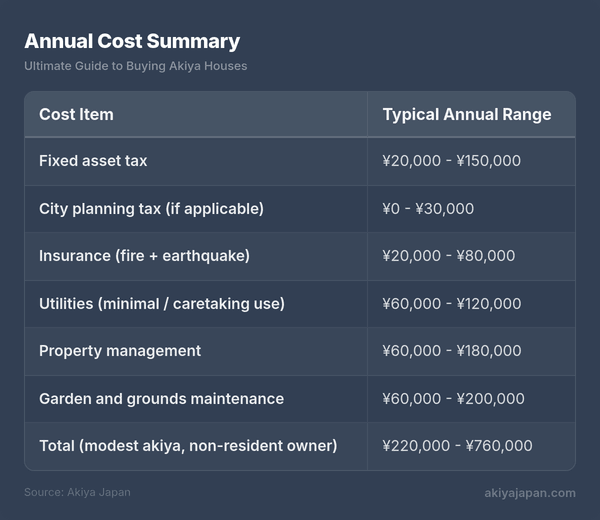
At the low end, ongoing costs for a rural akiya can be remarkably modest — under ¥250,000 per year (roughly $1,700 USD). But costs add up, and neglecting maintenance creates much larger expenses down the line.
Tips for Foreign Buyers
Buying property in a foreign country where you may not speak the language is inherently challenging. These practical tips will help smooth the process.
Language and Communication
Expect Japanese. The vast majority of property listings, government documents, contracts, and interactions with sellers, agents, and officials will be in Japanese. While translation tools have improved dramatically, property transactions involve nuance and legal precision that machine translation can miss. Having a human who is fluent in both Japanese and your language involved in the process is strongly recommended.
Use translation tools strategically. Google Translate's camera feature can translate Japanese text in real time by pointing your phone at documents, signs, and listings. DeepL often provides more natural translations of longer text. These tools are excellent for initial research and casual communication but should not be relied upon for contract review or legal matters.
Learn key terms. Even a basic understanding of property-related Japanese vocabulary will help you navigate listings and communicate with agents. Terms like 土地 (tochi / land), 建物 (tatemono / building), 間取り (madori / floor plan), 築年数 (chikunensū / building age), and 価格 (kakaku / price) appear in every listing.
Working with Agents
Find a bilingual agent if possible. A growing number of real estate agents in Japan serve foreign clients and can conduct business in English. They are more common in major cities and popular rural areas (like parts of Nagano, Chiba, and the Kii Peninsula) than in remote regions. A bilingual agent is worth their weight in gold — they can explain nuances that would otherwise be lost.
Understand the agent's role. In Japan, the real estate agent's responsibility is to facilitate a fair transaction, not to advocate exclusively for one party. Both the buyer's and seller's agents are bound by the same legal framework. The important matters explanation is a legal obligation, not a sales tactic — the agent is required to disclose known problems.
Be responsive. Japanese business culture values promptness. If your agent sends you documents to review or questions to answer, respond as quickly as possible. Delays on your end can be interpreted as lack of seriousness and may cause sellers to lose patience.
Visiting in Person
This is not optional. We cannot stress this enough. No matter how many photos you have seen, no matter how detailed the listing description, you must visit the property before buying. What you discover on the ground — the steepness of the access road, the condition of the neighbors' properties, the distance to the nearest convenience store, the sound of the nearby river, the cell phone reception — will inform your decision in ways that no listing can.
Plan an efficient trip. If you are coming from overseas, try to view multiple properties across two or three areas in a single trip. Japan's rail network makes this feasible. A well-planned week in Japan can include viewings in several prefectures.
Visit in different weather. If possible, visit the area in more than one season. Japan's climate varies enormously — a charming mountain village in spring can be buried under three meters of snow in winter. Areas that feel pleasantly warm in autumn may be unbearably humid in August. Understanding the year-round conditions of your chosen location is important for long-term satisfaction.
Due Diligence
Check the hazard maps. Japan's national and municipal hazard maps (ハザードマップ (hazādo mappu) / hazādo mappu) show areas at risk of flooding, landslides, tsunami, and other natural disasters. These maps are available online through municipal websites and the national hazard map portal. Do not skip this step — Japan has beautiful landscapes, but some of them are beautiful precisely because of the geological forces that also create hazards.
Verify infrastructure. In rural areas, do not assume that basic infrastructure exists or functions properly. Check:
- Water supply — municipal water (上水道 / jōsuidō) or well (井戸 / ido)?
- Sewage — connected to municipal sewer (下水道 / gesuidō), septic tank (浄化槽 (jōkasō) / jōkasō), or older-style treatment?
- Gas — city gas, propane, or no gas connection?
- Internet — fiber available, or mobile-only?
- Road access — publicly maintained or private road?
Research the municipality. The long-term viability of a community matters. A town that is actively trying to attract new residents may offer subsidies, language support, and community integration programs. A town that is in terminal decline may lose its school, its post office, and eventually its municipal services. Look at population trends and the municipality's revitalization plans.
Financial Planning
Budget conservatively. As a general guideline, budget the purchase price plus 50–100% of the purchase price for renovation, plus one year of carrying costs. If you buy a ¥3 million akiya, plan for ¥6–9 million in total spending over the first year to two years. If actual costs come in lower, that is a pleasant surprise. The reverse situation — running out of budget mid-renovation — is far more stressful.
Understand currency risk. If you are earning in a currency other than Japanese yen, exchange rate fluctuations will affect your costs. The yen's value against the dollar and euro has varied substantially in recent years. Consider locking in exchange rates for large transfers or budgeting with unfavorable rate assumptions.
Have a clear plan for the property. Before buying, be honest with yourself about how you will use the property: primary residence, vacation home, rental, renovation project, or eventual resale. Each use case has different requirements and cost profiles. A property that is perfect for summer vacations may be impractical as a primary residence if winter access is difficult or if the nearest hospital is an hour away.
Municipal Incentive Programs
Hundreds of municipalities across Japan are actively working to fill vacant houses and attract new residents. Many offer financial incentives that can significantly reduce the cost of buying and renovating an akiya.
Common Incentive Types
- Renovation subsidies (改修補助金): Grants covering a portion of renovation costs, typically 30–50% up to a cap of ¥1–3 million. Usually require that you live in the property for a minimum period (3–5 years).
- Moving subsidies (移住補助金): Cash grants for families or individuals who relocate from urban areas. Can be substantial — some municipalities offer ¥1 million or more for families with children.
- Child-rearing incentives: Additional support for families with children, including subsidized or free childcare, school supplies, and health care.
- Free or nearly free properties: Some municipalities will transfer abandoned properties at zero cost to buyers who commit to living in and maintaining them.
- Business startup support: Grants and low-interest loans for new businesses in the community, particularly in agriculture, tourism, and traditional crafts.
Eligibility for these programs varies. Some are restricted to Japanese nationals or permanent residents. Others are available to anyone willing to relocate. Many programs have annual application periods and limited budgets — early application is advisable.
Legal Considerations for Non-Residents
While there are no restrictions on foreign ownership, a few legal and practical matters deserve attention.
Tax Implications
In Japan: Property ownership generates tax obligations regardless of your residency status. Fixed asset tax is due annually. If you sell the property at a profit, capital gains tax applies — the rate depends on how long you held the property (approximately 30% for short-term holdings under 5 years, approximately 15% for long-term holdings over 5 years, plus surtax). If you rent the property, rental income is taxable in Japan.
In your home country: Most countries require their residents to report worldwide income, including rental income and capital gains from foreign properties. The specific rules depend on your nationality and residency. Tax treaties between Japan and many countries prevent double taxation, but navigating the interplay of two countries' tax systems can be complex. Consult a tax professional familiar with cross-border property ownership.
Inheritance Planning
Japan has its own inheritance tax system, and Japanese property held by a foreign national at the time of their death may be subject to Japanese inheritance tax. The tax-free allowance is ¥30 million plus ¥6 million per legal heir, so modest properties are unlikely to trigger liability. However, the administrative process of transferring property from a deceased foreign owner to their heirs can be cumbersome, requiring foreign documents to be notarized, apostilled, and translated.
Having a clear plan for what happens to your Japanese property if something happens to you is responsible ownership. At minimum, inform your heirs of the property's existence and leave documentation about its location, registration details, and contact information for your agent or property manager.
Registration Without a Japanese Address
Property registration in Japan normally requires a residential address. Foreign buyers who do not have a Japanese address can register using their overseas address plus a notarized declaration. The specific requirements have evolved over the years and may vary by Legal Affairs Bureau office, so work with your judicial scrivener to prepare the correct documentation.
The Emotional Side
A discussion of akiya buying would be incomplete without acknowledging the emotional dimension. There is a romance to these houses — the idea of rescuing a forgotten home, of living in a Japanese village, of slowing down and connecting with a different way of life. That romance is valid. People have changed their lives profoundly and positively by buying and restoring akiya.
But romance must be tempered with realism. Living in rural Japan as a foreigner can be isolating, particularly if you do not speak Japanese. Community integration takes effort, patience, and humility. Winters can be harsh and lonely. Infrastructure that city dwellers take for granted — hospitals, supermarkets, public transport — may be far away or nonexistent. The gap between the Instagram version of Japanese rural life and the Tuesday-in-February reality can be significant.
The most successful foreign akiya buyers tend to share certain traits: they research obsessively before buying, they visit multiple times before committing, they build relationships with local community members, they learn at least basic Japanese, and they approach the experience with realistic expectations about both the joys and the challenges.
Summary: Is an Akiya Right for You?
An akiya can be an extraordinary opportunity if you go in with clear eyes and realistic expectations. The financial barrier to entry is lower than almost anywhere else in the developed world. The legal framework is transparent and foreigner-friendly. Living in or regularly visiting a Japanese community is an experience with few equivalents elsewhere.
But it is not for everyone. An akiya purchase makes sense if:
- You are comfortable with the idea of a significant renovation project
- You have visited Japan and have a genuine affinity for the country and its culture
- You have realistic expectations about rural life and infrastructure
- You can commit the time and budget to see the project through
- You have a clear plan for how you will use the property
- You are willing to invest in professional help (agent, interpreter, inspector, scrivener)
If those criteria describe you, then the world of akiya is worth exploring seriously. The houses are waiting. Many of them have been waiting for a very long time. Browse our houses for sale in Japan search to see the full national inventory — or explore cheap houses under ¥5M — updated daily across all 47 prefectures.