You've found the property — the price is right, the location looks good on the map. But there's one question most buyers from abroad never think to ask: if you fell seriously ill at 2am, what happens next? And once you're at the hospital, how do you actually manage when you cannot speak or read Japanese?
This guide answers both. How to evaluate healthcare access before you commit to a location — and what to do once you're inside the system.
Japan's Healthcare Access Gap
Japan has a world-class healthcare system in its major cities. Outside them, the picture is more complicated — and it is getting worse, not better.
As of October 2022, Japan's Ministry of Health, Labour and Welfare counted 557 designated 無医地区 (mui chiku) (muri chiku — areas without doctors) — defined as communities with no medical facility within roughly 4 km and a population of at least 50. That covers 122,206 people with effectively no local healthcare access.
The broader picture is bleaker. As of 2022, 77 municipalities had no clinic at all. By 2040, the MHLW projects that figure will rise to 342 municipalities — 18% of all municipalities in Japan. The driver is demographic: 53% of Japan's clinic doctors were in their 60s or older as of 2022. Retirement will hollow out healthcare coverage over the next 15 years in ways that current maps cannot yet show.
This is not only a countryside problem. Outer suburbs of mid-sized cities, coastal towns, and island communities all sit in the same gap. For any buyer planning to actually live in their Japanese property, it is worth checking before you sign.
Japan's Tiered Healthcare System: Know the Difference
Not all medical facilities are equal, and misunderstanding the hierarchy can create false confidence. A nearby clinic will handle your prescription. It will not handle your cardiac event.
| Facility Type | Japanese | Beds | What It Handles |
|---|---|---|---|
| Clinic / GP surgery | 診療所 (shinryojo) | 0–19 | Routine illness, chronic conditions, referrals |
| Hospital | 病院 (byoin) | 20+ | Inpatient care, surgery, specialist departments |
| Emergency hospital | 救急病院 (kyukyu byoin) | Usually 200+ | 24/7 ER, trauma, life-threatening emergencies |
| Urgent care clinic | 救急診療所 (kyūkyū shinryōjo) | Small/walk-in | Evenings and holidays, urgent but not life-threatening |
The 20-bed threshold is the legal dividing line between clinic and hospital under Japan's Medical Care Act. The first — and sometimes only — nearby facility in many areas is a 診療所 (shinryōjo). It handles prescriptions and routine care. For emergencies, the question is whether a 救急病院 (kyūkyū byōin) can reach you — or you can reach it — within the hour.
Ambulance Response Times: The Real Numbers
Japan's national average ambulance response time (call to arrival at scene) is 9.4 minutes. That figure is built almost entirely on urban density. Outside major cities, response times routinely exceed 20–30 minutes for the ambulance alone — before the hospital journey begins.
The national average for call to hospital arrival is 40–43 minutes. In an area 40 km from the nearest 救急病院 (kyūkyū byōin), expect that figure to be considerably longer.
Japan operates a Doctor-Heli (医師ヘリ) helicopter system with 56 bases across 47 prefectures as of 2022. For genuine emergencies in more remote areas this provides a real safety net — but helicopter dispatch adds 15–30 minutes on top of the ground ambulance response, and prefectural coverage is uneven.
The practical threshold: if the nearest 救急病院 (kyūkyū byōin) is more than 60 minutes away by road, the location carries meaningful medical risk. That must be a conscious decision, not a discovered one.
How to Call 119 When You Don't Speak Japanese
This is the question most property guides skip. The answer is straightforward, but you need to know the procedure in advance.
When you dial 119, a dispatcher will answer in Japanese. Say clearly: "English, please." The dispatcher will initiate a three-way call with an interpreter. This service is available nationwide. Connection time varies — urban dispatch centres handle it faster — but the system works.
Have the following ready before any emergency arises:
- Your address in Japanese — save it as a note on your phone, copy it from Google Maps. This is the single most useful preparation you can make.
- The nature of the emergency in simple terms — an interpreter will help, but knowing kyobu no itami (chest pain) or kotsuu jiko (traffic accident) is useful
- Whether anyone at the property speaks Japanese
The JNTO Japan Visitor Hotline (050-3816-2787) operates 24/7 in English, Chinese, Korean, and Japanese. Not for life-threatening emergencies — call 119 first — but useful for navigating non-emergency care and translating diagnoses. Save this number before you need it.
Should You Contact Your Embassy?
Your embassy is not the first call in a medical emergency — dial 1 1 9 first. But there are specific situations where your embassy becomes essential, and knowing the number in advance is the difference between a manageable crisis and an overwhelming one.
When your embassy matters:
- Extended hospitalisation — they can notify your family, liaise with hospital staff on your behalf, and help navigate insurance claims with a Japanese provider
- Incapacitation — if you cannot speak for yourself, the embassy can act as next-of-kin contact and verify your identity to medical staff
- Medical repatriation — if you need to be flown home, the embassy coordinates with airlines, authorities, and your insurer
- Lost travel documents during hospitalisation — emergency passport replacement while admitted
The practical rule: save your embassy's emergency number in your phone before you arrive in Japan. Every major embassy in Tokyo has either a 24/7 duty officer or a routed emergency line. None of them are useful if you have to search for the number while in crisis.
| Country | Emergency Number | Hours |
|---|---|---|
| United States | +81-3-3224-5000 | 24/7 (duty officer) |
| United Kingdom | +81 (0)3 5211 1100, option 2 | 24/7 |
| Australia | +61 2 6261 3305 (Consular Emergency Centre) | 24/7 |
| Canada | +1-613-996-8885 (Ottawa, collect calls accepted) | 24/7 |
| New Zealand | +64 99 20 20 20 | 24/7 |
| Ireland | +353 (0)1 408 2000 (DFA Dublin) | 24/7 |
| Germany | +49 (0)30 18 170 (Federal Foreign Office, Berlin) | 24/7 |
| France | +81-80-9539-3970 (after-hours only — life-threatening emergencies only) | After hours |
| Netherlands | +81 3 5776 5400 | 24/7 |
| South Africa | +81-80-7953-6381 (Consular Services Manager mobile) | No central 24/7 line |
If your country is not listed, your embassy's website will have current contact details — verify and save them before you travel or move. Numbers for duty officers change; checking the official site once a year takes two minutes.
One practical note: embassies cannot pay your medical bills, get you preferential treatment, or override Japanese law and hospital procedure. What they can do is make an overwhelming situation significantly more manageable — particularly for longer admissions where language, paperwork, and family communication become the real burden.
Once You're There: Navigating a Japanese Hospital Without Japanese
Getting to the hospital is one thing. Functioning once you're inside is another. Most guides stop at "call 119" — this section does not.
Registration at the front desk
Show your health insurance card (国民健康保険 (kokumin kenkō hoken) — national health insurance). The card number is all the front desk needs to register you. If you are not yet enrolled in national health insurance, bring your passport and residence card instead.
Registration forms are in Japanese. Google Translate's camera mode reads printed Japanese text in real time — point your phone at the form and it overlays a translation. It is not perfect, but it handles standard clinic registration sheets reliably.
Explaining your symptoms
The Dr. Passport app is designed exactly for this: a body-region symptom selector covering 2,000+ symptoms in 14 languages, built for showing your phone screen to a Japanese doctor rather than trying to speak. It works offline. Download it before you need it.
Google Translate voice mode works in consultations but is slow. More practical: write your symptoms as a note in Google Translate before you arrive, show the Japanese text to the doctor, and let them type a response back.
If you need a formal medical interpreter, ask for "tsuyaku" (通訳 (tsuyaku)). Many larger hospitals subscribe to phone interpretation services and can connect one on request. You can also contact the AMDA International Medical Information Centre (03-6233-9266) — they provide referrals and interpretation support for non-Japanese speakers across Japan.
The free resource almost nobody uses
Every prefecture in Japan has an international exchange association (国際交流協会). Many provide medical interpreter dispatch, sometimes free, sometimes at a nominal charge (typically ¥1,000–3,000 per session). You call ahead, book an interpreter, and they accompany you to your appointment. This service exists in cities and in smaller prefectural towns. Almost no foreign resident knows about it. Find your prefecture's association by searching "[prefecture name] 国際交流協会 医療通訳 (tsuyaku)".
Foreign patient desks
Larger hospitals — particularly university hospitals and major regional hospitals — have dedicated foreign patient reception desks (外国人患者対応窓口). These handle paperwork, insurance questions, and can arrange interpretation. When researching hospitals near a property you are considering, checking whether the nearest large hospital has this desk is worth the two minutes it takes.
After the appointment: prescriptions
Japanese pharmacies can provide English-language drug information sheets on request — ask "Eigo no setsumeisho wa arimasu ka?" Most chain pharmacies keep them. The prescription itself will be in Japanese, but the sheet covers dosage, interactions, and side effects.
Check English-Friendly Hospitals Directly on the Property Map
If you are already browsing properties on Akiya Japan, you do not need a separate research step. The property search map includes an English-Friendly Hospitals layer built from the JNTO medical facility network — 2,508 verified hospitals and clinics across all 47 prefectures.
To activate it: open the map, then open the Town & Planning panel in the toolbar. Toggle English-Friendly Hospitals and every JNTO-verified facility appears as a pin alongside the property listings. A second toggle adds English-Friendly Dental clinics. Each marker shows the hospital name, address, phone, and a link to the facility website — check healthcare access for any property without opening a second tab.
Facilities accredited under the Japan Medical International Patient (JMIP) standard are flagged separately. JMIP hospitals have cleared a formal accreditation process covering staff language capability, interpretation services, and international patient procedures. If that matters to your evaluation, the map makes those facilities immediately visible.
This is the fastest cross-reference available: find a property you are evaluating, toggle the layer, and read off the nearest English-capable hospitals by driving distance in under a minute.
How to Research Healthcare Access Before You Buy
No single English-language tool covers this comprehensively. But combining three approaches gives a reliable picture of any property you are seriously evaluating.
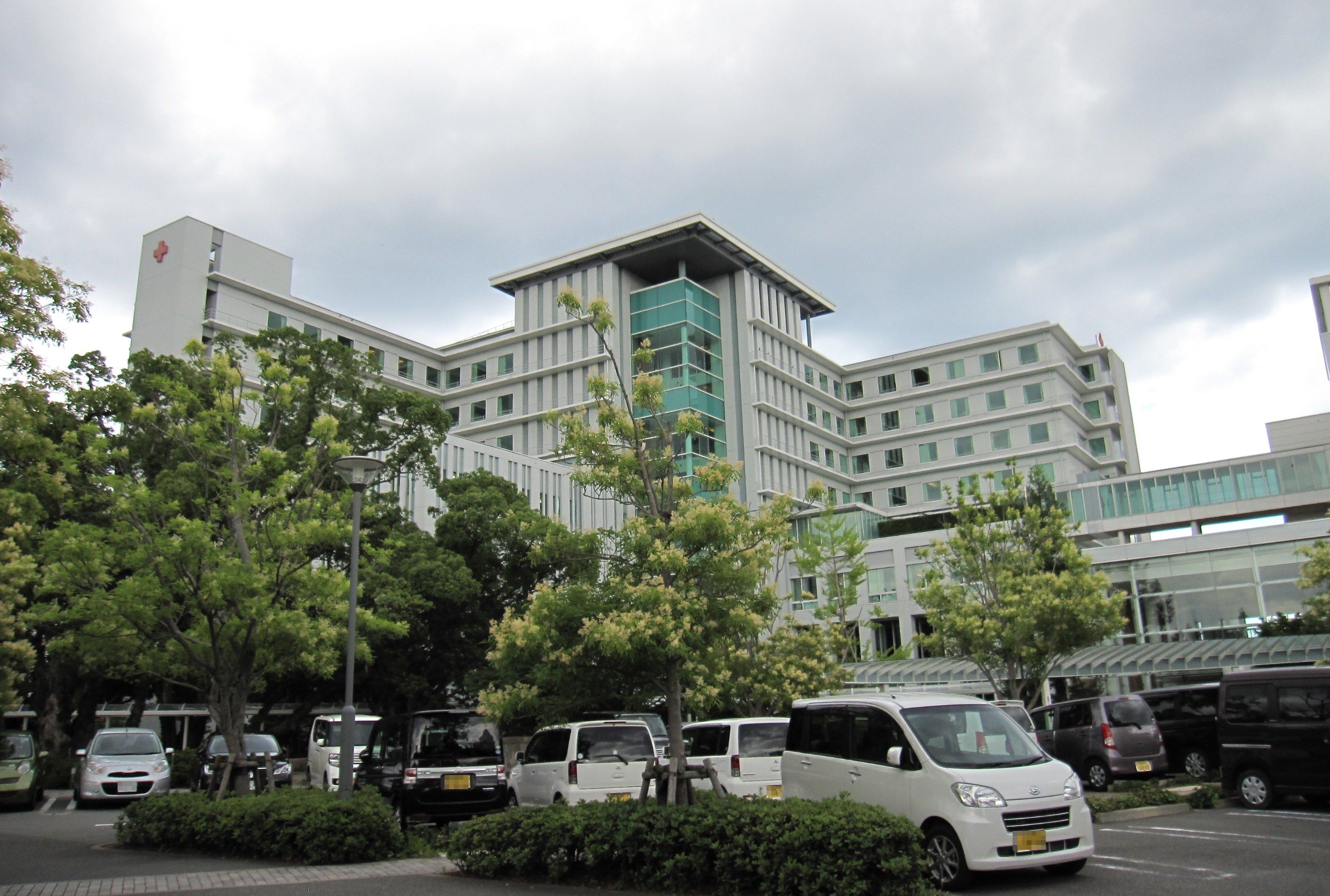
Tokushima Red Cross Hospital (徳島赤十字病院 (byōin)) — Photo: KishujiRapid, Wikimedia Commons, CC BY-SA 4.0
Step 1 — Google Maps (Most Useful)
Drop a pin on the property address. Search for 病院 (byōin) (hospital) or 救急病院 (kyūkyū byōin) (emergency hospital) nearby. Enable driving directions and check the time — not the distance — to the nearest 救急病院 (kyūkyū byōin). That time is your critical number.
Then search 診療所 (shinryōjo) or クリニック (clinic) for day-to-day access. Check whether those listings show operating hours and are marked as currently active. Many closed or inactive facilities still appear on maps.
Step 2 — JNTO Medical Institution Search
The Japan National Tourism Organization maintains an English-language medical facility directory searchable by prefecture and language capability. It identifies which hospitals in the area have English-speaking staff — a separate but equally important concern for long-term residents.
Step 3 — Japan Hospital Search
Managed by Medical Excellence Japan (japanhospitalsearch.org), this database provides searchable facility profiles with more detail than Google Maps alone. Useful for identifying larger hospitals within a prefecture and confirming they are currently operational.
Step 4 — AMDA International Medical Information Centre
Phone: 03-6233-9266. A referral service for non-Japanese speakers that can identify appropriate facilities by prefecture and help arrange interpretation support. Particularly useful when dealing with a new diagnosis and needing to locate specialist care.
Distance Framework: What Numbers to Actually Check
Use this table when evaluating any property. These benchmarks are drawn from Japan's healthcare planning literature and ambulance response data.
| Access Need | Benchmark | Risk If Exceeded |
|---|---|---|
| Nearest GP / clinic (診療所 (shinryōjo)) | Under 20 min drive | High — prescriptions, chronic condition management, and routine care all become burdensome |
| Nearest hospital (20+ beds) | Under 30 min drive | Medium — planned procedures require travel, not a daily issue for healthy residents |
| Nearest emergency hospital (救急病院 (kyūkyū byōin)) | Under 60 min by road | High — cardiac, stroke, and trauma outcomes degrade sharply beyond this threshold |
| Dialysis / oncology facilities | Under 45 min drive | Critical for anyone requiring multiple weekly specialist visits |
The 60-minute rule for emergency access is not arbitrary. Japan's healthcare planning literature uses this threshold explicitly. A cardiac event has an accepted treatment window. Being 90 minutes from a 救急病院 (kyūkyū byōin) puts you meaningfully outside it.
Which Areas Have the Biggest Coverage Gaps
Not all of Japan faces the same healthcare reality. The physician density gap between the best and worst prefectures is nearly 2:1 — a difference that translates directly into clinic availability and emergency response infrastructure.

A modern Japanese ambulance — average national response time is 9.4 minutes, but this varies widely by location. Photo: KUPS39M, Wikimedia Commons, CC BY-SA 4.0.
Areas with larger coverage gaps:
- Tohoku (Iwate, Aomori, Akita, Fukushima) — the most severe physician shortages nationally, compounded by depopulation and ageing demographics. Akita has the most rapidly ageing population of any prefecture.
- San'in Coast (Shimane, Tottori) — among Japan's most sparsely populated prefectures, with the lowest physician densities outside Tohoku
- Inland Shikoku, particularly Kochi — mountain terrain extends effective travel times even for properties that appear close on a flat map
- Inland Niigata — mountain routes can become unreliable for weeks in winter
Areas with stronger coverage:
- Okayama and surrounding western Honshu — noted for physician surplus relative to population
- Kyushu near Fukuoka — strong regional hub with reasonable coverage for surrounding prefectures
- Anywhere within 60–90 minutes of a medium-sized city (Sendai, Kanazawa, Matsuyama, Hiroshima) — proximity to a regional medical centre substantially changes the picture
Questions to Ask Before You Sign
If you are working with a buyer's agent — particularly as a non-Japanese speaker — these are the questions worth raising before any purchase commitment:
- What is the nearest 救急病院 (kyūkyū byōin), and what is the actual driving time?
- Is there an active 診療所 (shinryōjo) nearby? Has it been operating recently?
- Is this area on any municipal or prefectural healthcare shortage designation?
- Does the nearest hospital have English-speaking staff or a foreign patient support desk?
- Is there a local 国際交流協会 providing medical interpreter services?
A good agent will know these answers or know how to get them. For buyers working through a licensed brokerage that specialises in foreign clients — such as Teritoru, which handles the legal and administrative complexity of purchases in Japan on behalf of non-Japanese speakers — these queries can be incorporated into standard due diligence.
Sources
- MHLW — 令和4年度無医地区等調査 (2023): mhlw.go.jp — 無医地区 count, population figures
- Nippon.com — One in Five Municipalities Predicted to Have No Clinics by 2040: nippon.com — 77 municipalities, 342 by 2040 projection
- MHLW — 令和4年 医師・歯科医師・薬剤師統計: mhlw.go.jp — physician age data
- FDMA — 救急救助の現況 (2023): fdma.go.jp — ambulance response times
- HEM-Net — Doctor Helicopter deployment data: hemnet.jp — 56 Doctor-Heli bases
- JNTO — Japan Visitor Hotline: japan.travel — 050-3816-2787
- AMDA International Medical Information Centre: amdamedicalcenter.com — 03-6233-9266
- Dr. Passport app: dr-passport.com — multilingual symptom navigation
- Japan Hospital Search (Medical Excellence Japan): japanhospitalsearch.org
- Japan Medical Care Act — legal definition of clinic vs hospital: japaneselawtranslation.go.jp
- RAD-AR Council — Kusuri-no-Shiori (English drug information): rad-ar.or.jp
- US Embassy Tokyo — Emergency contacts: jp.usembassy.gov
- Australian Embassy Tokyo — Contact us: japan.embassy.gov.au
- Canadian Government — Emergency assistance abroad: travel.gc.ca
- New Zealand SafeTravel — 24/7 assistance: safetravel.govt.nz
The Right Framing
Medical access is not a reason to avoid buying property in Japan. It is a variable to measure, weight against your personal circumstances, and plan around deliberately. A healthy buyer in their 30s and someone managing a chronic condition face genuinely different thresholds.
What it should never be is a surprise discovered after contracts are signed. The data exists, the tools to access it in English exist, and now you know what to do once you're inside the system. Check it before you sign — not after.