Japan is one of the most open countries on earth for foreign property ownership. No nationality restrictions, no residency requirements, no caps on how many properties you can hold. But that openness means working through a legal system that operates entirely in Japanese, with processes that confuse even Japanese citizens. This guide covers visas, ownership mechanics, tax obligations, and practical steps for buying and managing property in Japan as a foreigner — whether you live there or not.
Foreigners Can Buy Property in Japan — With No Restrictions
Japan places no restrictions on foreign property ownership. You can be a citizen of any country, hold any visa status (or none at all), and purchase freehold land and buildings. Your name goes on the title deed at the Legal Affairs Bureau (法務局 (hōmu kyoku)) with exactly the same legal standing as a Japanese citizen.
This is unusual globally. Thailand, Indonesia, and the Philippines restrict or prohibit foreign land ownership. Australia, New Zealand, and Singapore impose approval requirements or surcharges. Japan does none of this. The property is yours, fully and unconditionally.
What Japan does require is compliance with its registration, tax, and transaction procedures — the same ones Japanese buyers follow. The challenge for foreigners is working through an unfamiliar system in an unfamiliar language, not overcoming legal barriers.
The Myth: Buying Property Gets You a Visa
This is the single most common misconception among foreign buyers: purchasing property in Japan does not grant residency, a visa, or any immigration benefit.
Japan's immigration system and property registration system are entirely separate. The Immigration Services Agency does not consider property ownership when evaluating visa applications. You can own a house in Hokkaido or a building in Shibuya — it has zero effect on your right to enter or remain in Japan.
This means you can own property while living overseas indefinitely. You can visit on a tourist visa. But you cannot live in Japan simply because you own something there.
Key Distinction
Property ownership and immigration status are governed by different agencies under different laws. Some visa categories (like Business Manager) may involve property as part of a business plan, but the property itself is not the qualifying factor — the business is.
Buying as a Non-Resident: What You Need
You do not need to live in Japan to buy property there. Non-resident purchases happen regularly. The process is more cumbersome than a domestic purchase, but well-established.
Registered Seal or Signature Certificate
Japan's legal system uses personal seals (印鑑 (inkan), inkan) rather than signatures. For property transactions, you need either a registered seal with a seal registration certificate, or — more commonly for non-residents — a signature certificate (サイン証明書 (sain shōmeisho)) issued by your country's embassy or consulate in Japan. You sign the document in person at the embassy, and they certify it.
Alternatively, a notarized signature with an apostille (for Hague Convention countries) may be accepted, though practices vary by Legal Affairs Bureau.
Address for Service in Japan
Property registration requires a Japanese address for official correspondence. Non-residents designate a representative — typically the real estate agent, judicial scrivener, or attorney — whose office address serves this purpose. This is entirely routine and handled as part of the transaction.
Japanese Bank Account
This is where things get difficult. Japanese banks are reluctant to open accounts for non-residents. Your options:
- Wire directly to the seller's or agent's account: Many transactions are completed this way, avoiding the need for your own Japanese account.
- Prestia (SMBC Trust Bank): One of the few banks that opens accounts for non-residents under certain conditions, with English-speaking staff.
- International transfer services (Wise, Revolut): Better exchange rates than bank wires, though the receiving end still needs a Japanese account.
- Agent's trust account: Some agencies and judicial scriveners receive funds on your behalf. Confirm the legal protections before proceeding.
My Number (Individual Number)
Japan's My Number (マイナンバー) is assigned to residents. Non-residents do not have one, and you do not need one to purchase property. It becomes relevant only if you earn income in Japan (e.g., rental income), in which case you can apply for a taxpayer identification number through the tax office with help from a tax representative.
Power of Attorney
If you cannot attend the closing in person, a power of attorney (委任状) authorizes a representative to sign and complete registration on your behalf. It must be notarized in your home country, authenticated with an apostille, translated into Japanese, and specific to the transaction. This adds time and cost — being present for the closing is preferable when possible.
Visa Types Relevant to Property Owners
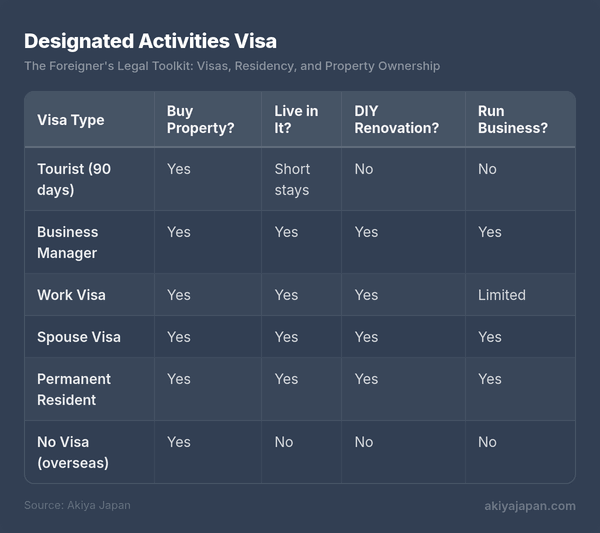
Your visa status determines what you can do with your property in Japan.
Tourist Visa (90 Days)
Citizens of 71 countries enter visa-free for short stays. You can visit your property, meet agents and contractors, and sign purchase contracts. You cannot do physical renovation work yourself (hiring contractors is fine) or earn income, including operating a guesthouse or rental business.
Business Manager Visa (経営・管理)
Required if you plan to run a business from your property — guesthouse, vacation rental, cafe, or any commercial operation. Requirements include a physical office in Japan, capital investment of at least 5 million yen (or two full-time employees), and a viable business plan. Initially granted for one year, renewable. After five years of continuous residence, you become eligible for permanent residency.
Spouse or Dependent Visa
Available if your spouse is a Japanese national or permanent resident. Allows unrestricted residence and work. Property ownership plays no role in the application but can demonstrate stability.
Work Visas
Standard work visas are tied to your employer and have no connection to property ownership. You can buy freely while on a work visa, but if you lose your job, your visa basis disappears — regardless of how much property you own.
Designated Activities Visa
Some rural municipalities have special visa arrangements tied to rural revitalization — typically linked to farming, employment, or community commitments rather than property ownership. These programs are highly localized and change frequently. Contact the specific municipality's revitalization office for current details.
Tax Obligations for Foreign Property Owners
Japan's tax system applies to property regardless of the owner's nationality or residency. If you own property in Japan, you owe Japanese taxes — no exemptions for foreigners.
Fixed Asset Tax (固定資産税 (kotei shisan-zei))
Every property owner pays fixed asset tax annually at 1.4% of the assessed value (typically 60-70% of market value). Most municipalities add a city planning tax of up to 0.3% for properties in urbanization areas.
For a rural house assessed at 3 million yen, expect roughly 42,000 yen per year in fixed asset tax (about $280 USD), plus 9,000 yen in city planning tax where applicable. Bills arrive in April or May.
Non-residents must appoint a tax representative (納税管理人 (nōzei kanri-nin)) in Japan to receive notices and handle payments.
Residential Land Tax Reduction
Land with a residential building receives a significant reduction: assessed land value drops to one-sixth for lots up to 200 sqm, one-third beyond that. This is why owners leave deteriorating houses standing — demolition removes the reduction and can multiply the land tax bill by six.
Rental Income Tax
Rental income is taxable in Japan. Residents pay progressive rates (5-45% plus 10% resident tax). Non-residents face a flat 20.42% withholding tax deducted at source by the tenant or property manager.
Non-residents can file a tax return to claim deductions (depreciation, maintenance, management fees) that may reduce the effective rate below 20.42%. Overpayments are refunded.
Capital Gains Tax on Sale
Gains on property sales are taxed at rates that depend heavily on holding period:
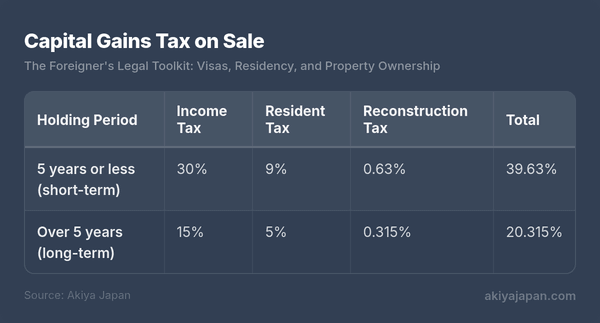
Important: the holding period runs from January 1 of the year after acquisition to January 1 of the year you sell. A property bought in March 2024 does not qualify as long-term until January 2030 — nearly six calendar years. For non-residents, the resident tax component does not apply, but the buyer must withhold 10.21% of the total sale price (not just the gain) for the tax office.
Acquisition Taxes
- Real estate acquisition tax: 3% of assessed value for residential buildings and land (4% for commercial). Billed a few months after purchase.
- Registration and license tax: 1.5% of assessed value for ownership transfer registration (reduced residential rate).
- Stamp duty: A few thousand to tens of thousands of yen depending on contract value.
Tax Treaties and Double Taxation
Japan has treaties with over 80 countries, generally giving Japan the primary right to tax property income and gains. Your home country may also tax worldwide income, but treaties typically provide foreign tax credits to prevent true double taxation.
Do not assume a treaty eliminates taxation in either country — it prevents being taxed twice at full rates on the same income. The interaction between two tax systems requires professional advice specific to your nationality and residence.
Inheritance and Succession Planning
Japanese inheritance tax applies to property in Japan regardless of the owner's nationality or residence. Japan has one of the highest inheritance tax rates in the world, reaching 55% at the top bracket.
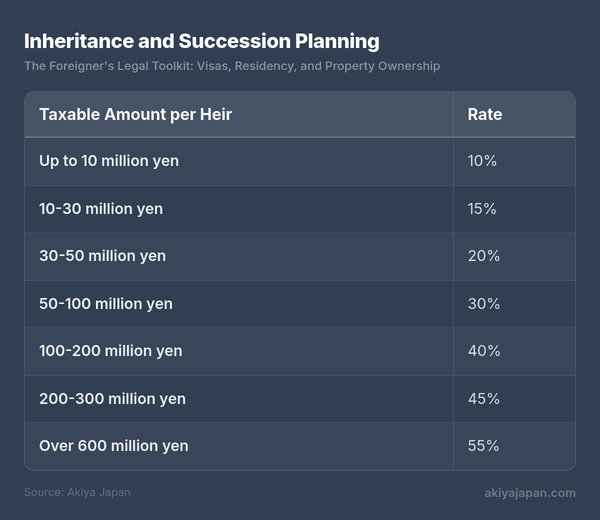
The basic deduction is 30 million yen plus 6 million yen per legal heir — generous enough that most akiya purchases fall within the tax-free threshold. But the complications are procedural: your heirs must work through a Japanese inheritance process, potentially from overseas and without Japanese language ability.
Practical Steps
- Make a will addressing your Japanese property. Japanese law allows foreign nationals' succession to be governed by home-country law, but this must be stated clearly. A will valid under your home country's law is generally recognized in Japan with translation and authentication.
- Consider a Japanese-format will. A notarized will (公正証書遺言) drafted at a Japanese notary office streamlines inheritance registration significantly. You can have both a Japanese will and a home-country will, each addressing assets in its jurisdiction.
- Inform your heirs. If they do not know about the property, they cannot manage it — and they also cannot easily disclaim it if they do not want the ongoing obligations.
- Understand forced heirship. Japanese law guarantees certain family members a minimum share (遺留分, iryūbun). Whether these provisions apply to a foreign owner depends on which country's law governs the succession.
The Professional Team: Who Does What
Japanese property transactions involve several distinct professional roles.
Judicial Scrivener (司法書士 (shihō shoshi))
Your primary professional for property transactions. They handle title searches, registration documents, ownership transfers, and seller verification. Think of them as specialized conveyancers — more affordable and more focused than attorneys for property work.
Attorney (弁護士)
Needed only for disputes, unusually complex transactions, litigation, or business structuring. For routine purchases, an attorney adds cost without adding value.
Tax Accountant (税理士)
Handles tax returns for rental income, capital gains calculations, tax treaty advice, and can serve as your tax representative. Essential if you earn income from the property or when you sell.
Real Estate Agent (宅地建物取引士 (takuchi tatemono torihiki-shi))
Handles the commercial side: finding properties, negotiating, preparing contracts, and delivering the legally required important matters explanation (重要事項説明) — a dense disclosure document covering the property's condition, legal status, and restrictions. For foreign buyers, an agent who communicates in your language is particularly valuable.
Land Surveyor (土地 (tochi)家屋調査士)
Needed when boundaries are unclear or disputed, registered area does not match actual area, you plan to subdivide, or an unregistered building needs registration.
Common Legal Pitfalls
These issues catch foreign buyers most frequently. None are dealbreakers, but all must be identified before you commit.
Unregistered Buildings (未登記建物)
In rural Japan, buildings that exist physically but not legally are surprisingly common. Extensions, outbuildings, and sometimes main houses were never registered — there is no penalty for skipping registration, and historically rural owners did not bother.
An unregistered building cannot be insured, may not receive the residential land tax reduction, and complicates future sales. The fix involves a land surveyor and judicial scrivener to complete initial registration — factor the cost into your budget.
Boundary Disputes
Many rural properties have boundaries established decades ago, based on natural features that may have changed or surveys with less precision than modern standards. Before purchasing, ask whether a boundary confirmation (境界確認) has been completed with all adjacent landowners. Boundary disputes after purchase are expensive and slow to resolve.
Shared Road Ownership (私道)
Many properties are accessed via private roads co-owned by multiple property owners. This generally works fine, but you share maintenance responsibilities, and building permits may require written consent from all co-owners. If a co-owner is deceased, missing, or uncooperative, this creates significant delays. Check access road status during due diligence.
Agricultural Land Restrictions (農地法)
The Agricultural Land Act restricts farmland sales to protect agricultural use. If any portion of a property is classified as agricultural land:
- Sale requires approval from the local Agricultural Committee (農業委員会)
- The buyer typically must demonstrate farming intent, or apply for land-use conversion (農地転用)
- Highly productive farmland (especially irrigated rice paddies) may not be convertible at all
- Foreign buyers may face extra scrutiny from committees, though there is no legal prohibition
This primarily affects rural properties with attached farmland. Urban residential lots are not subject to these restrictions.
Rebuild Restrictions (再建築不可)
Some properties cannot be rebuilt if demolished — usually because the lot does not front a road at least 4 meters wide for a minimum of 2 meters, as required by modern building codes. Renovation within the existing footprint is allowed, but the restriction severely impacts resale value. These properties are often priced cheaply for good reason.
Encumbrances and Liens
Always verify the property registry for mortgages (抵当権), leasehold rights (借地権 (shakuchiken)), easements (地役権), and tax liens (差押). Your judicial scrivener pulls a current registry extract and explains all entries. Do not proceed until every encumbrance is understood and problematic ones have a resolution plan.
Managing Property From Overseas
Many foreign owners do not live in Japan full-time. Remote management requires planning and a trusted representative.
- Tax representative (納税管理人 (nōzei kanri-nin)): Mandatory for non-residents. Receives tax correspondence and handles payments. Your judicial scrivener, tax accountant, or property manager can serve this role.
- Property management: If renting, a management company handles tenants, rent collection, maintenance, and withholding tax. Fees run 5-10% of monthly rent.
- Vacant property monitoring: Japanese houses deteriorate fast when empty — humidity, insects, and vegetation cause serious damage within a single season. Arrange periodic checks through a local contact or management service.
- Mail handling: Tax bills and municipal notices go to your Japanese address for service. Ensure your representative checks mail regularly — missed notices escalate into penalties.
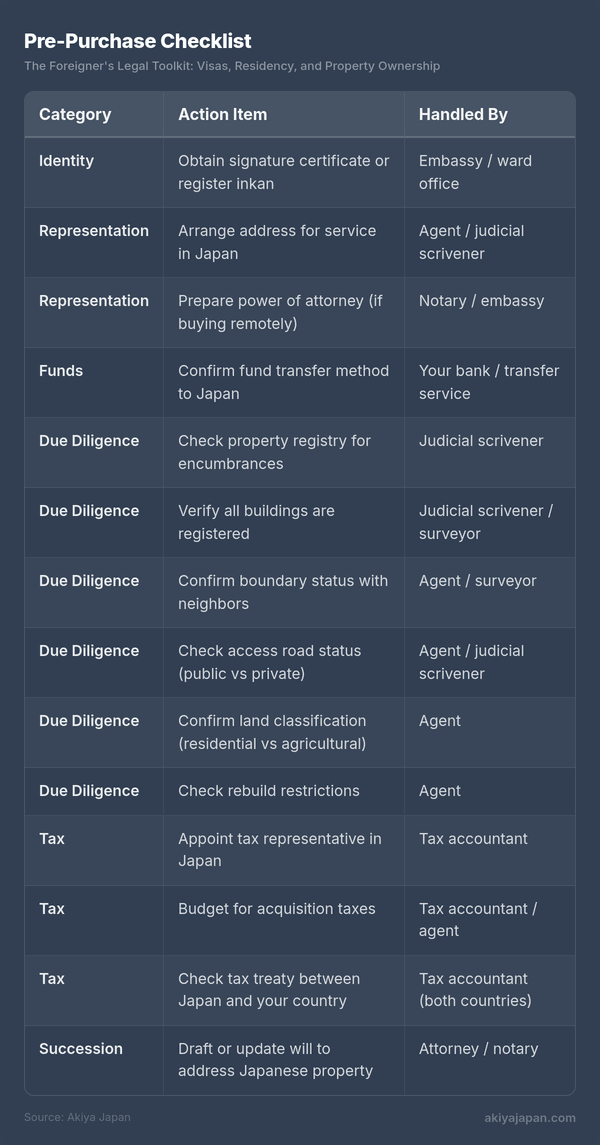
Pre-Purchase Checklist
Regulatory Trends
Japan's openness to foreign property ownership has been consistent for decades. Recent changes have introduced notification requirements for foreign buyers of properties near sensitive facilities (military bases, border islands) under national security legislation — these require additional disclosure but do not restrict the purchase.
April 2026 update: New foreign buyer registration requirements took effect in April 2026. Foreign purchasers must now disclose their citizenship at the time of purchase and file a residential use report within 20 days of taking possession. Your judicial scrivener (shihō shoshi) will handle this at settlement — ensure they are aware of these requirements before signing.
Municipalities have also increased pressure on owners of neglected vacant properties through the Vacant House Special Measures Act, which allows local governments to order maintenance, demolition, or sale of severely deteriorated buildings. This applies equally to Japanese and foreign owners.
The regulatory direction is toward more transparency and accountability for all owners, not toward restricting foreign ownership. Japan's demographic reality — a shrinking population with millions of vacant homes — gives the government little incentive to restrict foreign buyers.
Final Thoughts
The legal framework for foreign property ownership in Japan is remarkably open. The barriers are practical — language, distance, unfamiliar processes — not legal. With the right professional team, these barriers are entirely manageable.
The most important thing to understand is the separation between property rights and immigration rights. You can own property freely. Living in Japan is a separate question. Confusing the two leads to disappointment and bad decisions.
Get professional advice specific to your situation. Your nationality, tax residency, intended use, and long-term plans all affect which rules apply and which strategies make sense.