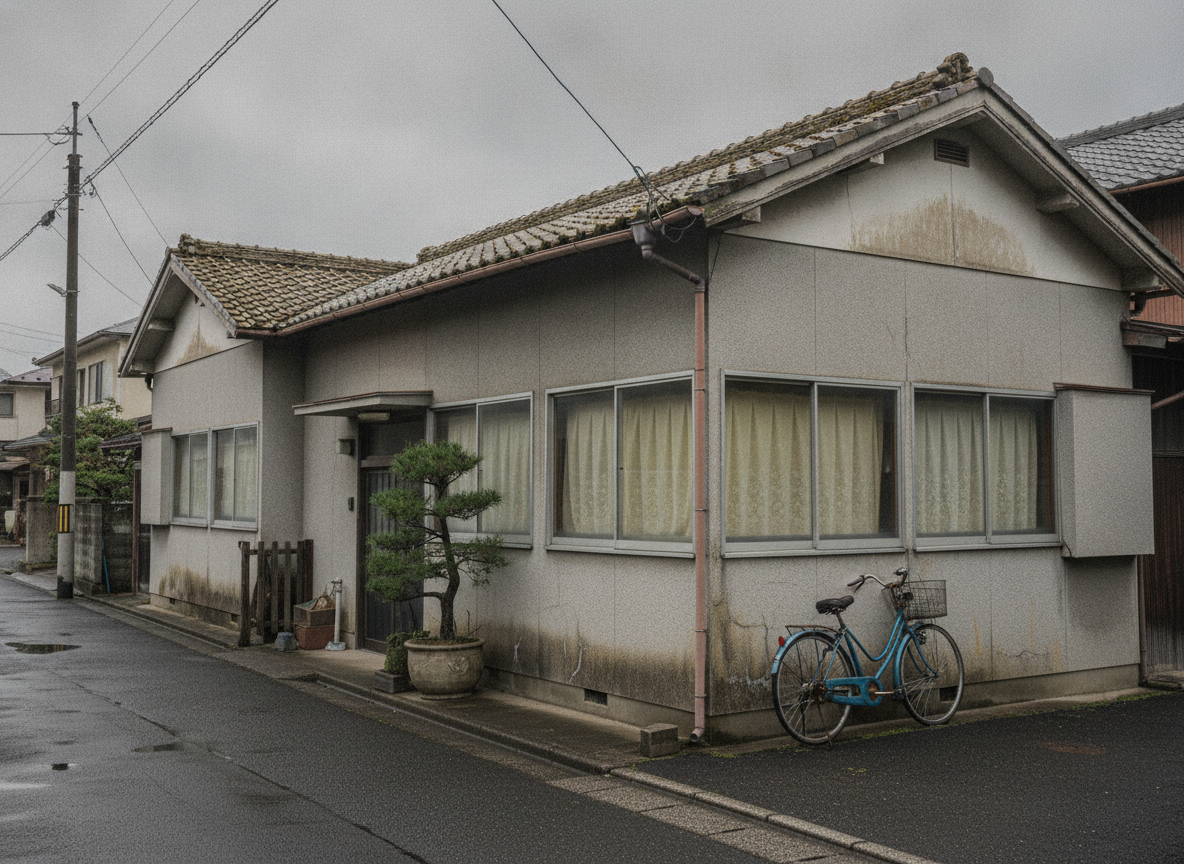
Akiya (空き家, akiya) is a word that has picked up a reputation it never earned. Type it into an English search bar and the results read like a horror trailer: ghost houses, cursed villages, a country rotting from the inside, homes handed out for free because nobody dares live in them. The photographs are always the same one, a caved-in roof under a grey sky, weeds pushing through the tatami, a child's doll left on a shelf. Somewhere between the census office and the headline, "akiya" stopped meaning what it says and started meaning "the sad, broken houses of a dying nation."
So let's put the word back where it belongs. Akiya means "empty house." That is the whole definition. It's an administrative label, the same kind your own country uses when it counts unoccupied dwellings. It says nothing about whether the house is sound, ugly, haunted, cheap, or worth buying. Roughly nine million homes in Japan wear this label right now, and the single most useful thing you can do as a buyer is stop hearing "abandoned" every time you read "vacant." They are not the same word, and treating them as one will make you either afraid of good houses or careless about bad ones.

Old machiya (町家, machiya) rooftops in Kyoto. Most akiya look far closer to this than to a ruin. Photo on Pexels.
Where the Word Comes From, and What It Actually Counts
Break it apart and there's no drama in it. 空き (aki) means "empty" or "vacant." 家 (ya, also read ie) means "house." Put together, 空き家 (akiya) is "empty house," full stop. The term has legal weight because it comes straight out of Japan's Housing and Land Survey (住宅・土地統計調査, jūtaku tochi tōkei chōsa), the census-style count run every five years by the Ministry of Internal Affairs and Communications. When that survey calls a home an akiya, it means one thing only: on the day the surveyor came around, nobody was living there.
That definition sweeps in a lot of houses that have nothing wrong with them. A flat between tenants is an akiya. A holiday cottage used three weekends a year is an akiya. A perfectly good house whose owner just died, sitting clean and locked while the family sorts out the paperwork, is an akiya. None of these are ghost houses. They are empty on a Tuesday, which is the only thing the word promises.
The English-language story flattened all of that into one image because the ruin makes a better picture than the tidy suburban house next door. But the census never said "abandoned." It said "empty." The freight the word carries in English was added in translation, and you can put it down.
The Nine Million, Actually Unpacked
The 2023 survey counted about 9 million vacant homes, a record, and about 13.8% of all housing in the country. That headline number is worth taking seriously. But the survey does something the headlines usually skip: it sorts those nine million into four very different piles.
- For rent (賃貸用, chintai-yō): about 4.43 million. Nearly half. These are rental units sitting empty between tenants or waiting to be let. A landlord's problem, not a ruin. You will never see most of these on an akiya map.
- For sale (売却用, baikyaku-yō): about 330,000. Homes already on the market, actively for sale. By definition somebody wants a buyer.
- Secondary homes (二次的住宅, nijiteki jūtaku): about 380,000. Holiday houses and villas, used sometimes, empty the rest of the year. Empty by choice, not by neglect.
- "Other" vacant homes (その他の空き家, sonota no akiya): about 3.85 million. This is the pile everyone actually means. Roughly 43% of the total. Houses with no current plan to rent or sell, most of them inherited and stuck.
Read that list twice, because it changes the whole picture. More than half of the "nine million abandoned houses" are ordinary rentals, listings, and holiday homes. The one category that is actually stuck, the one the ghost-house photos come from, is the "other" pile, and even that is not a synonym for "collapsing." A house lands in "other" the moment its owner dies and the heirs do nothing, whether it's a rotted shell in the hills or a spotless 1990s family home in the suburbs with the futons still folded in the closet. The label is about intent, not condition.
We wrote out the full arithmetic of this in our breakdown of the nine million empty homes, and the same lesson holds: the scary number is a bucket of four things, and only one of them looks anything like the stereotype.
"Vacant" Is Not "Condemned"
The second myth stacked on top of the word is that an old Japanese house is structurally spent, a teardown by the time it's a few decades old. This comes from a real thing misread. Japan's National Tax Agency assigns a wooden house a "useful life" of 22 years for depreciation. After 22 years, the building's book value on paper is essentially zero.

Book value of zero, structural value intact. A tatami (畳, tatami) room, the kind of interior that outlives its paper valuation by decades. Photo on Pexels.
That figure is a tax convention and a lending rule. It is not a physics report. A wooden house that has been maintained does not turn to dust on its 23rd birthday; a properly cared-for one commonly lasts 60 to 70 years, and Japan is full of houses far older than that still lived in every day. What "zero book value" actually means is that the paperwork stops crediting the structure, so on an older detached property you are mostly paying for the land, which holds its value while the building notionally doesn't. That is a quirk of accounting and mortgage underwriting, not a verdict on whether the roof keeps the rain out.
The practical takeaway cuts both ways, which is exactly why the word deserves neutrality rather than fear or hype. Plenty of akiya are structurally fine and priced low because the market discounts the building to nothing. Plenty of others really are past saving, with foundation movement, rot, or termite damage that will cost more than the house. The word "akiya" tells you which pile it's in exactly as well as the word "house" does: not at all. You find out by looking, ideally with an inspector, the same way you would anywhere. If the numbers side of this interests you, we walk through what an older building's value really rests on in the piece on when you're really buying the land, not the house.
The Confusion That Does Real Damage: Akiya Is Not Jiko Bukken
Here is where the "dirty word" reputation does actual harm, because two very different Japanese property terms get blended together in the English retellings.
An akiya (空き家) is an empty house. A jiko bukken (事故物件, jiko bukken) is a "stigmatized property," a specific legal-cultural category meaning a home where something bad happened inside it, most often a death, a suicide, a crime, or a lonely death that went undiscovered for a while. Japanese law requires a seller or landlord to disclose this history, and it moves the price and the buyer pool. There are agents who specialise in it and a well-known website that maps it.
The two words overlap only by accident. The vast majority of akiya are empty for the dullest reason imaginable: an elderly owner moved into care or passed away, and the children live in a city and haven't dealt with the house. That's inheritance limbo, not tragedy in the tatami room. Conflating "empty house" with "house where someone died" is how a plain vacant home inherits a ghost story it never had. When you see "akiya," think "nobody home." If a property carries actual jiko bukken history, that is disclosed separately and by name. Keep the two words apart and half the eeriness evaporates.
Why So Many Sit Empty (It's Paperwork, Not Curses)
If these houses aren't cursed and often aren't even broken, why are nearly four million of them just sitting there? The reasons are bureaucratic and financial, which is far less cinematic and far more useful to understand.
Inheritance drift. Japan's population is ageing and shrinking, so houses pass to heirs faster than heirs want them. The 2023 survey pinned most of the rise in the "other" category on inherited homes. Adult children who've built lives in Tokyo or Osaka inherit the family house in a distant town, feel too attached to sell and too busy to use it, and let it sit. Multiply by a generation and you get 3.85 million.
A tax rule that rewarded doing nothing. For years, keeping a house standing on a residential lot cut the land's fixed-asset tax (固定資産税, kotei shisan zei) by up to a factor of six. Knock the house down and the tax on the bare land jumped. So the rational move, even for a house you'll never use, was to leave it standing and empty. The building decays; the tax bill stays low.
Unclear title. A house inherited three generations ago and never re-registered can legally belong to a dozen scattered cousins at once. Nobody can sell it because nobody alone owns it. It can't move until the paperwork is untangled.
None of this is spiritual. It's the entirely ordinary friction of an ageing society with sticky property rules, and Japan has started pulling those rules apart on purpose. We looked at whether the "free house" version of this story holds up in our piece on whether akiya are really free, and the short answer is that the price on the sticker is rarely the real cost.

Old timber houses along a stone street in Higashiyama, Kyoto. Empty is not the same as unwanted. Photo on Unsplash.
The Rules Just Changed, and the Empties Are Moving
Two reforms landed recently that treat the akiya pile as a problem to unstick rather than a curse to fear.
First, the revised Vacant Houses Special Measures Act (空家等対策特別措置法, akiya-tō taisaku tokubetsu sochi-hō) took effect in December 2023. It created a new tier called 管理不全空家 (kanri fukanzen akiya), a "poorly managed vacant house." Municipalities can now strip the residential land-tax break from a home long before it's a near-collapse, at which point that fixed-asset tax can climb by up to six times. The old incentive to leave a house rotting in place has been turned on its head.
Second, since April 1, 2024, registering inherited real estate is mandatory. Heirs must register within three years of learning they've inherited, or face a fine of up to ¥100,000. Inheritances from before that date have until March 31, 2027. It applies to foreign heirs living abroad too, not only to residents in Japan. Together the two reforms end "passive ownership," the old habit of inheriting a house and simply forgetting about it. Owners now have to manage, monetise, or move the property, which is exactly why more of these homes are reaching the market.
For a foreign buyer, the practical effect is more inventory and clearer title. The complications, unclear ownership, sitting tax liabilities, disclosure history, are still real, and they're where a licensed agent earns their fee. Working with a broker like Akiya Japan Buyer Support, our licensed partner agent who handles foreign-buyer transactions can keep an inheritance-tangled akiya from turning into a legal headache after you've signed. Their founder, Ai Hioki, works in English and Japanese, and an initial consultation runs over web conference; you can book a consultation with Akiya Japan Buyer Support if a specific property has ownership questions you can't answer from the listing.
Where They Are, and Who's Actually Buying
Vacancy isn't spread evenly. The 2023 survey put the two highest prefecture rates in Wakayama and Tokushima, both at 21.2%, well above the 13.8% national figure. But it's a mistake to file the whole subject under "rural decline." Empty houses exist in every prefecture, including the wards of Tokyo, where an inherited flat can sit vacant for the same paperwork reasons as a farmhouse in the hills. Akiya are an urban, suburban, coastal, and rural phenomenon at once, and so are the buyers.
There's even a small linguistic tell that the stigma is lifting. Younger Japanese buyers have started renovating older houses and calling them "our akiya" with something like affection, keeping the word after the house is full again because it now signals a project with character rather than a shameful ruin. The word is being reclaimed by the people closest to it. The English-language conversation is a step behind, still reaching for "ghost house" out of habit.
How to Read the Word on a Listing
Because "akiya" tells you nothing about condition, the work is in reading past the label. A few habits keep you honest:
- Separate "empty" from "damaged." Ask how long it's been vacant, why, and whether it was maintained while empty. A house locked up clean for two years after an owner moved to care is a different animal from one open to the weather for fifteen.
- Look at the land, then the building. On an older property you're largely buying the plot. Check what the land alone is worth and treat the structure as a bonus that may or may not survive an inspection.
- Confirm the title is clean. After the 2024 registration rule, ownership should be clearer, but a long-inherited house can still have multiple owners. Get this confirmed in writing before you fall in love with it.
- Ask directly about jiko bukken history. It's a separate, disclosable fact. If there's none, you'll be told none. Don't let the ghost-house framing make you assume every empty house has a story.
- Read the listing's own language carefully. The words agents use carry warnings and reassurances that don't always survive translation. We break down that vocabulary in how to read a Japanese listing like a local and the specific phrases to distrust in the deal-killers hiding in Japanese listings.
Do that, and "akiya" goes back to being a neutral filter on a search page rather than a warning label. Some empty houses are wrecks. Some are the best-value sound home you'll find anywhere in the developed world, discounted purely because the tax code stopped counting the building and the family moved to the city. The word can't tell the two apart. Only you, an inspector, and a decent agent can.
So no, akiya is not a dirty word. It's a plain one, "empty house," that got dressed up in someone else's ghost story on the way into English. Take the costume off and you're left with what was always there: nine million homes, a handful of dull reasons they're vacant, and a real chance for a buyer patient enough to read past the headline.
Empty is a status, not a sentence. The house doesn't know it's an akiya. It's just waiting for someone to open the door.
Sources
- Nippon.com -- Number of Vacant Homes in Japan Reaches Record 9 Million (2023 Housing and Land Survey)
- CNN -- Super-aged Japan now has 9 million vacant homes
- Plaza Homes -- Registration mandatory when inheriting real estate in Japan (April 2024)
- Plaza Homes -- Amendment of Japan's Real Property Registration Act
- e-Gov -- Ministerial Ordinance on the Useful Life of Depreciable Assets (wooden dwellings: 22 years)
- Statistics Bureau of Japan -- 2023 Housing and Land Survey (vacant-home categories and rates)
- The Japan Times -- First lesson of Japan's akiya gold rush: no such thing as a free house