Japan's property market is shaped by a distinct set of annual rhythms — and if you're buying property here, that calendar will affect everything from the price you pay to whether your contractor shows up on Monday morning. The Japanese fiscal year, weather patterns, national holidays, and deeply ingrained seasonal rhythms create windows of opportunity and periods of dead time that foreign buyers rarely anticipate.
This guide maps out the entire year from a property buyer's perspective: when prices drop, when offices close, when inspections reveal the most, and when your renovation crew will actually be available.
The Japanese Fiscal Year: Why April 1 Changes Everything
Japan's fiscal year runs from April 1 to March 31. Every major institution — corporations, universities, banks, government offices, and schools — resets on this date. The ripple effect on real estate is enormous.
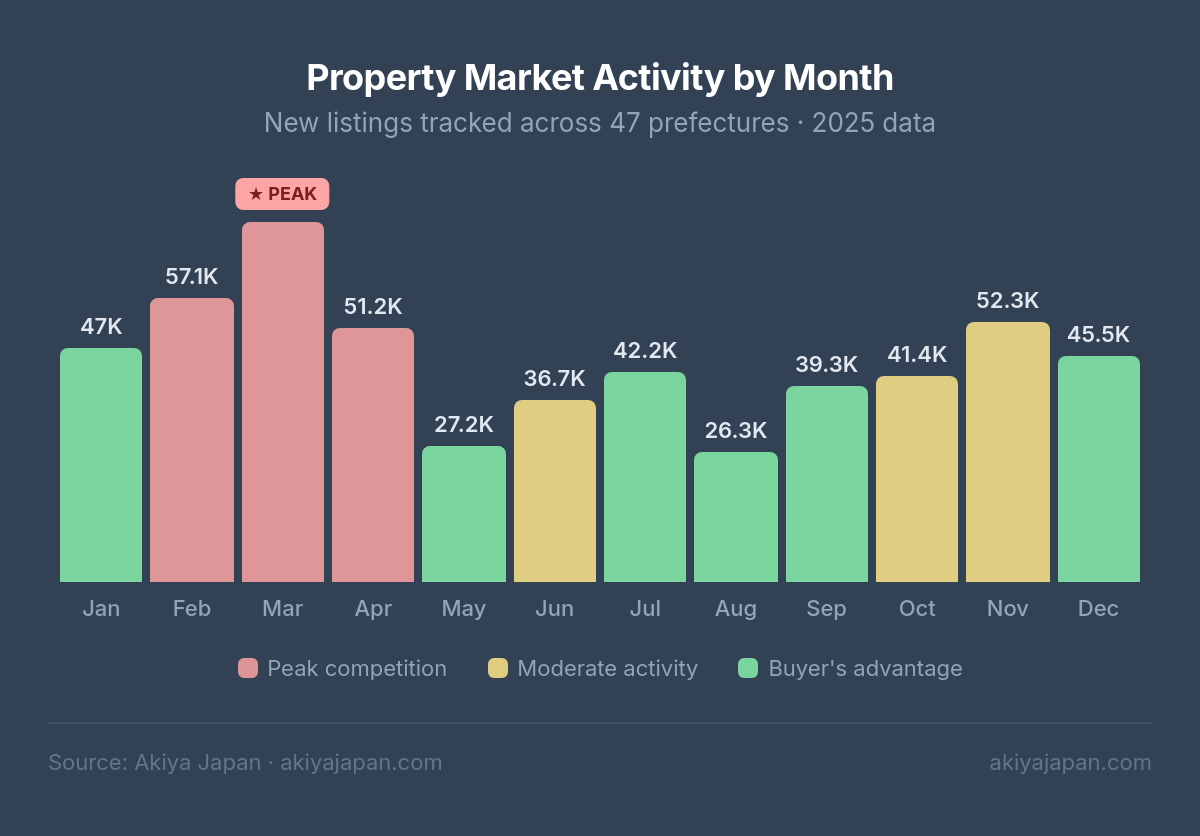
From January through March, Japan experiences its annual moving surge. New graduates starting their first jobs, employees receiving corporate transfers (tenkin), and students entering universities all need housing by April 1. Real estate agencies are at their busiest. Sellers list properties in February and March to catch peak demand, and competition among buyers intensifies. This is generally the hardest time to negotiate a good price — sellers receive multiple inquiries and have little reason to discount.
The flip side is that properties which fail to sell during the spring rush often carry price reductions by autumn. By October or November, sellers who listed optimistically in March are more motivated, especially if they want to close before the December holiday season or the critical January 1 tax assessment date.
Banks also follow this rhythm. Variable mortgage rates are typically reviewed every April and October. If the Bank of Japan raises its policy rate between October and February, expect banks to pass that through in the April rate revision — making pre-April mortgage locking a meaningful timing consideration for financed buyers.
Starting from April 2026 (Fiscal Year 2026), foreign buyers must disclose citizenship when registering property ownership, providing a passport or proof of nationality. Non-Japanese citizens will also need to file a residential use report within 20 days of purchase. Plan accordingly if you're targeting a spring closing.

When Prices Drop: The Seasonal Buying Windows
Japan's property market has distinct seasonal price patterns. Understanding them can save you hundreds of thousands of yen — or more.
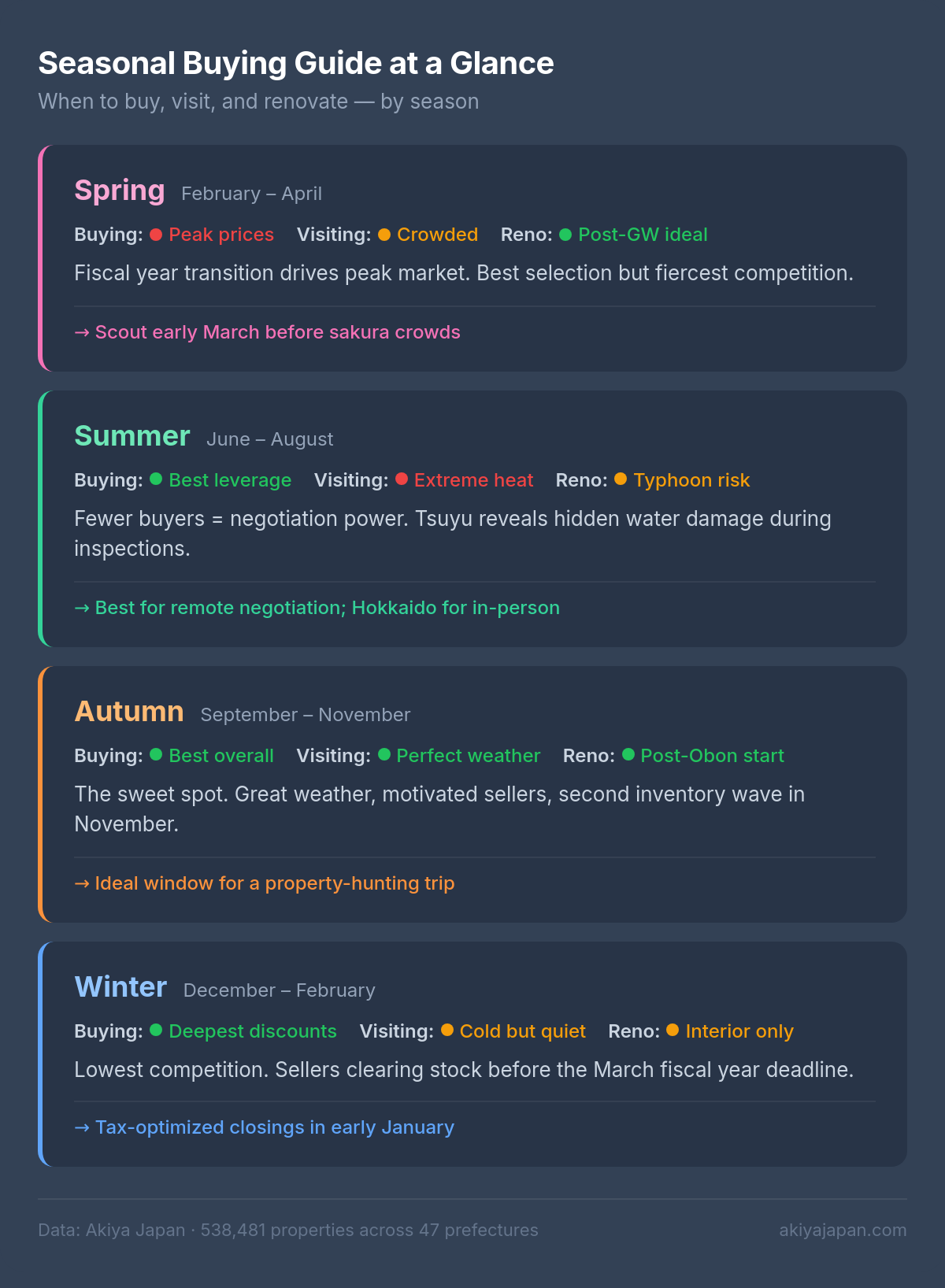
Spring (February–April): Peak Season
The fiscal year transition drives the busiest market period. Newly built homes are timed for March completion. Buyers compete for listings, and sellers hold firm on prices. For akiya and rural properties, the effect is less pronounced than in Tokyo or Osaka, but agent availability is still stretched thin. Unless you have a specific property in mind that might sell to someone else, this is not the ideal time to be shopping for deals.
Summer (June–August): The Quiet Opportunity
The rainy season (tsuyu) and extreme summer heat discourage property viewings. Buyer foot traffic drops significantly. Sellers who haven't moved their property since spring are often more receptive to negotiation. For rural akiya in particular — where there's no fiscal-year urgency driving transactions — June and July can offer genuinely better prices with fewer competing buyers.
Autumn (September–November): The Sweet Spot
Widely considered the best overall season for purchasing rural Japanese property. The weather is excellent for inspections. Properties that sat unsold all summer have typically been repriced. Sellers are motivated to close before year-end. Activity picks up again after the summer lull, but without the frenzied competition of spring.
Winter (December–February): Deepest Discounts, Hardest Logistics
The holiday season and cold weather keep buyers at home, creating the year's quietest market. Sellers with year-end financial motivations or who want to unload before the January 1 tax assessment may offer the steepest discounts. However, office closures around New Year (December 28 – January 4) effectively freeze all transactions for at least a week, and inspecting properties in snow country during winter has serious limitations.
The January 1 Tax Rule: The Most Important Date on Your Calendar
If you remember only one date from this article, make it January 1. Under Japan's fixed asset tax system (kotei shisan zei), whoever owns a property on January 1 is liable for the entire year's tax — no exceptions, no partial-year assessments from the government's perspective.
The tax rate is 1.4% of the assessed value (plus up to 0.3% City Planning Tax in urban areas). Assessed values are set by the municipality and are typically 60–70% of market value for land and 30–50% for older buildings. For a rural akiya purchased for ¥5 million, the annual tax bill might be just ¥14,000–¥28,000. For urban or semi-urban properties, it's proportionally higher.
Strategic Timing Around January 1
Consider two scenarios:
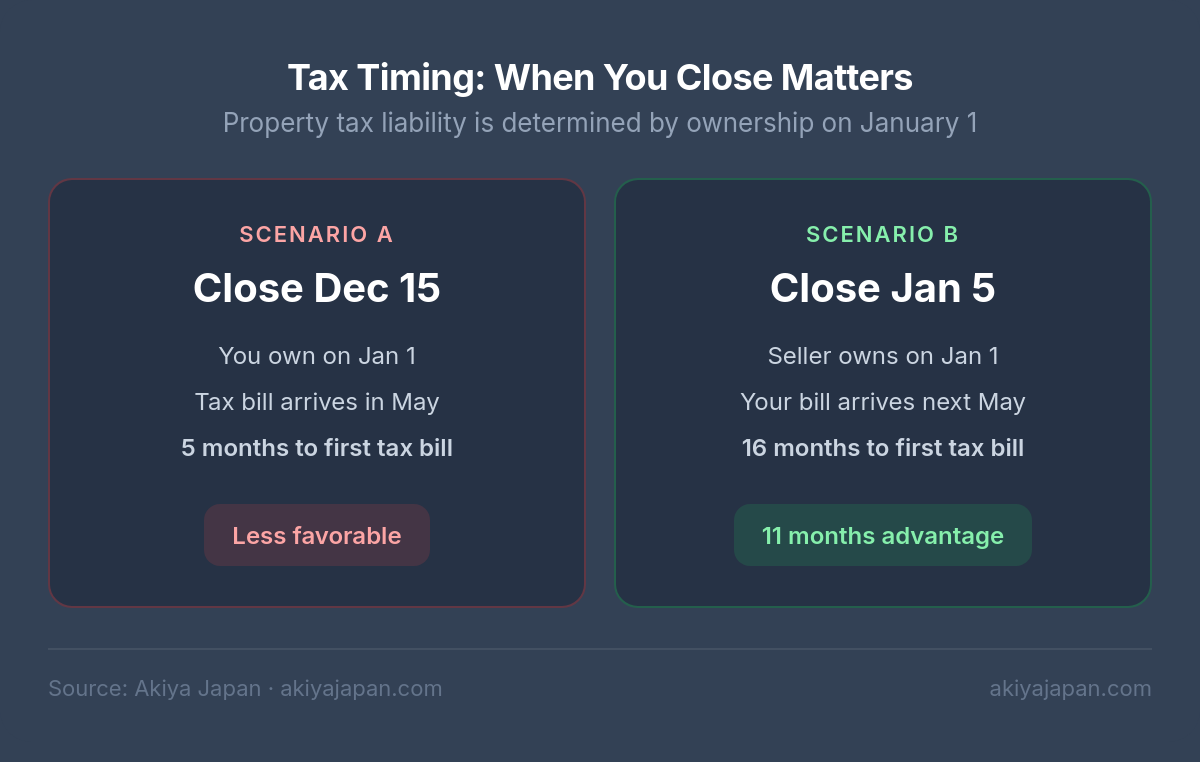
That's a difference of about 11 months of tax-free ownership, simply by timing your closing a few weeks later.
In practice, Japanese convention is for buyers and sellers to prorate the tax at closing based on days of ownership. This is negotiable but standard. Even with proration, closing just after January 1 gives you maximum cash-flow breathing room.
One more detail assessed values are updated on a three-year cycle (the next reassessment is 2027 for most municipalities). If you buy before a reassessment year when surrounding property values have risen, you benefit from the older, lower assessed value for up to three years.

When to Visit: Planning Your Property-Hunting Trip
Combining a property search with travel to Japan requires balancing weather, cost, crowd levels, and whether real estate offices are actually open. Here's how the year breaks down.
Best Windows for Property Visits
Late May (May 8–31): The single best window for a property-hunting trip. Golden Week is over, tourists have cleared out, accommodation prices normalize, real estate agents are back at work, and the weather across most of Japan is warm and sunny. The only exception is Okinawa, which enters its rainy season in late May.
September 1–18: Excellent weather, post-Obon recovery, affordable accommodation, and motivated sellers entering the autumn closing window. Note that in 2026 specifically, Silver Week falls on September 19–23 (the first Silver Week since 2015, and it won't happen again until 2032), so plan around those dates.
Early October: Japan's weather is arguably at its best. Autumn colors are starting in the north, tourist numbers are lower than November, and you're right in the heart of the best buying season.
Workable but Imperfect
Early March (before the 20th): Pleasant weather, before cherry blossom crowds descend. Good for seeing properties before peak listing competition begins. Accommodation is still affordable.
Early December (1st–20th): Cool but comfortable. Sellers are motivated by year-end deadlines. The drawback is limited daylight — sunset comes around 4:30 PM, shortening your inspection window.
January–February (excluding New Year week): Japan's least touristy period outside ski resorts. Cold but usually sunny. Accommodation is at its cheapest. Real estate agents have time for you because so few buyers are looking. Excellent for serious negotiation — but exterior property inspections are limited in snow regions.
Avoid or Plan Carefully
Cherry blossom season (late March–mid April): Hotel rates in popular areas double or triple. Quality hotels in Kyoto reach ¥40,000–¥80,000 per night ($260–$520) for rooms normally priced ¥15,000–¥30,000. Budget accommodation sells out months ahead. If your target properties are in rural areas far from tourist hotspots, this matters less.
Late November: Autumn foliage (koyo) crowds in Kyoto and famous foliage spots rival cherry blossom season. Book accommodation 2–4 months ahead if visiting popular areas.
July–August: Extreme heat and humidity make property inspections physically exhausting, especially in unoccupied houses without running air conditioning. The exception is Hokkaido, where summer weather is mild and pleasant — June through August is actually the best time to visit properties there.
The Rainy Season Advantage: Why Tsuyu Is Your Secret Weapon
Most guides tell you to avoid Japan's rainy season. For property buyers — especially those looking at older wooden akiya — tsuyu is actually one of the most revealing times to inspect.
Tsuyu is not just rain. It's a sustained period of warm, high-humidity conditions (70–90% humidity in central Japan) that reveals every weakness in an older wooden home. The season typically runs from early June to mid-July across most of Honshu, though timing varies by region:
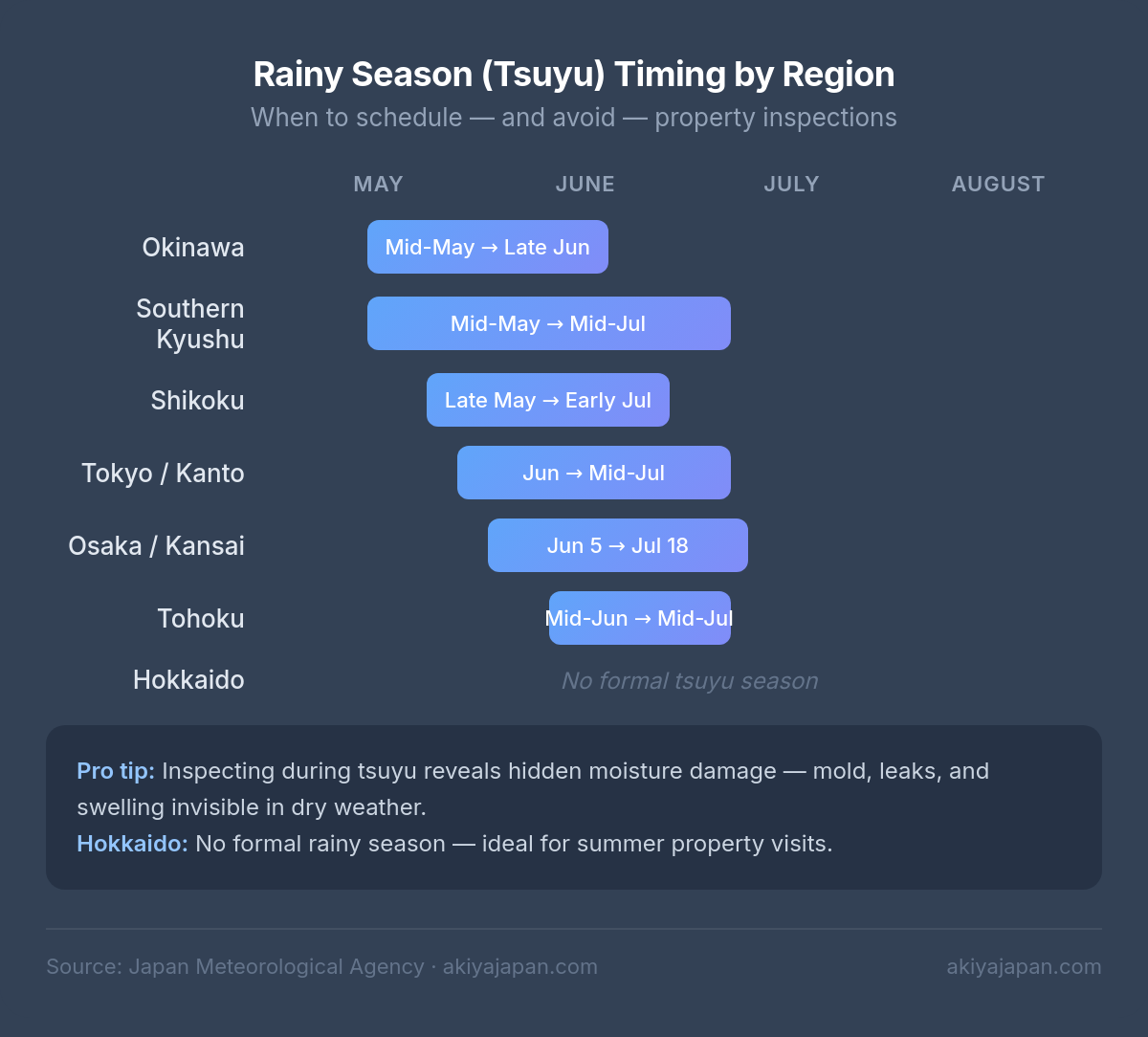
During an inspection in tsuyu, you can spot issues invisible in dry weather:
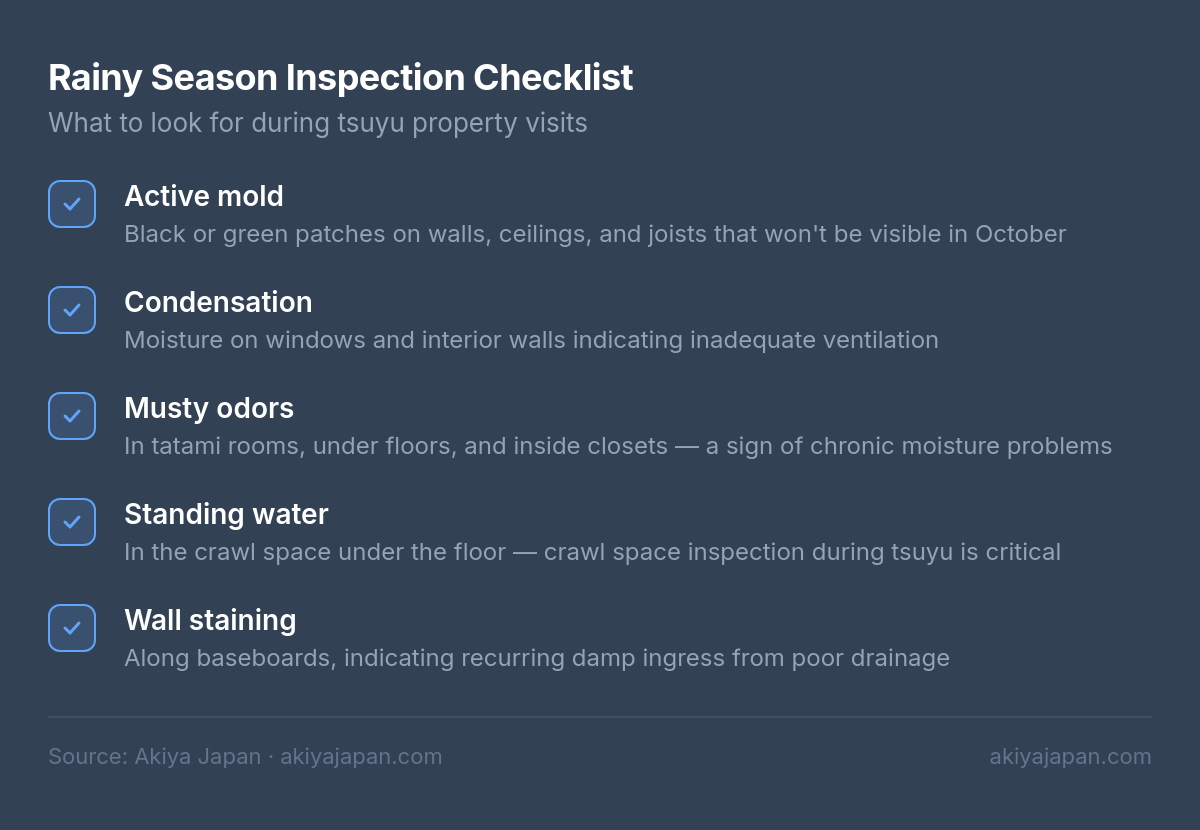
Traditional Japanese homes with tatami mats, shoji screens, and uninsulated wooden walls are particularly vulnerable to humidity damage. Seeing a property at its worst-case condition — during tsuyu — gives you the most honest picture of what you're buying.

Typhoon Season: Impact on Inspections and Renovations
Typhoon season runs from June through November, peaking from late July through October. The southwestern Pacific coast, Kyushu, Shikoku, and the Kii Peninsula are most exposed. Hokkaido and northern Tohoku face less risk but are not immune.
For property inspections, typhoon-season disruptions are real: access roads in mountainous and coastal areas can be closed for days after a storm. Post-typhoon debris and flooding can temporarily obscure foundation issues. Before any site visit during these months, check weather forecasts and download the local municipality's hazard map (hazard mappu), which shows flood, landslide, and storm surge risk zones for every property location.
For renovation projects, typhoons primarily affect outdoor work — roofing, exterior painting, foundation repair, drainage installation. Contractors working in southern or coastal Japan between August and October should build typhoon contingency buffers of one to two weeks into their timelines. Interior work (kitchens, bathrooms, flooring) is less affected.
After any typhoon, check your property for: displaced roof tiles, damaged eaves and gutters, water ingress into the attic and crawl spaces, foundation erosion, and blocked or damaged access roads.

When to Renovate: Japan's Construction Calendar
Japan's construction industry is in a prolonged labor crisis. One in four construction workers is over 60 years old. Skilled trades — carpenters, tile setters, electricians, plumbers — are in the shortest supply. Construction cost inflation was 5.6% in 2025, and the trend continues. In rural areas, where most akiya are located, contractor availability is even tighter than in cities.
Do not assume you can close on a property and have contractors on-site within weeks. In rural Japan, booking a local carpenter or structural engineer can take three to six months of advance planning.
Holiday Shutdowns That Stop All Construction
Best Windows for Starting Renovation Work
Post-Golden Week (late May): Contractors return from the spring rush. Weather is ideal for both exterior and interior work. This is typically the most productive renovation start window.
Post-Obon (September): Another strong window. Temperatures are dropping from summer extremes, and the construction industry's holiday calendar is mostly clear until New Year. Exterior work is feasible, though typhoon delays remain possible in southern regions.
Winter (December–February): Structurally the slowest season, which means contractors may have more flexibility and availability. Ideal for interior renovation work — kitchens, bathrooms, flooring, electrical. However, outdoor work is limited in cold and snowy regions, and the New Year shutdown interrupts any project spanning late December.
The 2025 Building Code Changes
A major revision to Japan's Building Standard Law took effect in April 2025, and it directly affects akiya renovations. Previously, two-story wooden homes under 200 square meters were largely exempt from building permit requirements for renovations. That exemption — the so-called "Category 4 Special Exception" — is gone.
Now, any two-story wooden home requires a building permit for structural renovations, regardless of size. This means:
- Modifications affecting more than 50% of primary structural components (walls, columns, floors, beams, roofs, or stairs) require a formal permit
- Permits require submission by a licensed architect (kenchikushi), adding architect fees and typically 1–4 weeks for approval
- For pre-1981 buildings (built before modern seismic codes), a structural renovation permit may trigger a requirement to bring the entire structure up to current seismic standards — a potentially major unexpected cost
- One-story wooden homes under 200 square meters remain exempt
- Interior cosmetic work — kitchens, bathrooms, flooring, non-structural walls — generally falls outside the permit threshold
Additionally, a new national energy efficiency mandate requires all new residential construction to meet strict consumption benchmarks. For renovation projects, only newly added or modified sections need to comply. This has created a nationwide retrofit wave that further pressures already-scarce contractor availability.
Working with a licensed agent who understands current building regulations is essential for meeting these requirements. Teritoru, our licensed partner agent, specializes in helping foreign buyers coordinate renovations — from architect referrals to permit applications to contractor management. If you're planning structural work on an akiya, booking a consultation early in the process can prevent expensive surprises.

Snow Country: A Different Calendar Entirely
Properties in Japan's snow country (yukiguni) — Niigata, Toyama, parts of Hokkaido, Akita, Yamagata, and mountainous Nagano — operate on a completely different seasonal schedule. One cubic meter of snow weighs approximately 500 kilograms. Roof collapse from accumulated snow is a documented cause of structural failure in older rural homes.
When to Inspect Snow Country Properties
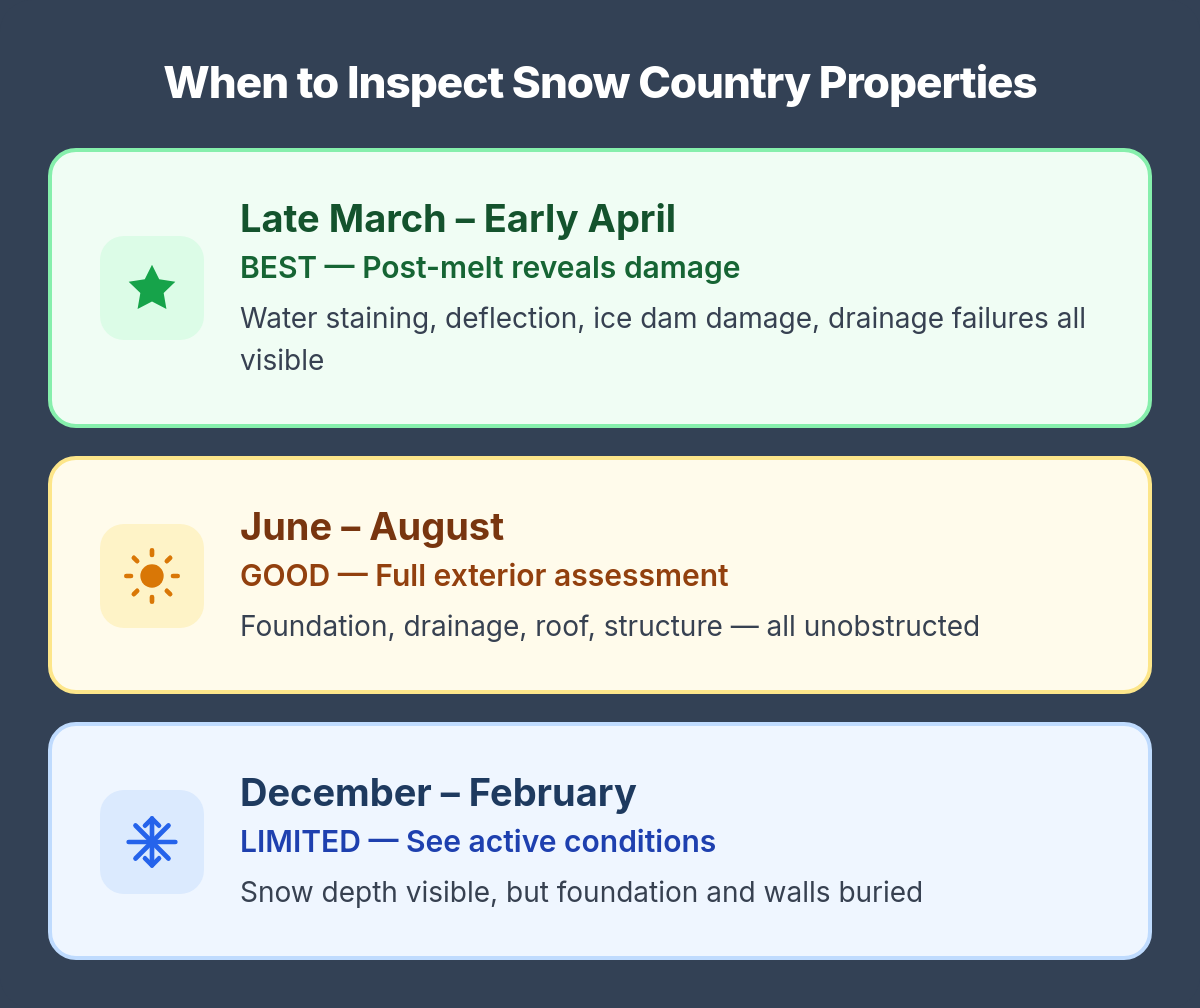
The ideal approach is two visits: one in late March/early April and one in summer. If budget allows only one, choose post-melt spring.
Critical Snow Country Due Diligence
Before purchasing any snow country akiya, ask these questions:
- Who removes snow from the roof during winter? Many rural communities have informal snow-removal networks for vacant properties — understanding the local custom is part of your due diligence.
- Does the property sit on a road at least 6 meters wide? Japanese law requires wider road access in designated snow zones. A property on a 4-meter road in a snow zone may be classified as non-rebuildable — meaning you can renovate but cannot demolish and rebuild.
- Have the pipes been drained and winterized? Frozen burst pipes are the most common damage in vacant snow country properties.
- Are there signs of foundation heave from freeze-thaw cycles?
Transaction Timelines: Working Backward From Your Target Date
A standard Japanese property transaction takes 60–90 days from accepted offer to settlement for cash or pre-approved buyers. For foreign buyers arranging financing or managing the process remotely, the full journey — search, due diligence, and settlement — commonly spans 6–12 months.
Key Milestone Timelines
Working Backward From Common Target Dates
Want to settle before April 1 (start of Japan's new fiscal/school year)? Your offer should be accepted by late January for a cash purchase, or early December for a mortgaged purchase. Add time if your timeline crosses the New Year shutdown.
Want to avoid the January 1 tax assessment? You need title transfer complete by December 31. That means your contract should be signed by early November — and you must account for any holidays in between.
Want to close after January 1 for tax advantages? Push settlement to the second week of January (after the New Year holiday), and your first tax bill won't arrive for another 16 months.
Any timeline that crosses Golden Week (late April–early May), Obon (mid-August), or New Year (late December–early January) should add at least 10 business days to account for office closures. The Legal Affairs Bureau, municipal tax offices, and most bank mortgage departments are all closed during these periods.
Month-by-Month Quick Reference
Here's the full year at a glance, optimized for foreign property buyers:
| Month | Buy | Visit | Reno | Key Notes |
|---|---|---|---|---|
| January | ● | ● | ● | Tax-advantaged closing window after Jan 1. Avoid first week. |
| February | ● | ● | ● | Spring listing surge begins. Last chance for winter deals. |
| March | ● | ● | ● | Peak competition & prices. Early March (before 20th) OK for visits. |
| April | ● | ● | ● | Fiscal year begins. High competition. New mortgage rates. |
| May 1–6 | ▬ | ▬ | ▬ | Golden Week — offices closed, construction stopped. |
| May 7–31 | ● | ● | ● | Best all-around window. Great weather, agents available, tourists gone. |
| June | ● | ● | ● | Tsuyu begins. Market quiets. Great for revealing moisture problems. |
| July | ● | ● | ● | Quietest month. Maximum negotiating leverage. Very hot. |
| August | ● | ● | ● | Still quiet. Obon shutdown Aug 13–16. |
| September | ● | ● | ● | Market resumes. Excellent for visits. Silver Week Sep 19–23 (2026). |
| October | ● | ● | ● | Ideal weather. Peak autumn buying window. Best for rural inspections. |
| November | ● | ● | ● | Koyo crowds in tourist areas. Good deals on repriced properties. |
| December 1–20 | ● | ● | ● | Year-end discounts. Watch the Jan 1 tax deadline. |
| December 21–31 | ▬ | ▬ | ▬ | Shutdown approaching. Avoid settlements in last week. |
Putting It All Together
These seasonal and bureaucratic patterns are predictable — which means they can be used to your advantage. The fiscal year creates predictable demand waves. The January 1 tax rule offers a clear optimization target. Weather patterns dictate when inspections are most revealing — and sometimes, the "worst" weather for visiting is the best weather for buying. Holiday shutdowns can add weeks to your timeline if you don't plan around them, and the construction labor shortage means renovation scheduling needs to start months before you'd expect.
Japan's calendar isn't an obstacle — it's a tool. Use it strategically, and you'll pay less, see more, and avoid the pitfalls that catch buyers who treat every month the same.