Japan's snow country — yukiguni (雪国 (yukiguni)) — stretches along the Sea of Japan coast from Niigata up through Akita and Aomori, with Nagano, Toyama, and Hokkaido completing the picture. These regions receive some of the heaviest snowfall on earth. Tokamachi in Niigata regularly records 3+ meters of accumulated snow. Nozawa Onsen in Nagano gets buried every winter. This isn't decorative powder — it's a structural load that affects your roof, pipes, heating bills, and daily routine.
With 27,400+ properties for sale across Japan's snow belt and nearly 8,000 houses under ¥5 million, the prices are compelling. But buying a snow country akiya without understanding winterization means expensive surprises in your first winter. This guide covers what you need to know — and what you need to budget — before committing to a property in heavy snowfall areas.
Snow Region Properties on Akiya Japan
Snow Load: The Force That Breaks Roofs
The single biggest structural concern in yukiguni is snow load (積雪荷重 (sekisetsu kajū) / sekisetsu kajū). Wet snow weighs roughly 300-500 kg per cubic meter. At 2 meters of accumulation on a 100 square meter roof, you're looking at 60-100 tonnes sitting on your house. That's the weight of a loaded freight truck — on your ceiling.
Japanese building codes require snow country structures to be engineered for their specific region's expected snowfall. But here's the catch: many akiya were built decades ago under older codes, or were maintained by elderly owners who cleared snow religiously. When a house sits vacant for years without snow removal, damage accumulates quietly.
What to inspect
- Roof type: Traditional steep-pitched roofs (急勾配屋根 (kyū kōbai yane)) shed snow naturally. Flat or low-pitched roofs require manual removal or mechanical heating systems. Know which you're buying.
- Roof material: Metal roofing (ガルバリウム鋼板) is standard in heavy snow areas — it's lighter than tile and snow slides off. Clay tile roofs (瓦屋根) are a red flag in deep snow zones; they're heavy themselves and trap snow.
- Ridge beam and rafters: Look for sagging, cracking, or bowing in the main ridge beam (棟木). Snow damage often shows here first. A structural engineer can assess whether accumulated damage is cosmetic or critical.
- Yukidomari (雪止め): Snow guards along the roof edge. These prevent dangerous avalanches off the roof onto walkways, cars, or neighbors. Missing or damaged guards need replacement before your first winter.
- Gutters: In heavy snow areas, gutters are either reinforced or intentionally absent. Standard gutters get ripped off by sliding snow. Check whether the house was designed with or without them.
Cost: Roof Reinforcement or Replacement
Metal re-roofing: ¥1.5-3M. Structural reinforcement of rafters/ridge beam: ¥500K-2M. Snow guard installation: ¥200-400K. Total for a neglected snow country roof: potentially ¥2-5M before you've touched anything else.
Heating: Kerosene Is King
Forget what you know about central heating. The vast majority of snow country homes — even relatively modern ones — run on kerosene (灯油 / tōyu). A large fan heater (ファンヒーター) or floor-mounted stove burns kerosene and pushes warm air into the room. Some homes have kerosene-fed underfloor heating (床暖房), which is genuinely excellent but expensive to run.
The kerosene reality
- Outdoor tank: Most snow country homes have a 200-400 liter kerosene tank outside, refilled by delivery truck every 2-4 weeks during winter. Budget ¥100-120 per liter (prices fluctuate with oil markets).
- Monthly cost: A typical house burns 300-600 liters per month in deep winter. That's ¥30,000-72,000/month (~0-480 USD) just for heating. Poorly insulated houses burn more.
- Ventilation: Kerosene heaters produce moisture and CO₂. You must ventilate regularly — cracking a window for a few minutes every hour is standard practice. Yes, you let cold air in to stay safe. It's not ideal.
- Carbon monoxide: All kerosene heaters must be used with a CO detector. This is non-negotiable. Deaths from CO poisoning in improperly ventilated rooms still occur every winter in Japan.
Alternatives and upgrades
- Heat pump air conditioners (エアコン): Modern inverter units work down to -15°C or lower, but efficiency drops sharply below -5°C. In Hokkaido's deepest cold, they're supplementary at best. In Nagano or Niigata, a good unit can handle most of winter.
- Wood stoves (薪ストーブ): Popular with renovation-minded foreign buyers. Beautiful, effective, but requires: chimney installation (¥500K-1M), a dry wood supply, and compliance with local fire regulations. Some rural communities welcome them; dense residential areas may not.
- Pellet stoves: A cleaner alternative to wood. Pellets are widely available in snow country. Installation is simpler than a wood stove but still requires venting.
- Kotatsu (こたつ): The iconic heated table. Not a whole-house solution, but the Japanese approach to winter is often "heat the person, not the room." A kotatsu, warm slippers, and a fleece is how many locals actually get through winter.
Pipes: The Overnight Disaster
Frozen pipes are the number one cause of property damage in vacant snow country homes. Water expands when it freezes, splitting pipes and fittings. When temperatures rise and the system thaws, water pours into walls, floors, and ceilings. A single burst pipe in an unoccupied house can cause hundreds of thousands of yen in damage before anyone notices.
Prevention systems
- Water draining (水抜き / mizunuki): The standard procedure for leaving a snow country home unoccupied. You shut off the main water supply and open all taps to drain the system completely. Every snow country homeowner knows how to do this. If you're buying, learn the procedure for your specific house — it varies by plumbing layout.
- Pipe heating cables (凍結防止ヒーター): Electric heating cables wrapped around exposed pipes. These run automatically when temperatures drop below a set point. Effective but add to your electricity bill (¥3,000-8,000/month in winter depending on the system).
- Insulated pipe wrapping: Basic foam insulation on exposed pipes. Cheap (¥10,000-30,000 to do the whole house yourself) but only delays freezing — it won't prevent it during extended cold snaps if the house is unheated.
Critical If You Won't Be Living There Full-Time
If your snow country akiya will sit empty during winter months, water draining is mandatory every time you leave. Alternatively, keep heating running at a minimum level (10-12°C) — this prevents pipe freeze but costs ¥15,000-30,000/month in heating fuel plus electricity. Many absentee owners hire a local caretaker (管理人) to check the property weekly during winter. Budget ¥10,000-20,000/month for this service.
Insulation: Japan's Biggest Weakness
Japanese houses are famously under-insulated. This isn't limited to snow country, but it matters far more when it's -10°C outside. Many akiya — especially those built before the 1999 energy efficiency standards — have little to no wall insulation, single-pane windows, and gaps around doors and fixtures that let cold air pour in.
What to check and what it costs
- Windows: Single-pane aluminum-frame windows are the worst offenders. Replacing with double-glazed (ペアガラス) or Low-E glass makes the single biggest difference in comfort and heating costs. Budget ¥50,000-150,000 per window, or ¥500K-2M for a whole house.
- Wall insulation: Older homes may have zero insulation in exterior walls. Blown-in cellulose or spray foam can be added without removing wall surfaces (¥500K-1.5M for a typical house). This is the best ROI renovation for snow country living.
- Floor insulation: Cold floors are the top complaint from foreign owners. Underfloor insulation boards or spray foam (¥300K-800K) transform livability. Some owners opt for underfloor heating instead or in addition (¥1-2.5M).
- Ceiling/attic: Heat rises and escapes through uninsulated attics. Blown-in insulation in the attic space is relatively cheap (¥200-400K) and highly effective.
- Draft sealing: Weather stripping, door sweeps, and gap filling around pipes and wiring penetrations. A weekend DIY project costing ¥10-30K in materials that can cut heat loss by 10-20%.
The Japanese government offers insulation subsidies through programs like the 住宅省エネキャンペーン. Depending on the year and program, you can recover 30-50% of insulation renovation costs. Check with your municipality — snow country local governments often have additional prefectural subsidies stacked on top.
Yukigakoi: The Snow Fence Tradition
Yukigakoi (雪囲い) is the practice of installing protective barriers around a house before winter. In snow country, this isn't decorative — it's essential maintenance that protects the building from snow pressure, sliding roof snow, and wind-driven drifts.
What yukigakoi involves
- Wooden boards or panels placed against ground-floor windows and vulnerable walls to prevent snow pressure from cracking glass or warping frames
- Post-and-board structures around garden plants, stone lanterns, and other landscape features
- Rope tying of trees and shrubs to prevent branches snapping under snow weight
- Drain covers and protective barriers around utilities
In traditional communities, yukigakoi is done communally in late November and removed in April. If you buy in a rural snow country neighborhood, participating in this seasonal tradition is part of being a good neighbor. Many communities organize group work days (共同作業) where everyone helps with each other's properties.
Professional yukigakoi installation costs ¥50,000-150,000 per season depending on house size. Many long-term residents do it themselves once they learn the technique.
Snow Removal: Your Winter Part-Time Job
In deep snow regions, snow removal (除雪 / josetsu) is not occasional — it's a regular commitment from December through March. Municipal plows clear main roads, but your roof, driveway, walkways, and around your kerosene tank are your responsibility.
Roof snow removal (雪下ろし (yukioroshi) / yukioroshi)
Unless your roof is designed to shed snow naturally, you'll need to clear it when accumulation exceeds 1-1.5 meters. This is physically demanding and genuinely dangerous work done at height in freezing conditions. Options:
- DIY: Requires a snow removal shovel (スノーダンプ), safety harness, and ideally a partner. Never do it alone. Falls from roofs during yukioroshi are estimated to kill dozens of people each winter in Japan, mostly elderly homeowners.
- Professional service: ¥20,000-50,000 per visit. In a heavy snow year, you might need 3-5 visits. Budget ¥60,000-250,000 per winter.
- Roof heating system (融雪装置): Electric or hot-water systems embedded in or on the roof that melt snow automatically. Installation: ¥1-3M. Running cost: ¥30,000-80,000/month during snow season. Expensive but eliminates the most dangerous maintenance task.
Ground snow removal
- Hand shoveling: Fine for light snow. A daily 30-60 minute commitment in heavy snow periods.
- Snowblower (除雪機): Honda and Yamaha make excellent residential models. New: ¥200,000-800,000. Used: ¥100,000-400,000. Essential if you have a driveway longer than 10 meters. Requires fuel, maintenance, and storage space.
- Municipal snow dump sites: You can't just pile snow anywhere indefinitely. Many towns designate areas for dumping excess snow or have rivers where residents push snow in. Ask about this before buying.
The Annual Cost of Snow Country Ownership
Here's what a snow country akiya costs beyond the standard ownership expenses you'd face anywhere in Japan:
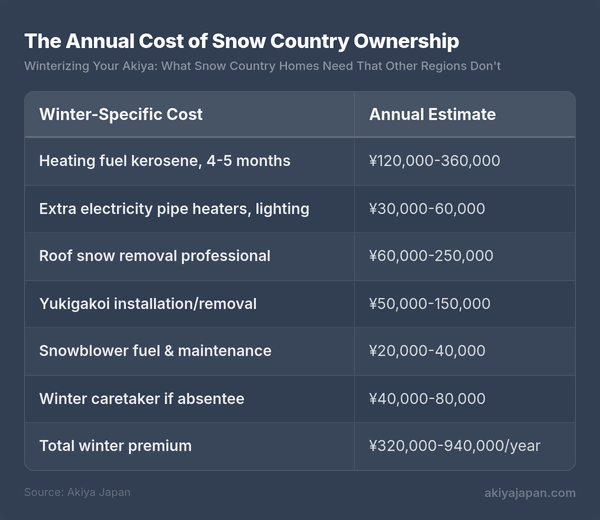
That's ¥320,000-940,000 (~,100-6,200 USD) per year on top of normal property tax, insurance, and maintenance. It's not a dealbreaker — but it must be in your budget. A ¥2M akiya in Niigata with ¥500K in annual winter costs is a very different financial commitment than a ¥2M house in Okayama.
The Upside: Why People Buy Here Anyway
After all those warnings, here's why snow country akiya remain some of the most sought-after properties on our platform:
- Onsen access: Snow country is hot spring country. Niigata, Nagano, Akita, and Yamagata have hundreds of natural hot springs. There's nothing quite like soaking in an outdoor onsen while snow falls around you.
- Ski and snowboard: Your house is the lodge. Properties near Myoko, Nozawa, Madarao, Hakuba, Furano, or Niseko put world-class skiing within a 20-minute drive — or walking distance in some cases.
- Summer escape: Snow country summers are cooler than the sweltering Pacific coast. While Tokyo bakes at 35°C, Nagano and highland Niigata sit comfortably at 25-28°C.
- Food culture: Niigata grows Japan's best rice (Koshihikari). Toyama has the country's finest sushi. Akita has kiritanpo and premium sake. Nagano produces excellent soba, wine, and mountain vegetables. Snow country food is a genuine draw.
- Community strength: Ironically, the harsh climate creates stronger communities. Snow removal cooperation, seasonal festivals, and mutual aid traditions mean that snow country villages are often more welcoming and socially cohesive than suburbia.
- Prices: The winter maintenance costs are reflected in lower purchase prices. A house that would cost ¥15M in Chiba or Kanagawa might be ¥3M in Niigata or Akita. The total cost of ownership, including winter expenses, is often still lower.
Before You Buy: A Snow Country Checklist
- Visit in winter. A snow country property in August looks nothing like it does in February. See the snow accumulation, the access roads, the heating system in action. If you can only visit once, make it January or February.
- Ask about snow history. How much accumulation does this specific location get? Is the road plowed by the municipality? When was the roof last cleared? Has the house survived recent heavy snow winters without damage?
- Check the roof. Type, material, pitch, and condition. This is your most expensive potential problem.
- Test the heating. Turn everything on. Check the kerosene tank, delivery access, and backup options.
- Inspect the plumbing. Look for signs of past freezing — patched pipes, water stains, buckled fittings. Ask about the mizunuki (water drain) procedure.
- Assess insulation. Touch exterior walls in winter. If they're ice-cold, there's no insulation. Check window type — single or double glazed.
- Budget honestly. Add ¥500,000-1,000,000 per year to your ownership costs for winter-specific expenses. If that breaks the budget, consider a milder region.
- Talk to neighbors. They'll tell you things no listing will — which side of the house drifts pile up on, whether the town snow plow service is reliable, which contractors are trustworthy for roof clearing.
Snow country akiya ownership works well for people who go in with realistic expectations and a proper budget. The winters are hard, the maintenance is real, and the costs are higher than temperate Japan. But the landscapes, the onsen, the food, and the community are extraordinary. Budget properly, winterize thoroughly, and you'll have a home that offers something most properties in the world simply can't.
Browse Niigata properties → | Browse Nagano properties → | Browse Hokkaido properties →