Step into almost any Japanese home between November and March and you will find the same scene: a low table draped in a thick blanket, a warm orange glow underneath, and a family gathered around it with their legs tucked in and a plate of mandarin oranges within reach. This is the kotatsu — part furniture, part heating system, part social institution — and it has shaped how Japan lives through winter for over 500 years.
What Exactly Is a Kotatsu?
The concept is disarmingly simple. Take a low wooden table frame. Attach an electric heater to its underside. Drape a heavy quilt — the kotatsu-gake — over the frame, then place a flat tabletop on top. Sit on the floor, slide your legs under the blanket, and the trapped warm air does the rest.
The heat stays contained beneath the quilt rather than dissipating into the room. It is, in effect, a heated cocoon for the lower half of your body — and it costs almost nothing to run. Modern electric kotatsu draw roughly 300–500 watts, translating to about ¥2–¥5 per hour. A full month of daily use rarely exceeds ¥2,000 (around $13 USD).
From Charcoal Pits to Electric Heaters
The kotatsu's origins trace back to the Muromachi period (1336–1573), when Japanese homes featured an irori — a sunken hearth built into the floor. Families cooked over the irori and warmed themselves beside it. At some point, someone placed a low platform over the embers and draped a quilt across it. The kotatsu was born.
For centuries, the heat source was charcoal. A clay pot containing glowing coals sat beneath the table, which required careful ventilation and carried a genuine fire risk. The electric kotatsu arrived during the Taisho period (1912–1926), though it didn't become mainstream until after World War II. By the 1960s, electric models with heaters bolted directly to the underside of the frame had become the standard — safer, cleaner, and effortless.
Why Japan Never Adopted Central Heating
To understand why a heated table matters so much, you need to understand Japanese homes. Outside of Hokkaido, central heating is rare. Traditional Japanese houses were designed for hot, humid summers — open floor plans, thin walls, sliding screens, and excellent ventilation. All qualities that make them brutally cold in winter.

Rather than heating entire buildings, Japanese culture developed a philosophy of heating the person. The kotatsu is the purest expression of this idea. Instead of warming a 40-square-metre room to 22°C, you warm the space under a blanket to a comfortable temperature and layer up everywhere else. It is frugal, effective, and deeply ingrained.
Even modern Japanese apartments often rely on individual room air conditioners for heat, which dry the air and drive up electricity bills. The kotatsu, by contrast, keeps costs minimal and adds zero dryness. Many households use both — the air conditioner for the first blast of warmth, the kotatsu for sustained, low-cost comfort.
The Cultural Heart of Winter
A kotatsu is not just a heater. It is where winter happens.
Once the kotatsu goes up — usually in October or November — it becomes the gravitational centre of the household. Meals are eaten there. Homework gets done there. The television remote lives there. Conversations drift on there for hours. There is even a well-known Japanese phenomenon: kotatsu de neru, falling asleep under the kotatsu, which every Japanese person will tell you is one of life's great comforts (and, they'll add, terrible for your health — dehydration from the dry heat while sleeping is a real concern).
The classic kotatsu scene — family huddled around the table, a bowl of mikan (mandarin oranges) in the centre, a pot of nabe (hot pot) bubbling away — is one of the most enduring images of Japanese domestic life. It appears constantly in anime, manga, and film. When a character in a Studio Ghibli movie is shown under a kotatsu, every Japanese viewer immediately understands: this is home, this is warmth, this is belonging.
New Year's gatherings almost always centre on the kotatsu. Families return to their hometowns, crowd around the table, eat osechi (New Year dishes), and watch the annual Kōhaku Uta Gassen song contest on NHK. The kotatsu is not incidental to these traditions — it is the stage on which they play out.
Modern Kotatsu: Still Thriving
Far from fading, the kotatsu has adapted. The rise of remote work since 2020 sparked a wave of new designs: single-person kotatsu for home offices, chair-height models for people who prefer not to sit on the floor, and sleek minimalist frames that would look at home in a Scandinavian apartment.
Some modern kotatsu feature reversible tabletops — light oak on one side, dark walnut on the other — allowing owners to change the aesthetic with the seasons. Others include built-in power outlets for laptops and phones, acknowledging that the kotatsu is now as much a workspace as a family gathering spot.
Prices range from around ¥5,000 ($33 USD) for a basic model at Nitori (Japan's answer to IKEA) to ¥50,000+ ($330 USD) for designer pieces. The blanket — often sold separately — adds another ¥3,000–¥10,000. For the full experience, add a kotatsu shikimono (an insulating mat that goes under the table on the floor) to prevent heat from escaping downward.
Modern Kotatsu: What's on the Market
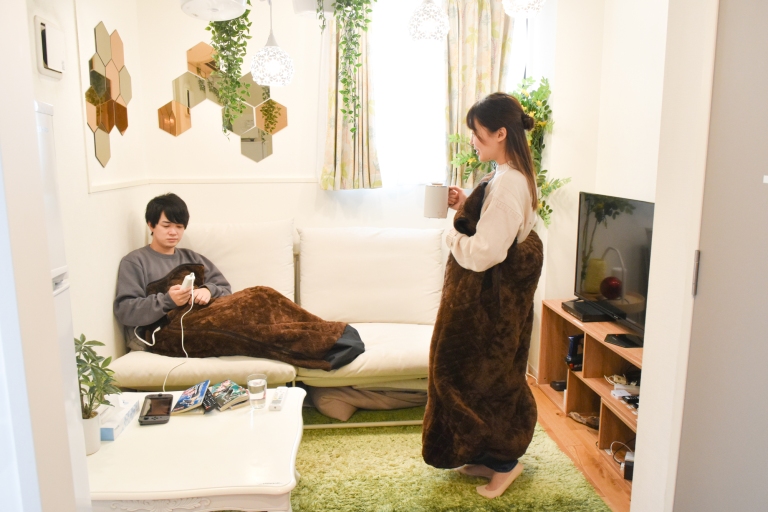
The kotatsu has come a long way from charcoal pits and basic wooden frames. Here are some of the designs available today:


What This Means If You're Buying Property in Japan
If you are looking at older Japanese homes — particularly traditional wooden houses — understanding the kotatsu isn't just cultural trivia. It has practical implications for how you will live in the property.

Heating is not included
Most older Japanese homes come with no heating infrastructure whatsoever. No radiators, no furnace, no ductwork. You will need to plan your own heating strategy, and the kotatsu is the cheapest and most culturally appropriate option. A complete kotatsu setup — table, heater, blanket, and floor mat — can be assembled for under ¥15,000 ($100 USD).
Insulation varies wildly
A 1970s wooden house in Niigata and a 2005 apartment in Osaka will have vastly different insulation levels. In poorly insulated homes, the kotatsu becomes less of a luxury and more of a necessity. Many long-term foreign residents of traditional Japanese homes describe the kotatsu as the single most important piece of furniture they own during winter months.
The kotatsu fits the architecture
Traditional rooms with tatami flooring are designed for floor-level living. The kotatsu is a natural extension of this — low table, zabuton cushions, and legs folded underneath. If you are buying a home with washitsu (Japanese-style rooms), a kotatsu is the most ergonomically appropriate heating solution.
Running costs matter in older homes
Heating a draughty old house with air conditioning alone can cost ¥20,000–¥40,000 per month in winter. A kotatsu, at ¥1,000–¥2,000 per month, covers the room where you spend most of your time. Pair it with a portable kerosene heater for the worst days, and you have a practical winter strategy that won't shock your electricity bill.
How to Buy a Kotatsu
If you are already in Japan, kotatsu are sold at virtually every home goods store from September onward. Nitori, Muji, and home centres like Cainz and Komeri all carry them. Online, Amazon Japan and Rakuten offer extensive selections with delivery.
For buyers still overseas, don't worry about sourcing one before you arrive. Kotatsu are inexpensive, widely available, and straightforward to set up. It takes about five minutes: unfold the frame, plug in the heater, lay the blanket, place the top. Done.
One tip: buy the blanket and the table together, as sizing matters. A blanket too small for the frame will leak heat; one too large will bunch awkwardly. Most retailers sell matched sets.
More Than Furniture
The kotatsu endures because it solves a practical problem — cold homes — with warmth that is both physical and social. It pulls people together. It makes a room feel lived-in. It turns a draughty old house into somewhere you actually want to spend a winter evening.
For anyone considering a home in Japan, particularly a traditional property, the kotatsu is worth understanding not as a quaint novelty but as a genuinely smart piece of domestic technology that has been refined over five centuries. It is cheap, efficient, and — once you have spent a winter evening under one with a bowl of hot pot and a pile of oranges — impossible to give up.