Short version. The merchant name printed on your statement is the only thing that identifies who charged you. Ours is AKIYAJAPANCOM on a card, or Akiya Japan as the merchant name on a PayPal transaction. Anything else and the money went to a different company, and only that company can stop it.
Most weeks somebody writes to us about a charge they're sure they made here, and the money turns out to have gone to a business that picked a name like ours. It's a horrible position to be in. You paid for something, you're being billed again, and the site you thought you signed up to says it has no record of you. So here is how to settle it, whether the answer turns out to be us or not.
Start with the merchant name, not the amount
Every card payment carries a merchant descriptor, the short string of capital letters your bank prints beside the amount. It names the company that actually took the money. The merchant sets it at the payment processor, and no other business can borrow it. The amount can't tell you this on its own. A currency conversion, a yearly plan renewing when you had forgotten it would, or a price that changed since you signed up can each make the number look wrong while the money is still ours, or make it look right when the money went somewhere else. The descriptor is the part that doesn't move.
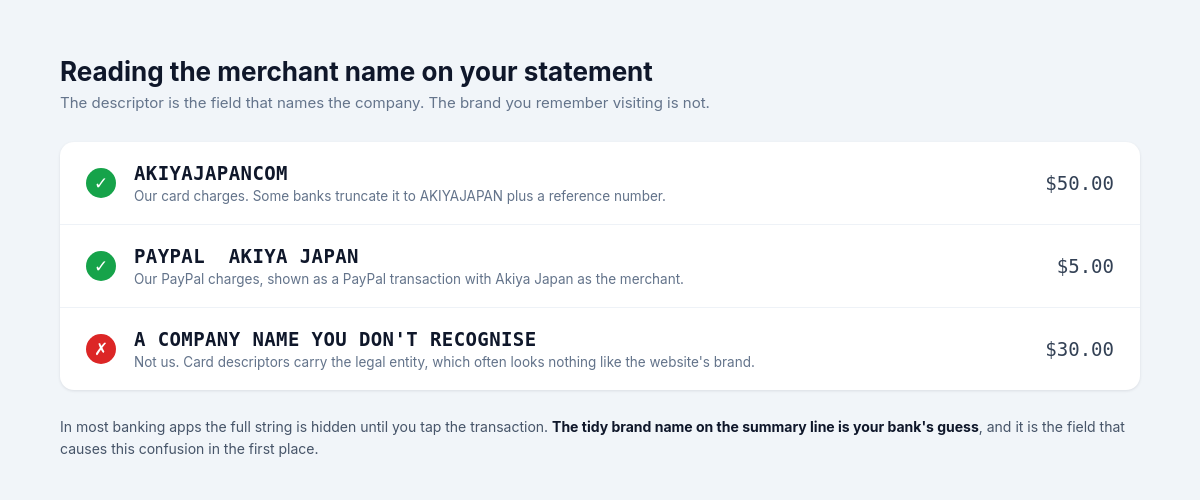
Card payments to us arrive as AKIYAJAPANCOM. Some banks truncate it, so you might see AKIYAJAPAN followed by a reference number. PayPal is the other way money reaches us, and those charges show Akiya Japan as the merchant, sometimes with a country name in front of it on a bank feed rather than a PayPal statement itself. Those are the only strings that mean the money came here. If your statement shows a name that isn't one of these, it isn't us, however close it looks.
Bookings work the same way. If you paid for a consultation or a property viewing arranged through this site, the money runs through our processor before it reaches the person you booked with, so the statement reads AKIYAJAPANCOM rather than their name. That one catches people out in the opposite direction. The charge is right and the name looks wrong. If you booked a partner through us and see our descriptor, that is what you are supposed to see.
In most banking apps the full descriptor is hidden until you tap the transaction. The summary line usually shows a tidied-up brand name your bank guessed at, and that guess is exactly what causes the confusion. Open the transaction detail and read the raw string. If it names a company you've never heard of, that's still your answer. The descriptor carries the legal entity behind a site, and the company that takes the money and the brand on the pages you were reading don't have to match. Often they don't.
Three steps that end the charge
- Read the descriptor. Tap the transaction in your banking app, or find it on the paper statement, and write down the exact string including any numbers after it.
- Search that string. Put it into a search engine in quotes. It nearly always resolves to a company name and a support contact. If it doesn't, the transaction detail screen usually carries a phone number or a URL that your card network requires the merchant to supply.
- Cancel with that company directly. Only the merchant holding the agreement can end it. We can't cancel a subscription we don't hold, and your bank can't either without opening a formal dispute, which takes weeks and doesn't always work. Cancelling the card won't cancel the agreement, either. Plenty of processors will simply re-present the charge against your replacement card.
If the charge really is ours
Then you don't need us to stop it. Sign in, open your account settings, and cancel there. It takes about thirty seconds and takes effect immediately. If you've already paid for the current period you keep access until it ends, because you paid for it.
If you'd rather we checked the record for you, send us the date, the amount, the last four digits of the card and any email address you might have used, through our contact form. We'll look it up and tell you either way, including telling you plainly when the charge was ours. That does happen, usually when someone subscribed with a work address years ago and has forgotten. What we can't do is refund or cancel a payment made to another company. We have no access to their systems and no standing to act for you. The three steps above are the fastest route; going through your bank first is usually the slowest.
If you can't sign in, the account may not be here
The same confusion turns up at the login screen. Someone subscribes to a site with a name like ours, comes to akiyajapan.com, types in the email and password they think they used, and the login is rejected because no account here was ever created under that address. From their side it looks like we're locking them out of something they paid for. We're not. A login only works on the site where the account was actually created, and we can only let you into an account that exists here.
A password reset settles this in about two minutes. Ask for a reset link on this site and watch your inbox, spam folder included. If a link from Akiya Japan arrives, you have an account here. Set a new password and you're in. If nothing arrives, you don't have an account here, and the site that will send you a reset link is the same company whose name sits on your bank statement. If you're sure you signed up with us and still can't get in, send us the email address through our contact form and we'll check the record and tell you either way.
Why the mix-up is so easy to make
Our website is akiyajapan.com, and it's the only site we bill from. We're not going to list the others by name; the point here is to help you read your own statement, not to send you elsewhere. Several paid sites, and a couple of large social-media groups, use names built to sound like ours and to trade on the recognition the name has earned over the years. If you subscribed somewhere believing it was us, that's a reasonable mistake to have made. It's the mistake those names are designed to produce.
Some of the overlap is innocent. Akiya (空き家) is ordinary Japanese for a vacant house, the way "vacant home" is ordinary English, so nobody owns the word. But not all of it is an accident. This site has been the top English result for akiya listings for years, and several of the names now causing the confusion were chosen after that was already true, close enough to ours to borrow the recognition without being ours. You don't have to settle who intended what to protect yourself from the result, because the result is the same either way. Someone sees a charge, remembers the name they associate with akiya listings, and writes to us convinced we took their money and are denying it. Reading the descriptor is what ends that, in about two minutes, against two weeks of disputing a charge your bank can't trace.
What the bigger fees in this market buy
We built this site to help the people actually in a transaction, the buyer, the seller, and the licensed Japanese agents who do the regulated work. Not to stand between them. The rush of interest in akiya over the last few years has, like any gold rush, drawn in operators who see it the other way, treating that interest as something to be mined rather than people to be served. They have no real stake in the buyer paying the fee, the seller waiting for a sale, or the agents whose licence and liability the deal actually runs on.
It shows up in what they charge. Japanese law caps what a licensed agent can bill you. It's three percent of the price plus ¥60,000 plus consumption tax for a normal sale, or up to ¥330,000 including tax for anything sold at or under ¥8,000,000, which is the figure that actually governs most akiya. Fees well above that, from companies that don't hold a Japanese brokerage licence, are for coordination and translation, not for the transaction itself. We went into that in Japoński limit prowizji pośrednika: Co licencjonowany agent może legalnie pobrać. If you're comparing the search sites rather than the purchase services, How to Evaluate a Japan Property Website covers what each one actually holds, and if you're ready to work with a Japanese agent directly, Jak współpracować z japońskim agentem is the practical version.
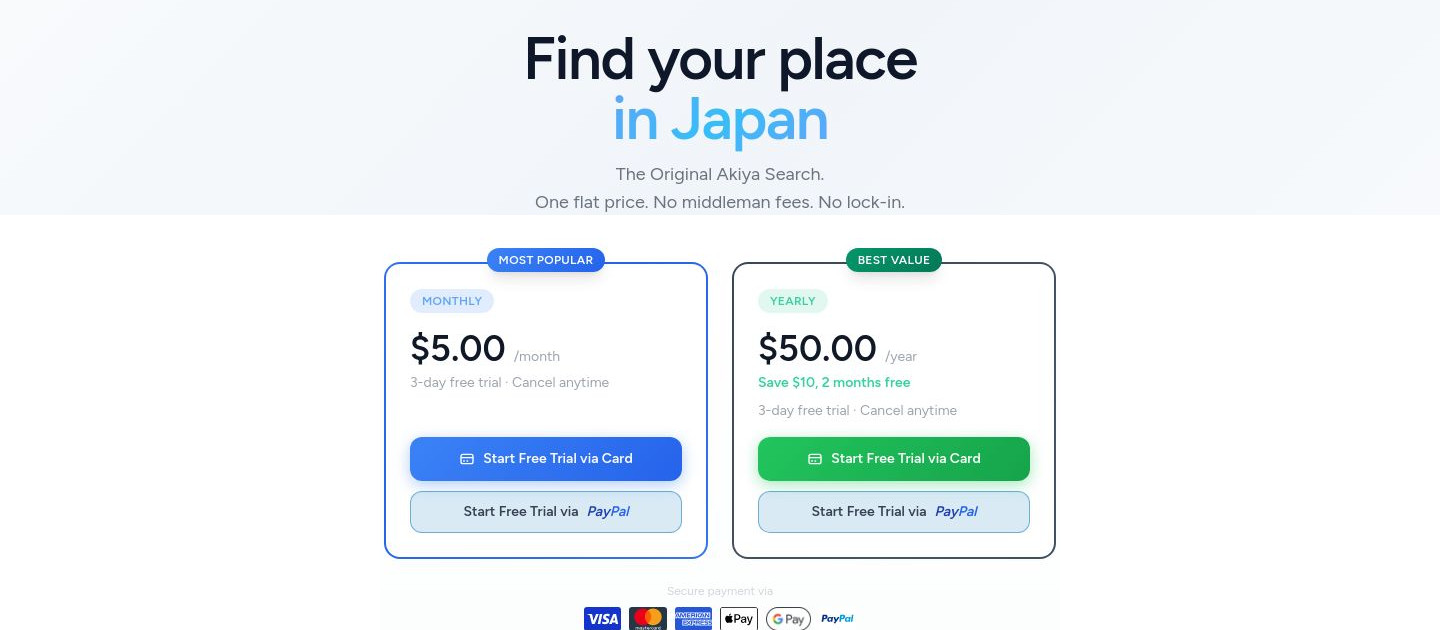
What we charge is the plan price and nothing else. A subscription covers unlimited search across every listing we carry, anywhere in Japan, with no per-inquiry credits, no fee to contact an agent, no separate "guided purchase" charge added at the end, and none of the extras that turn a modest-looking membership somewhere else into a much larger final bill.
Whatever the statement says, the descriptor settles it. That is the two minutes worth spending before anything else.