
There is a moment, well-known to anyone who has ever sat beside one, when the fire in an irori (囲炉裏) settles into a low, steady rhythm and the room feels somehow older and quieter than it did before. The kettle on the hook begins its slow whisper. Woodsmoke mingles with the cedar of the overhead beams. For thousands of years, this sunken floor hearth was the absolute center of Japanese domestic life — the place where food was cooked, where families gathered through long winter evenings, and where the hierarchy of the household was silently reaffirmed by who sat where.
Today, tens of thousands of akiya (空き家, vacant houses) across Japan — many of them kominka (古民家, old traditional farmhouses) built during the Edo and Meiji periods — contain the physical remains of irori that were simply boarded over when gas stoves and electric heaters arrived. Restoring one is not just an aesthetic choice. It is an act of recovery: bringing back a feature that was designed into the house's structure, its ventilation, its social logic.

A traditional irori at Shirakawa-go: the jizaikagi hook, iron kettle, and seated cushions arranged around the sunken hearth — Wikimedia Commons
What Is an Irori?
An irori is a sunken open hearth built directly into the wooden floor of a traditional Japanese room — not a fireplace in the Western sense, but a square or rectangular pit (typically 90 cm across) filled with a deep bed of fine ash, with a small wood or charcoal fire burning at its center. Above the fire hangs the jizaikagi (自在鉤), an adjustable iron pothook suspended from the ceiling beam, counterbalanced so a kettle or pot can be raised and lowered with one hand.
Unlike a stove, the irori radiates heat in all directions at floor level, warming everyone sitting around it evenly. It is also, in use, a cooking surface, a light source, a clothes dryer, and the social anchor of the house. Each seat around the hearth had a name tied to family hierarchy — head of household, honored guest, wife, eldest son. Visitors could read the entire family dynamic without a word spoken.
The smoke rising from the irori served the house itself. Filtering slowly through the roof structure, it deposited wood tar on every beam and rafter — a powerful preservative and insect repellent. Houses with active irori for generations show remarkably well-preserved timbers. Homes where the hearth was extinguished often show accelerated decay in the decades that followed.
Does Your Akiya Already Have One?
Many pre-1945 rural akiya contain irori that were boarded over rather than demolished. Identifying whether yours does can save significant construction cost. Look for these signs:
- A square section of floor with a different wood grain or visible joint lines suggesting a frame beneath
- Scorched or darkened ceiling beams directly above a central area of the main room
- A hook anchor or mounting point on a central ceiling beam (even if the hook is gone)
- An unusually high ceiling in one room compared to the rest of the house
- White ash residue visible under the floorboards near the center of the main room
If you find evidence, document it with photographs before any renovation work begins. Your contractor needs to understand what is original and what was added when the hearth was covered — typically a layer of joists, insulation, and plywood over the original pit.
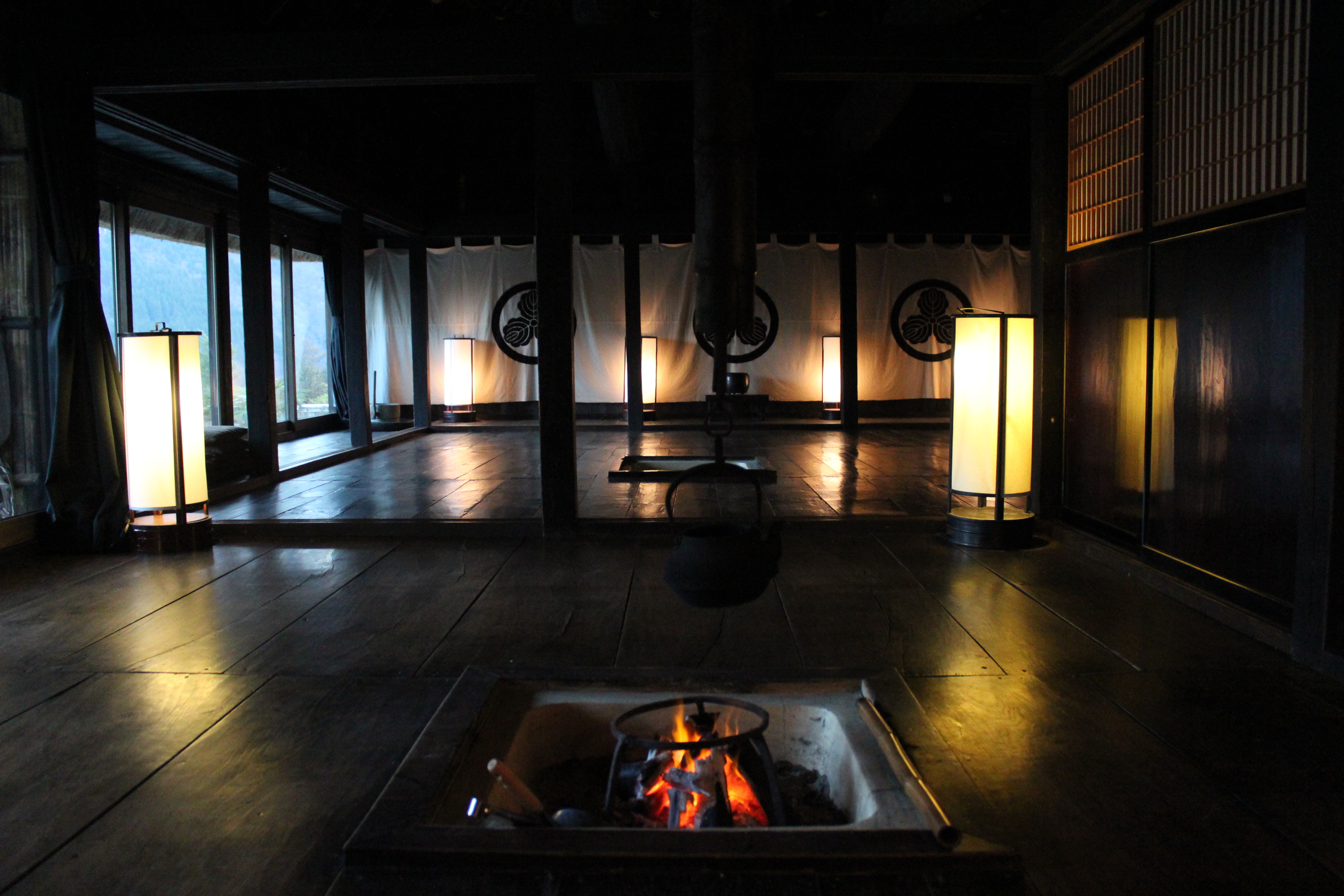
The Chiiori irori: an active fire in a restored farmhouse hearth, with the jizaikagi suspended from the ceiling — Wikimedia Commons
What a Restoration Actually Involves
A viable irori restoration requires a traditional raised wooden floor (concrete slabs won't work), ceiling height of at least 250–300 cm above floor level, and a designed ventilation solution — either a smoke window (kemuri mado) cut into the ceiling, or a custom hood and flue through the roof. The ventilation is where most of the engineering complexity lives. Modern tile roofs are airtight; smoke cannot filter out the way it did through traditional thatch.
Japan's Building Standard Law also requires that all materials within 1 meter of an open hearth be noncombustible or fire-resistant. Any modernized room with vinyl flooring or plasterboard walls will need remediation before the hearth can legally operate. A fire department inspection (shōbōsho) is required before the first fire is lit.
Costs
- Restoring an existing frame with original pit intact: ¥300,000–¥800,000
- Full restoration with new ventilation hood and flue: ¥800,000–¥1,800,000
- New irori where none existed: ¥1,500,000–¥3,500,000
- Premium restoration with antique hardware: ¥2,000,000–¥5,000,000+
Budget for 130–150% of your initial quote — irori restorations routinely surface surprises: asbestos in post-1970 renovation layers, rotted joists, undersized roof ventilation. Government grants of ¥500,000–¥2,000,000 are available in many municipalities (Gifu, Okayama, Tottori, Shimane) for preserving traditional architectural features. Check with your local akiya bank coordinator before engaging a contractor.

The irori room at Shirakawa-go — tatami, smoke-blackened beams, and the hearth at the centre — Wikimedia Commons
Getting the Right Help
Find a carpenter with experience on registered cultural properties (bunkazai, 文化財) or listed with your prefecture's traditional building association, rather than a general renovation contractor. An irori restoration that goes wrong can be very expensive to undo.
For foreign buyers in particular — navigating building permits, municipal grants, and the contracts involved in both purchasing and renovating a traditional property — specialist support makes a significant difference. Teritoru, our licensed partner agent, works specifically on this type of transaction, from acquisition through renovation planning. You can book an initial consultation by web conference before committing to any property.
An irori is not a decorative addition. Done correctly, it transforms a house into something genuinely irreplaceable. For a property that has carried one for a century or more, bringing it back is less restoration than reunion.


