
Japan has one of the most comprehensive public healthcare systems in the world. For foreign residents, that system is fully accessible — provided you understand how it works, when eligibility kicks in, and what it does not cover. For buyers over 55 who are planning a long-term move, these details are not peripheral. They are central to whether a relocation is sustainable.
This guide covers the two public insurance systems you will pay into as a resident: National Health Insurance (国民健康保険 kokumin kenko hoken, or NHI) and Long-Term Care Insurance (介護保険 kaigo hoken). It also explains the full spectrum of senior care facilities available in Japan, what each costs, and what falls outside public coverage. And it addresses a structural reality that surprises many would-be retirees: Japan has no retirement visa.
How National Health Insurance Works for Foreign Residents
Any foreign national with a valid residence card and a visa of three months or longer is legally required to enroll in public health insurance. If your employer does not provide social insurance (社会保険 shakai hoken), you enroll in NHI through your local ward or municipal office (区役所 kuyakusho or 市役所 shiyakusho) within 14 days of registering your address.
Late enrollment triggers retroactive billing for up to two years of unpaid premiums, plus gaps in coverage. Enrollment is not optional and, from 2027, it becomes directly tied to visa renewal: foreigners with unpaid NHI premiums will be denied visa extensions under rules announced by Japan's immigration authorities in January 2026.
Premiums are set by each municipality and calculated on three components: a medical portion (funding core healthcare), a late-stage elderly support portion (funding the 75+ system), and a long-term care portion for residents aged 40 to 64. The combined annual cap for FY2025 is ¥1,060,000. That sounds like a large sum, but it applies only to very high earners. Most foreign retirees arriving with no Japan-sourced income qualify for the 70% statutory reduction, bringing annual premiums as low as ¥20,000 to ¥50,000 per year. Declaring your income — even if that income is zero — at the municipal office is the essential step to trigger this reduction.

Active senior life in Japan extends well beyond the clinic — shopping arcades, community markets, and neighborhood routines form the fabric of daily life for older residents. Photo: Yuki / Pexels
Co-payment Rates by Age
NHI covers standard outpatient care, specialist consultations, hospital stays, and prescriptions. What you pay out of pocket depends on your age:
- Under 70: 30% co-payment on all approved medical costs
- Ages 70 to 74: 20% (rising to 30% for high-income earners)
- Age 75 and over: 10% (rising to 30% for high-income earners)
NHI does not cover income replacement during illness, dental implants, or non-emergency cosmetic procedures. It also does not cover repatriation in a medical emergency, which makes supplemental international health or travel insurance worth considering in the early years before you have established full Japanese residency.
The 75+ Transition: Late-Stage Elderly Medical Care
At age 75, all residents in Japan — Japanese nationals and foreign residents alike — automatically transfer out of NHI into a parallel system: the Late-Stage Elderly Medical Care System (後期高齢者医療制度 kouki koreisha iryoseido). The practical difference is the reduced 10% co-payment rate at point of service. Premiums under this system are income-based and are typically lower than equivalent NHI contributions for the same household.
This transition happens automatically. Your municipal office will notify you and issue a new insurance card. Coverage continuity is seamless provided your address registration is current.
The High-Cost Medical Expense Safety Net
Japan's most important financial protection for medical costs is the High-Cost Medical Expense Benefit (高額療養費 kogen ryoyohi). This caps your out-of-pocket medical spending in any calendar month. If actual expenses exceed the cap for your income bracket, the excess is refunded -- typically within a few months of application at your municipal health insurance office.
For standard-income residents under age 70, the monthly cap is calculated as ¥80,100 plus 1% of costs above ¥267,000 -- meaning even catastrophic surgery rarely results in more than ¥100,000 to ¥150,000 out of pocket in a single month. For lower-income residents, the flat cap is ¥57,600. After three qualifying months in a twelve-month period ("frequent qualifier" status), caps reduce further -- the standard tier drops to ¥44,400 per month.
For residents aged 70 to 74 on ordinary income, the outpatient-only cap is ¥18,000 per month (with a ¥144,000 annual ceiling), rising to ¥57,600 per month when inpatient costs are combined.
One important caveat: this cap applies to NHI-covered medical services only. Room and board during hospitalization, care facility accommodation fees, and out-of-scope items are excluded. These out-of-pocket costs are where foreign seniors should focus their financial planning, not on the insured medical services themselves.
Long-Term Care Insurance: The Second System
Japan operates a separate public insurance system specifically for age-related care: Long-Term Care Insurance (介護保険 kaigo hoken). All residents aged 40 and over are required to enroll and pay premiums. Foreign residents are included on identical terms.
Premiums differ by age group:
- Ages 40 to 64 (Category 2): Premiums are collected as part of NHI (the care portion, capped at ¥170,000/year). Access to benefits is limited to 16 designated age-related conditions including early-onset dementia, Parkinson's disease, and late-stage cancer.
- Age 65 and over (Category 1): Premiums are billed separately by the municipality -- the national average for the current (8th) plan period (2024-2026) is approximately ¥6,000 to ¥8,000 per month. If you receive a Japanese pension, premiums are deducted directly from it.
At 65, you become eligible to apply for care services regardless of the cause of your condition. The standard co-payment is 10% of approved care service costs, rising to 20% or 30% for higher-income households. Importantly, kaigo hoken covers the cost of care services -- but not room and board at care facilities. That distinction has significant financial implications, detailed below.
The Care Level Assessment
To access care services, you apply to your municipal long-term care insurance division for a Care Level Assessment (要介護認定 yokaigo nintei). The process involves a home visit by a municipal assessor, a written opinion from your attending physician, and review by a panel. Results are typically issued within 30 days.
Japan uses seven levels:
- 要支援1・2 (Yoshien 1-2): Mild decline; preventive services, light support
- 要介護1 (Yokaigo 1): Partial help with daily activities
- 要介護2 (Yokaigo 2): Regular assistance with bathing, dressing
- 要介護3 (Yokaigo 3): Cannot perform most activities independently; required for public nursing home admission
- 要介護4 (Yokaigo 4): Near-full dependence
- 要介護5 (Yokaigo 5): Fully dependent; constant care required
The assessed level determines which services are covered and the monthly benefit ceiling. In-home care services -- visiting nurses, home helpers, day care centers (デイサービス dei saabisu), respite stays -- are all covered at standard copay rates and are widely used before facility placement becomes necessary.
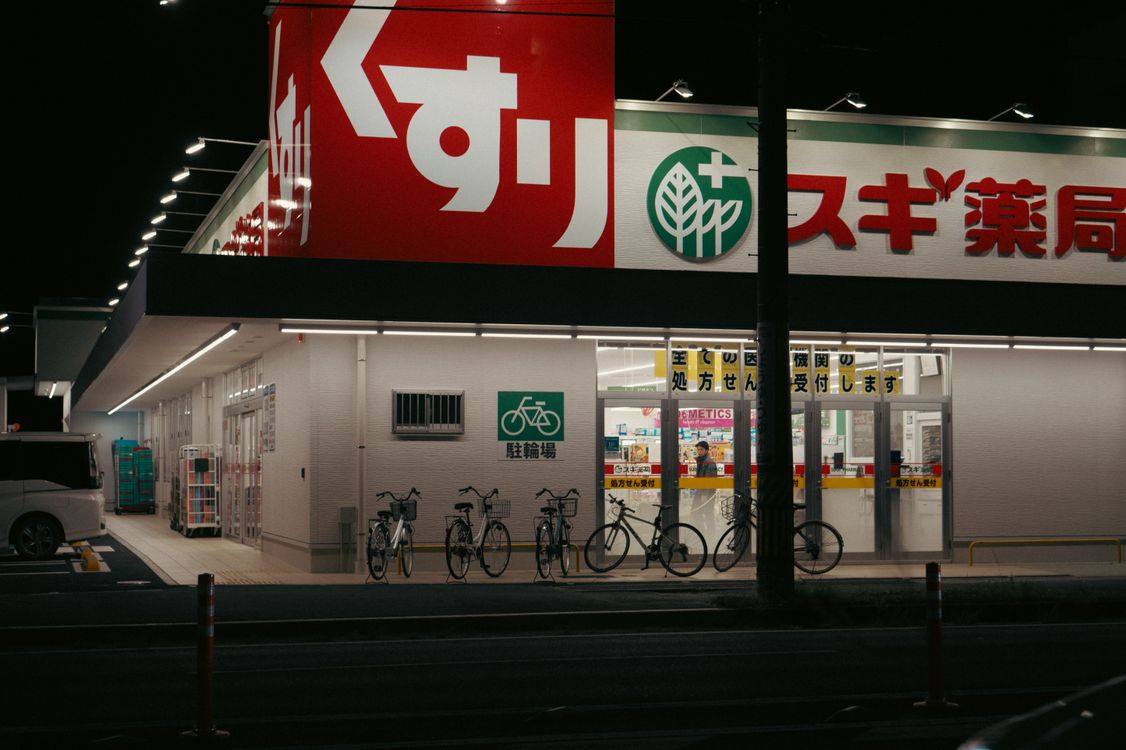
Japan's pharmacy network (調剤薬局 chozai yakkyoku) is dense and accessible — prescriptions are typically filled same-day at low cost under NHI. Photo: Tien Nguyen / Pexels
Senior Care Facilities: Types, Costs, and Waitlists
Understanding the facility landscape matters before you buy. The type of care available in your chosen municipality -- and how quickly you can access it -- varies significantly by location and budget.
特別養護老人ホーム (Tokubetsu Yogo Rojin Homu -- Public Nursing Homes)
Known colloquially as tokuyo, these government-subsidized facilities provide 24-hour care for residents assessed at Care Level 3 and above. They have no entrance fee and monthly costs of ¥80,000 to ¥140,000 -- among the most affordable permanent care options in the developed world. The kaigo hoken system covers the care component; residents pay income-adjusted room and board on top.
The catch: waiting lists of 2 to 5 years are typical in urban areas. The most recent national figures show over 500,000 people on tokuyo waiting lists across Japan. Foreign buyers should not assume rapid access to the lowest-cost public option. If you are planning to age in place and want a tokuyo as your fallback, begin investigating availability in your target municipality before you purchase.
介護付き有料老人ホーム (Kaigo Tsuki Yuryo Rojin Homu -- Private Care Homes)
Private facilities with round-the-clock care staff and nursing personnel. Single rooms are standard. Average entrance fees run around ¥5.74 million, though zero-deposit options are increasingly available (and more common in less expensive regions). Monthly fees average ¥231,000 to ¥289,000. The kaigo hoken insurance subsidy applies to the care portion; room and board are entirely out-of-pocket. Waitlists are short to none.
サービス付き高齢者向け住宅 (Saabisu Tsuki Koreisha Muke Jutaku -- Serviced Senior Housing)
Often abbreviated as saako-ju, these are private apartments with a minimum of daily safety-check and on-call support built in. More independent residents can live here with optional meal and care services added as needs grow. Deposits are typically low and refundable. Monthly costs range from ¥110,000 to ¥250,000, with a national average near ¥155,000, broken down roughly as: rent ¥65,000-70,000, service/common area fee ¥25,000-35,000, meals ¥35,000-45,000 if included, and utilities ¥10,000-15,000. When care services are needed, the standard kaigo hoken co-payment applies.
For buyers who want flexibility -- living independently now, with care infrastructure available when needed -- saako-ju represents a practical middle ground.
グループホーム (Group Homes -- Dementia-Specific Facilities)
Small residential settings (typically 9 to 18 residents) designed specifically for people with dementia. Admission requires a dementia diagnosis and Care Level 2 or above. Entrance fees are low to zero. Monthly fees run ¥100,000 to ¥150,000, with care costs covered by kaigo hoken at standard co-payment rates.
老人保健施設 (Rojin Hoken Shisetsu -- Rehabilitation Facilities / Roken)
Intermediate care settings for post-hospitalization recovery. Not designed for permanent residence -- the goal is return to home or lower-level care. Monthly fees of ¥80,000 to ¥120,000, heavily subsidized by kaigo hoken. Stays are typically limited to three months, with extension subject to reassessment.
In-Home Care
Many older residents in Japan remain at home far longer than in comparable countries, supported by visiting care workers, day service centers, and meal delivery. Kaigo hoken covers most of this. Monthly out-of-pocket costs for moderate in-home care packages typically run ¥30,000 to ¥100,000 depending on care level and service frequency.
The Visa Gap: Japan Has No Retirement Visa
This is the most important structural reality for foreign buyers to understand: Japan has no income-based retirement visa. Property ownership does not create residency rights. The scenarios that allow long-term legal residence are limited:
- Spouse or family visa: Married to a Japanese national or permanent resident
- Long-Term Resident visa: Primarily available to people of Japanese descent (日系人 nikkei-jin)
- Business Manager visa: Requires a minimum ¥5,000,000 investment in a Japan-registered company and active management involvement
- Permanent Residency (PR): Generally requires 10 years of continuous legal residence, reduced to 5 years with a Japanese spouse or 3 years as a highly-skilled professional
Many buyers begin with a shorter-term visa and build toward PR. Others use Cultural Activities visas for extended stays. What matters for healthcare planning is this: NHI and kaigo hoken eligibility are triggered by residency registration, not by visa type. Any valid long-stay visa combined with municipal registration unlocks both systems. But residency must be maintained continuously -- extended absences from Japan can interrupt both coverage and the residency clock toward PR.
Begin planning your visa pathway 2 to 5 years before your intended relocation date. For many buyers, this is the longest lead-time item in the entire pre-move checklist. For navigating the legal and residency elements of a Japan purchase, a licensed brokerage like Teritoru -- which specializes in supporting foreign buyers through the full transaction and residency process -- can help identify the right visa pathway alongside your property search.

Tokyo neighborhood life for older residents: walkable streets, local commerce within reach, and community structure that supports aging in place. Photo: 8Percent Media / Pexels
Where You Live Matters: Geographic Variation in Senior Services
Senior care infrastructure in Japan is uneven. Urban areas offer a much denser network of kaigo-certified facilities, more private facility options, shorter waits for intermediate care, and access to specialist hospitals. Rural areas face compounding pressures: a national care worker shortage (Japan estimates a gap of 1.7 million care workers, with rural areas disproportionately affected), older facility stock, and fewer private alternatives when public tokuyo waitlists are long.
For buyers specifically considering rural properties -- the akiya (空き家) market extends across every prefecture and every degree of urbanization -- the practical planning question is: what happens when care needs increase? Buying in a village two hours from a city hospital is a different lifestyle calculation at 62 than it is at 75.
Several cities stand out for foreign senior residents based on healthcare infrastructure, international community, and cost of living:
- Fukuoka: Consistently ranked Japan's most livable city for international residents. Strong hospital network, lower cost than Tokyo or Osaka, proximity to Korea, and a growing English-speaking professional community. Property prices remain reasonable.
- Kyoto: Excellent healthcare including Kyoto University Hospital's International Patient Support Center (JMIP-accredited, interpreters in 18 languages). High cultural quality of life. Property prices are rising but still below Tokyo.
- Sapporo: Modern city with good healthcare and lower cost of living than Honshu metros. Winters are harsh -- a relevant factor for mobility-limited seniors -- but the urban infrastructure is solid.
- Kanazawa: Strong local healthcare, high quality of life, scenic environment, and lower costs. Less international infrastructure, but manageable for residents with some Japanese.
A practical planning framework for rural buyers: the "two-stage" approach. Live in a rural property during active years, with a clear plan to transition toward a city when care needs increase. Identify your nearest JMIP-accredited hospital before you buy, and map the realistic transit time during winter, not just the best-case scenario.
English-Language Medical Support
Japan Medical Service Accreditation for International Patients (JMIP) is the most reliable indicator that a hospital meets foreign patient standards, including multilingual support. JMIP certification is granted by Japan's Ministry of Health, Labour and Welfare and should be the first thing to search when identifying your local medical infrastructure.
Key hospitals with established English support include:
- Tokyo: St. Luke's International Hospital (聖路加国際病院) in Chuo-ku -- JCI-accredited, full English support, NHI accepted. Tokyo Medical and Surgical Clinic (TMSC) in Minato-ku -- fully English-speaking physicians trained in the US, UK, and Australia.
- Osaka: Osaka Red Cross Hospital's International Medical Center -- NHI accepted. Osaka University Hospital has an international patient desk.
- Kyoto: Kyoto University Hospital (JMIP-accredited). Japan Baptist Hospital (バプテスト病院) in Sakyo-ku.
Outside these major cities, English-language medical capability drops sharply. At most rural clinics and district hospitals, English capability is limited or absent. The AMDA International Medical Information Center provides phone-based medical information in English, Chinese, Korean, Thai, Spanish, and Filipino -- a useful resource for foreigners navigating care in areas without English-speaking staff.
Budgeting for Healthcare Before You Relocate
Japanese government data shows couples aged 65 and over spend approximately ¥286,877 per month on average. Foreign retirees typically spend slightly more due to imported goods and English-language professional services.
Here is a practical framework for healthcare-specific budget items:
- NHI premiums (zero Japan income, 70% reduction): ¥20,000 to ¥50,000 per year
- NHI premiums (moderate pension or foreign income declared): ¥100,000 to ¥400,000 per year
- Standard co-payments (regular GP and specialist visits): ¥30,000 to ¥100,000 per year
- Kaigo hoken premiums (age 65+, average municipality): ¥72,000 to ¥96,000 per year
- Room and board at a care facility (not covered by kaigo hoken): ¥600,000 to ¥2,400,000 per year depending on facility type
The room-and-board exposure at care facilities is the largest variable in senior financial planning, and the one most commonly underestimated. Insurance covers the care services. What it does not cover is housing -- and in private care homes, that can cost ¥180,000 to ¥240,000 per year for accommodation alone, even after the care subsidy.
The recommended planning reserve cited across Japanese retirement planning resources is ¥20M to ¥50M (approximately $130,000 to $345,000 USD) in liquid savings beyond property acquisition costs. This is not a ceiling -- it is a floor, intended to cover the non-insured care costs over a multi-year horizon.
A Pre-Relocation Checklist for Buyers Over 55
- Confirm your visa pathway first. Property ownership does not establish residency. Identify your route to a long-stay visa 2 to 5 years before your target move date.
- Register your address within 14 days of arrival. This triggers NHI and kaigo hoken enrollment automatically.
- Declare your income -- even if zero -- at the municipal office. This is the step that unlocks the 70% NHI premium reduction.
- Apply for a My Number Card (マイナンバーカード). As of late 2025, this replaces the physical NHI card at clinics and hospitals. Apply at your ward office after registering your address.
- Research tokuyo waiting lists in your target municipality. Contact the municipal welfare office before purchasing. Waiting times vary enormously between cities.
- Identify your nearest JMIP-accredited hospital. Map the transit time realistically, including winter conditions if applicable.
- Check bilateral social security agreements. Japan has agreements with several countries (US, UK, Germany, Australia, and others) that prevent double-contribution to pension systems. These also affect whether you qualify for Japanese pension benefits after years of contribution.
- Budget separately for care facility room and board. This is the largest non-covered expense and the one that most commonly causes financial surprises.
- Plan for the two-stage scenario. Active years in your chosen location, with a clear plan -- including finances and facility research -- for when care needs increase.
Sources
- National Health Insurance for Foreigners in Japan: Complete Guide -- Kantenna (2026)
- Nursing and Elder Care Options in Japan for Foreigners -- Japan Living Life
- How to Retire in Japan as a Foreigner -- Japan Living Life
- Senior Care in Japan: Costs, Choices, and What Foreigners Should Know -- Navigator Japan
- Japan's Long-Term Care Insurance System -- PMC/NIH
- Senior Care Facility Costs 2025 -- LIFULL Kaigo
- High-Cost Medical Expense Benefit -- IBM Japan Health Insurance Association
- Skip Health Insurance in Japan? You Could Lose Your Visa (2027 Rule) -- Japan Today
- Japan Health Ministry Panel Agrees to Raise Medical Fee Caps -- The Japan Times (December 2025)
- Japan Elderly Care Guide for Expats -- Expat Focus


