The number that keeps circulating is $5,000 — roughly ¥750,000 at current exchange rates. And yes, there are residential properties in Japan listed at that price point and below. Hundreds of them exist across Japan. But acquisition cost and total cost of ownership are fundamentally different numbers. In this case, they are different by a factor of 4 to 17. That gap is where buyers either build remarkable value or make expensive mistakes. Here are the numbers.
The Supply Side: Why These Properties Exist
Japan currently has an estimated 9 million vacant houses (akiya, 空き家 (akiya)), and demographic projections suggest that number will keep climbing. The mechanics are straightforward: population decline plus urban migration equals a structural surplus of rural housing stock. In economic terms, supply vastly exceeds demand in specific geographic segments, driving prices toward zero.
These are not distressed sales in the North American sense. There is no foreclosure, no bank liquidation. These are legitimate properties with clear title deeds, offered through municipal akiya banks (空き家 (akiya)バンク (akiya bank)), licensed real estate agents, and aggregator platforms. The Japanese government actively subsidises their transfer as part of a national depopulation strategy.
The listings are real. The question is: what does the complete financial picture look like once you move past the sticker price?
Asset Profile: What ¥500,000 Buys
At the sub-¥1-million price point, the typical property profile looks like this:
- Construction era: 1960–1985. Many predate the 1981 revision to Japan's earthquake-resistance building code (shin-taishin kijun, 新耐震 (shin taishin)基準 (shin taishin kijun)) — a critical structural consideration.
- Location: Rural or semi-rural municipalities. Typically 30–60 minutes by car from the nearest city or rail station. Think mountain villages, agricultural communities, small coastal towns.
- Condition: Vacant for years, often decades. Deteriorated roofing, pest damage, overgrown exterior, interiors requiring full renovation.
- Floor area: Surprisingly generous — 80–150 sqm across 4–6 rooms, often with attached land of 200–1,000+ sqm.
- Construction type: Traditional Japanese timber frame — tatami rooms, sliding doors. Some qualify as kominka (古民家 (kominka), traditional farmhouses) with exposed beam construction and genuine historical character.
To put the land component in perspective: 500 sqm of land in rural Japan for under $5,000 works out to roughly $10 per square metre. In Montreal's suburbs, comparable land runs $150–$400 per square metre. The raw land value alone makes these properties interesting — but only if you budget correctly for everything that comes after the purchase.
Transaction Cost Analysis
Every property purchase in Japan triggers a set of unavoidable transaction costs. For sub-¥1-million properties, these costs often exceed the purchase price itself — a ratio that would be absurd in most markets but is standard here.
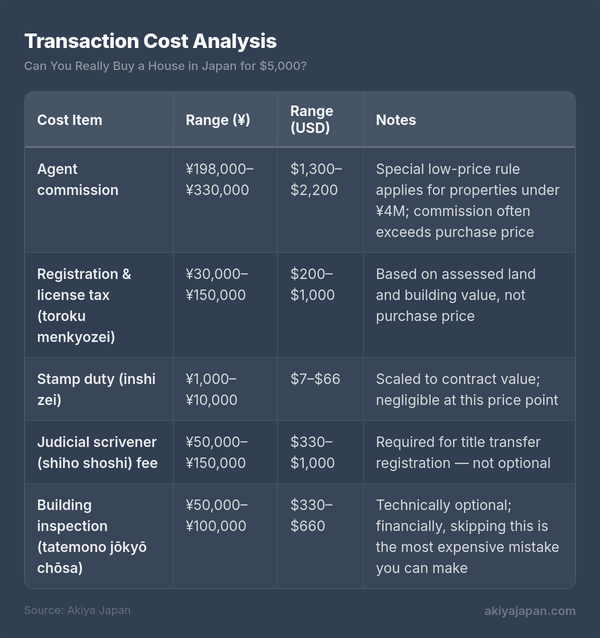
Transaction cost subtotal: ¥330,000–¥740,000 ($2,200–$4,900). On a ¥500,000 purchase, that is 66–148% of the acquisition price going to fees alone. In Canadian real estate, transaction costs run 1.5–4% of purchase price. The inverted ratio here catches many first-time buyers off guard.
Renovation Cost Breakdown
This is the largest line item in your budget — and the one most commonly underestimated. A property that has been vacant for a decade or more in Japan's humid, seismically active climate will need significant work. Here is what each major system typically costs:
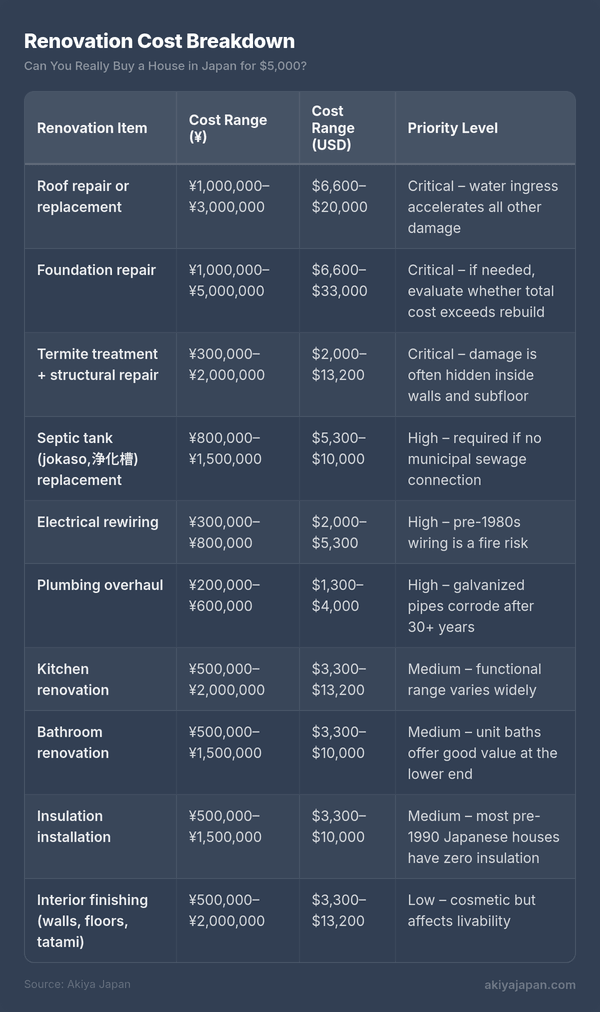
The numbers break into three tiers. A minimal renovation — making the property structurally safe and basically habitable — runs ¥3–5 million ($20,000–$33,000). A comfortable renovation with a modern kitchen, functioning bathroom, sound roof, and decent insulation lands at ¥6–10 million ($40,000–$66,000). A comprehensive, turnkey renovation pushes to ¥12–20 million ($80,000–$130,000+).
For comparison, a full gut renovation on a similar-age house in rural Quebec runs CAD $80,000–$200,000. Japanese renovation costs are broadly comparable per square metre, but labour availability in remote areas can push timelines — and therefore costs — higher than urban estimates suggest.
Annual Holding Costs
Acquisition and renovation are one-time expenses. Holding costs recur every year you own the property, whether you live in it or not. This is the number that determines long-term affordability.
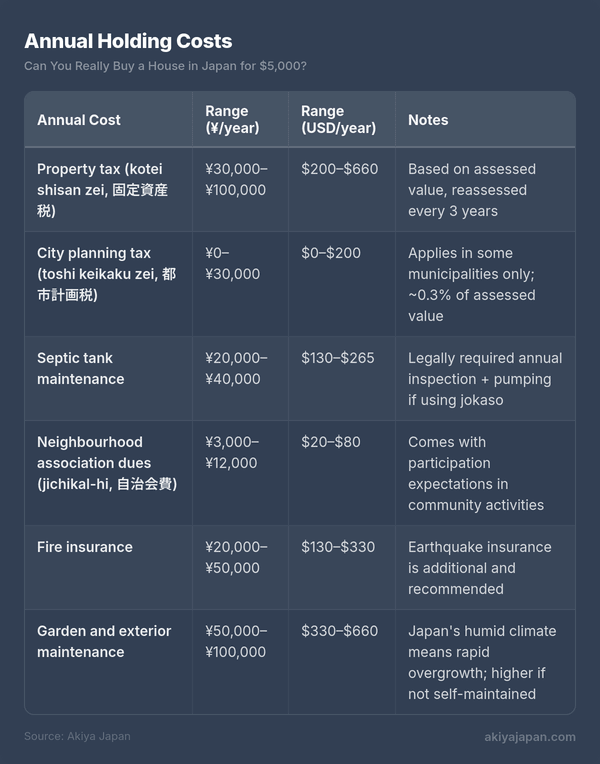
Annual holding cost: ¥150,000–¥330,000 ($1,000–$2,200)/year. Remarkably low by international standards — property taxes alone on a comparable rural property in Ontario or Quebec would run CAD $3,000–$6,000. But these costs are not zero, and they apply even to properties you bought for ¥0. Owners who abandon cheap akiya because they did not budget for holding costs are part of how these properties became vacant in the first place.
Five-Year Total Cost of Ownership
This is the number that actually matters. Acquisition price is a single data point. Total cost of ownership over your first five years tells you what you are genuinely committing to financially.
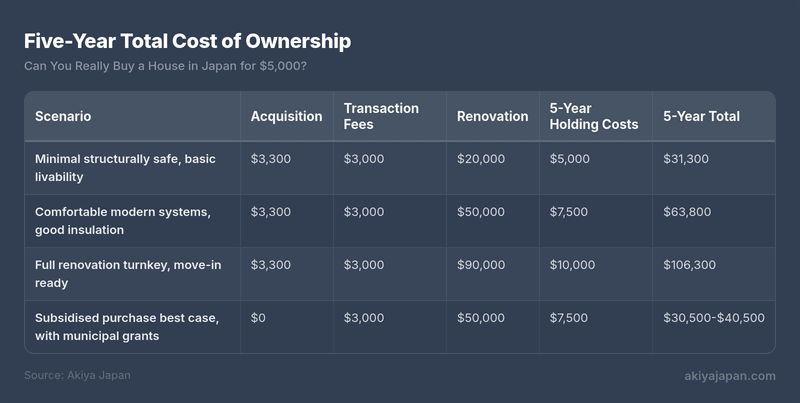
Look at the subsidised scenario closely. A fully renovated traditional Japanese house on a large rural plot, with five years of ownership costs included, for $30,000–$40,000. That is not a fantasy number — it is achievable if you target municipalities with strong incentive programmes and qualify for their grants. Even the full-renovation scenario at $106,000 over five years represents extraordinary value. A comparable property in most G7 countries would cost 5–10 times that amount.
The difference between a good outcome and a costly mistake is not the price tag. It is the quality of your due diligence and the accuracy of your budget.
Municipal Subsidies: The Variable That Changes Everything
This is the most underreported part of the akiya equation, and for most buyers, it's the single largest opportunity to reduce total cost. Many rural municipalities are not just allowing cheap property sales — they are actively funding them.
- Purchase subsidies: ¥500,000–¥2,000,000 toward acquisition. Some municipalities cover 100% of the purchase price for qualifying buyers.
- Renovation grants: ¥1,000,000–¥5,000,000 toward renovation costs, sometimes covering 50–75% of the total. This is where the real money is.
- Relocation incentives: Cash grants for families moving from urban to rural areas, structured as either lump sums or annual payments.
- Child-rearing bonuses: Additional grants for families with children — some municipalities offer ¥500,000+ per child.
The financial logic for municipalities is sound: a vacant house generates zero tax revenue, depresses neighbouring property values, and creates a maintenance liability. A subsidised sale generates property tax, consumption tax from renovation spending, and — if the buyer relocates — income tax revenue and community vitality. The subsidy often pays for itself within a few years in recovered tax revenue.
The conditions are important. Most programmes require you to reside in the property (not use it as a holiday home), commit to a minimum residency period (typically 5–10 years), and sometimes participate in community activities. Your agent or the municipal government office can identify which programmes you qualify for — this is one of the strongest arguments for working with a local agent who knows the specific incentive landscape in your target area.
Where to Source Sub-$5,000 Properties
The three primary acquisition channels, each with different trade-offs:
Municipal Akiya Banks (空き家 (akiya)バンク (akiya bank))
Government-operated databases listing vacant properties within each municipality's jurisdiction. These typically offer the lowest prices, including ¥0 properties, and often come with direct access to local subsidy programmes. The trade-off: listings are in Japanese, the process involves municipal bureaucracy, and response times can be slow.
Property Aggregators
Platforms like Akiya Japan consolidate listings from hundreds of Japanese sources into a searchable, English-language database. You can filter by price, prefecture, and property type across all 47 prefectures — significantly more efficient than searching individual akiya banks one municipality at a time.
Direct Agent Relationships
Some properties never reach public databases. A local real estate agent in your target area may know of unlisted akiya whose owners would sell for nominal amounts. This channel requires either Japanese language ability or a bilingual agent, but it can surface opportunities that aggregators and akiya banks miss entirely.
Due Diligence Checklist
Properties priced under ¥1 million are priced that way for specific reasons. Before committing capital, systematically verify each of the following areas. Skipping any one of these can turn a good deal into an expensive lesson.
Structural Assessment
Commission a professional building inspection (tatemono jōkyō chōsa, 建物状況調査). At ¥50,000–¥100,000, this is the highest-ROI expenditure in the entire process. The inspector should evaluate: foundation settlement and cracking, roof membrane condition and remaining life, termite damage to structural members (particularly sill plates and floor joists), and compliance with post-1981 seismic standards. If the building predates 1981 and has not been seismically retrofitted, factor ¥1–3 million for reinforcement into your budget.
Infrastructure and Access
- Road access: Verify year-round vehicle access. Some rural properties are reached only by narrow unpaved roads or footpaths. In snow regions, confirm winter accessibility and municipal snow-clearing coverage.
- Water supply: Municipal water, well, or spring? Each carries different reliability profiles, maintenance costs, and regulatory requirements.
- Sewage: Municipal connection, functional septic tank (jokaso), or something older? Upgrading from a pit toilet to a modern jokaso is one of the single most expensive items — budget ¥800,000–¥1,500,000.
- Electrical: Confirm grid connection and inspect the breaker panel. Pre-1980s wiring typically needs full replacement.
- Internet: Fibre optic coverage is surprisingly extensive in rural Japan, but some remote areas are limited to satellite or mobile connections. If you plan to work remotely, verify this before purchase.
Legal and Regulatory Status
- Land designation: Residential, agricultural (nochi, 農地), or forest? Agricultural land transfers require approval from the local Agricultural Commission (nōgyō iinkai, 農業委員会), adding time and uncertainty to the process.
- Building restrictions: Properties in urbanization control areas (shigaika chōsei kuiki, 市街化調整区域) face restrictions on rebuilding and expansion.
- Hazard designations: Review the municipal hazard map (hazādo mappu, ハザードマップ (hazādo mappu)) for landslide, flood, and tsunami risk zones. A property in a designated risk zone may be uninsurable or face future building restrictions.
- Boundary survey: Rural properties sometimes have poorly documented boundaries. A professional survey costs ¥200,000–¥500,000 but eliminates future disputes.
Hidden Liabilities
- Unpaid property taxes carried forward from previous owners
- Demolition obligations on deteriorated outbuildings
- Shared road or water infrastructure maintenance responsibilities
- Community participation obligations tied to the property
Each of these items has a quantifiable financial impact. The building inspection and a thorough conversation with the selling agent should surface most of them before you commit.
Frequently Asked Questions
Can foreigners buy property in Japan?
Yes. Japan imposes no restrictions on foreign property ownership. No visa, residency permit, or citizenship is required. The purchase process is identical for foreign and Japanese buyers. This is unusual among major economies — many countries in Asia and Europe restrict foreign land ownership in some form.
Are $5,000 houses in Japan a scam?
No. Sub-¥1-million properties are legitimate listings through licensed agents and government akiya banks. The low prices reflect property condition, rural location, and Japan's structural oversupply of vacant housing. The gap between headline price and actual cost is not a scam — it is a budgeting problem. Transaction fees, taxes, and renovation typically add $20,000–$90,000 to the acquisition price.
Can I buy a house in Japan for free?
Some municipalities offer properties at ¥0, but you still pay transaction fees (¥300,000+), annual property taxes, and renovation costs. "Free" refers to acquisition cost only — total cost of ownership is never zero.
Can I buy a house in Japan remotely without visiting?
Legally, yes — via power of attorney. Financially, it is the riskiest approach for properties in this price range, where hidden defects are most common. At an absolute minimum, have a licensed agent conduct a physical inspection, commission a building survey report, and provide a detailed video walkthrough. For more on the risks and risk mitigation strategies, see Can You Buy a House in Japan Without Visiting?
What are the cheapest prefectures for akiya?
The lowest acquisition prices cluster in depopulating rural prefectures: Akita, Yamagata, Shimane, Tottori, Kochi, Tokushima, and parts of Niigata and Nagano. But cheapest acquisition price does not equal lowest total cost of ownership. Factor in renovation costs, contractor availability, access to subsidies, and proximity to transportation infrastructure. A ¥500,000 house near a train line in Nagano may deliver better total value than a ¥0 house in a remote mountain village with limited contractor access.
Do I need to speak Japanese to buy property?
Not if you work with a bilingual agent. Legal documentation is in Japanese, but a licensed agent and judicial scrivener (shiho shoshi) handle the paperwork and registration process. For navigating municipal subsidy applications, coordinating with local contractors, and communicating with neighbourhood associations, Japanese ability is a significant advantage — or you need an agent who manages these interactions on your behalf.
Further Reading
- The Real Cost of Buying an Akiya — every fee, tax, and hidden cost broken down for accurate budgeting
- The Akiya Inspection Checklist — the systematic inspection process before committing to any property
- Can You Buy a House in Japan Without Visiting? — remote purchase risk assessment and mitigation strategies
- How to Read a Japanese Property Listing Like a Local — decoding Japanese listing terminology and identifying red flags
- The Foreigner’s Legal Toolkit — visas, residency requirements, and property ownership regulations
The Real Numbers
The $5,000 headline is technically accurate and financially misleading in equal measure. The acquisition price is real. The total cost of ownership — $20,000 to $106,000 over five years depending on renovation scope, holding costs, and subsidy eligibility — is the number you should be planning against.
But run those numbers against any comparable market and the value proposition remains compelling. A renovated traditional Japanese house with land, in a country with excellent infrastructure, universal healthcare, and one of the lowest crime rates in the world — for a fraction of what a modest condo costs in Montreal, Toronto, Sydney, or London. The buyers who build real value are the ones who treat this like any sound investment: thorough due diligence, realistic budgeting, professional support, and a clear understanding of the difference between price and cost.