Japanese property listings pack a lot of information into a format that can look impenetrable to foreign buyers. Every field, every abbreviation, and every seemingly minor notation carries meaning that Japanese buyers understand instinctively but foreign buyers often miss. This guide decodes the anatomy of a Japanese property listing, field by field, so you can evaluate properties with the same confidence as someone who grew up reading them.
Why Japanese Listings Look So Different
If you have ever browsed Suumo, Homes.co.jp, or an akiya bank website and felt overwhelmed, you are not alone. Japanese property listings follow a standardized format dictated by the Real Estate Transaction Act (宅地建物取引業 (takuchi tatemono torihiki-gyō)法), which requires agents to disclose specific details in a regulated format. This is actually a significant advantage for buyers: unlike many Western markets where agents can cherry-pick what to highlight, Japanese law mandates transparency on structural details, legal restrictions, and potential risks.
The typical listing is dense by design. Where an American or British listing might lead with lifestyle photography and flowery descriptions, a Japanese listing leads with data: exact measurements, legal classifications, construction details, and zoning information. Once you learn to read these fields, you will find that Japanese listings are structured transparency mandated by law, rather than marketing copy chosen by agents.
The listings also reflect a fundamental difference in how Japanese buyers evaluate property. In Japan, buildings are considered depreciating assets. A wooden house is typically valued at zero after 20 to 25 years regardless of condition. Land is where the enduring value lies. This is why land area, zoning, road access, and building rights receive so much attention in listing details.
Price: 価格 (Kakaku)
The first thing most buyers look at is the price, but Japanese price notation takes some getting used to.
Understanding 万円 (Man-en)
Japanese prices are expressed in units of 万 (man), which equals 10,000. So when you see a listing priced at 580万円, that means 580 times 10,000 yen, or 5,800,000 yen. For larger properties, you may encounter 億 (oku), which equals 100,000,000.
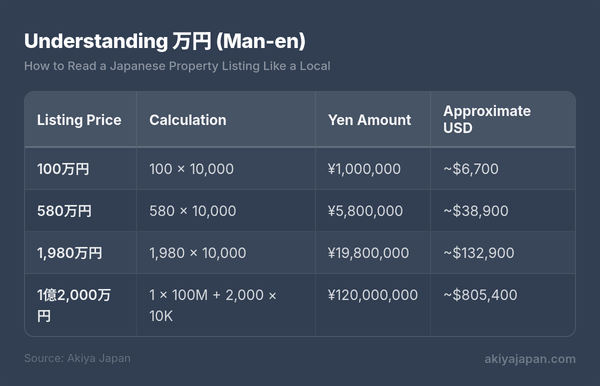
Quick mental conversion tip: At roughly 149 yen to the dollar, you can get a ballpark USD figure by dividing the yen amount by 150. For a 500万円 property: 5,000,000 ÷ 150 = about $33,300.
Price-Related Terms
- 応相談 (ou soudan) — "Price negotiable." The seller is flexible, or the property has been sitting unsold and the agent wants to gauge interest before committing to a number.
- 要相談 (you soudan) — "Contact for pricing." Sometimes used when the seller does not want to advertise a low price publicly.
- 価格変更 (kakaku henkou) — "Price changed." Often a sign the property has been reduced, indicating motivation to sell.
- 非公開 (hi koukai) — "Not disclosed." The price is available only on inquiry.
Floor Plan: 間取り (Madori)
The madori is one of the most distinctive features of Japanese listings. Instead of simply stating the number of bedrooms, Japanese listings use a letter-based notation system that tells you exactly what type of rooms the property has.
Decoding the Letters
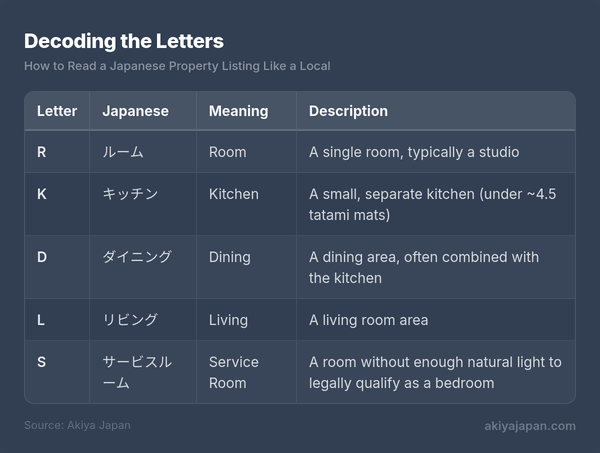
The number before the letters indicates private rooms (bedrooms or multipurpose rooms) separate from the kitchen, dining, and living areas.
Common Floor Plan Types
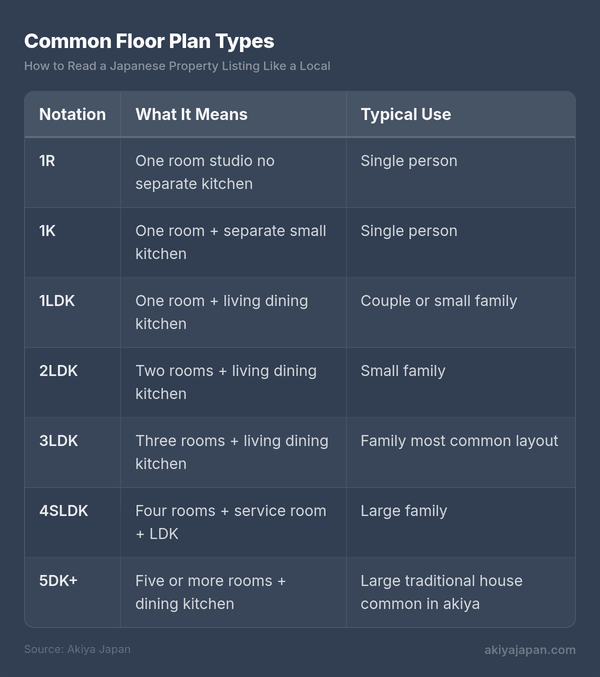
Key insight for akiya buyers: Many older houses are listed as 4DK or 5DK with no living room designation. This reflects the traditional Japanese layout where individual tatami rooms served multiple purposes. These layouts can actually be advantageous for renovation since the individual rooms can be opened up to create larger modern spaces.
The "S" designation is particularly important. A service room is functionally a bedroom in many cases, but because Japanese building codes require bedrooms to have windows meeting specific size requirements, rooms that fall short must be classified as service rooms. A 2SLDK may effectively function as a 3LDK but cannot be advertised as such.
Building Age: 築年数 (Chikunensuu)
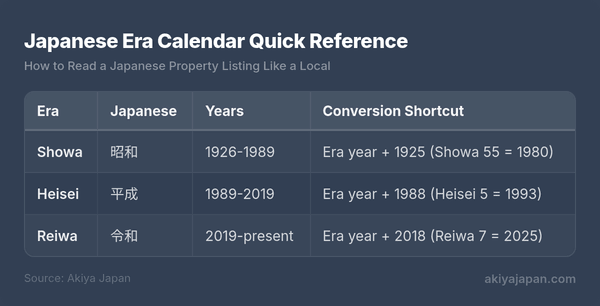
Building age is expressed as the year of construction, using either the Western calendar or the Japanese era calendar. You might see 築年月: 昭和55年 (1980) or simply 築45年 (45 years old).
The 1981 Earthquake Code Divide
One date matters more than any other in Japanese real estate: June 1981. This is when Japan implemented its New Earthquake Resistance Standards (新耐震 (shin taishin)基準 (shin taishin kijun)). Properties built before this date were constructed under the old code, designed to prevent collapse in a moderate earthquake but not necessarily a major one. The new code requires buildings to withstand a major earthquake (roughly magnitude 7+) without collapse.
- Post-1981 buildings generally meet modern seismic standards, though the code was further strengthened in 2000 for wooden houses.
- Pre-1981 buildings may need a seismic evaluation (耐震診断) and potentially retrofitting. Banks are often reluctant to finance pre-1981 structures.
- Pre-1971 buildings were built before even the intermediate code update and carry the highest structural risk.
Most akiya fall into the pre-1981 category. This does not automatically make them dangerous, but it affects financing, insurance, and renovation budgets. A seismic retrofit for a wooden house typically costs between 1 million and 3 million yen.
Japanese Era Calendar Quick Reference
Land and Building Area
土地 (tochi)面積 (Tochi Menseki) — Land Area
Land area is expressed in square meters (㎡), but you will also encounter the traditional unit 坪 (tsubo). One tsubo equals approximately 3.31 square meters, or roughly the area of two standard tatami mats (about 35.6 square feet).
In rural areas where akiya are common, land plots can be surprisingly large. A 200 tsubo (660 ㎡) lot is not unusual in the countryside, whereas 30 tsubo (100 ㎡) would be generous in suburban Tokyo.
Watch for: Some listings show land area two ways: 公簿 (koubo) is the area according to the official registry, while 実測 (jissoku) is actually surveyed. These sometimes differ, especially for older properties where boundaries have never been formally surveyed.
建物面積 (Tatemono Menseki) — Building Area
Building area refers to the total floor area across all stories, expressed in square meters. Two important ratios connect the building to the land:
- 建ぺい率 (kenpei ritsu) — Building coverage ratio. The maximum percentage of the lot that the building footprint can cover, typically 30% to 80% depending on zoning.
- 容積率 (youseki ritsu) — Floor area ratio. The maximum total floor area as a percentage of lot size. A 200% FAR on a 100 ㎡ lot means you can build up to 200 ㎡ of total floor space.
These ratios matter enormously if you plan to rebuild or expand. If an existing house already exceeds the current ratios (common with older properties built under different regulations), you may not be able to rebuild to the same size. This condition is known as 既存不適格 (kizon futekikaku) — "existing non-conforming."
Construction Type: 構造 (Kouzou)
The construction type tells you what the building is made of, which directly affects durability, earthquake resistance, and renovation possibilities.
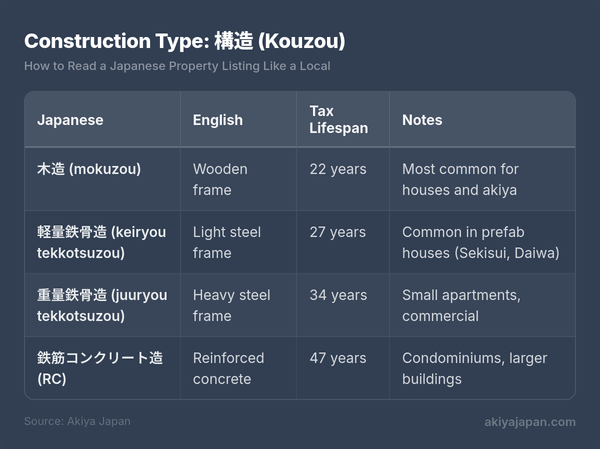
The "tax lifespan" is the statutory useful life for depreciation, not the actual lifespan. A well-maintained wooden house can last well over a century. However, because the tax system depreciates wooden houses to zero in about 22 years, this heavily influences market pricing.
For akiya, the vast majority will be 木造 (wooden frame). You may see additional descriptors: 在来工法 (zairai kouhou) means traditional post-and-beam construction (easier to renovate, walls can be moved), while 2×4工法 means Western-style 2x4 framing (walls are structural, harder to modify the layout).
Zoning: 用途地域 (Youto Chiiki)
Japan has 13 zoning classifications that control what can be built in each area. The most relevant for residential buyers:
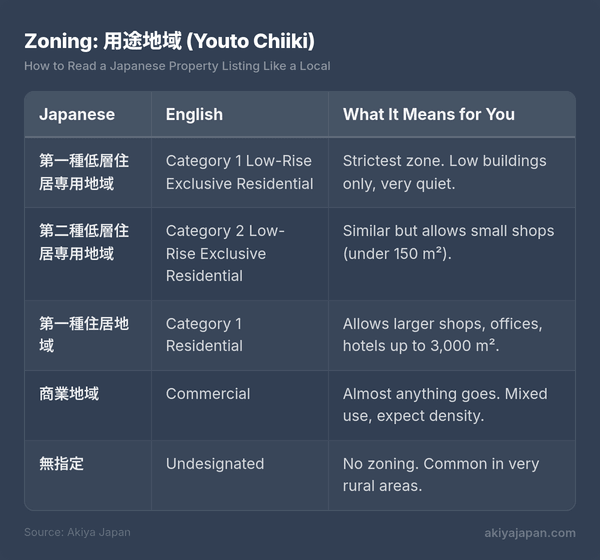
Why this matters: If you plan to convert a property into a guesthouse, cafe, or other business, the zoning must permit that use. A property in a Category 1 Low-Rise Exclusive Residential zone cannot legally operate as a hotel or restaurant. Check the zoning before you plan your renovation, not after.
Urban Planning Zone: 都市計画 (Toshi Keikaku)
Closely related to zoning but distinct from it, the urban planning designation tells you whether the area is slated for development or intentionally kept undeveloped.
- 市街化区域 (shigaika kuiki) — Urbanization Promotion Area. Development is encouraged, infrastructure is maintained, building permits are straightforward.
- 市街化調整区域 (shigaika chousei kuiki) — Urbanization Control Area. Development is actively restricted. New construction requires special permission and may be denied. You can often live in an existing house, but rebuilding or major expansion may be prohibited.
- 非線引き区域 (hi senbiki kuiki) — Undesignated Area. Neither promoted nor restricted. Rules are looser but infrastructure may be limited.
- 都市計画区域外 (toshi keikaku kuiki gai) — Outside City Planning Area. Very rural, minimal regulations but also minimal infrastructure.
The distinction between 市街化区域 and 市街化調整区域 is one of the most consequential details on any listing. A cheap property in an Urbanization Control Area may seem like a bargain, but if you cannot rebuild when the existing structure deteriorates, the long-term value proposition changes dramatically.
Road Access: 接道 (Setsudou)
Road access is not just about convenience in Japan. It is a legal requirement for building rights. Under the Building Standards Act, a property must front a road that is at least 4 meters wide for a length of at least 2 meters to qualify for new construction.
Listings typically describe road access with these details:
- 接道方向 (setsudou houkou) — Direction the road faces (north, south, east, west)
- 道路幅員 (douro fukuin) — Road width in meters
- 公道 (koudou) — Public road (maintained by municipality)
- 私道 (shidou) — Private road (maintained by owners, may involve shared access agreements)
Setback Requirements
If a property faces a road narrower than 4 meters, the owner may be required to set back (セットバック) the building line when rebuilding. The setback is measured from the road centerline to create an effective width of 4 meters. You lose usable land area and cannot build anything in the setback zone, including walls or fences.
The listing may state セットバック要 meaning a setback is required. On a narrow lot, losing even half a meter of depth can significantly impact what you can build.
Ownership Type: 権利 (Kenri)
- 所有権 (shoyuuken) — Freehold. You own the land and building outright. This is the most common and most desirable form of ownership.
- 借地権 (shakuchiken) — Leasehold. You own the building but lease the land. You pay ground rent (地代) and the lease has a fixed term, typically 30 to 50 years. Significantly cheaper but comes with restrictions on selling and rebuilding.
- 旧法借地権 (kyuuhou shakuchiken) — Old-law leasehold. Pre-1992, generally more favorable to tenants with stronger renewal rights.
- 定期借地権 (teiki shakuchiken) — Fixed-term leasehold. No automatic renewal. When the lease expires, you must remove the building and return the land.
For most akiya buyers, you want 所有権 (freehold). Leasehold arrangements add complexity and ongoing costs. However, they can represent value if the remaining lease term is long and ground rent is modest.
Reading Between the Lines
Condition and Sale Terms
- 現状渡し (genjou watashi) — "As-is delivery." The property will be handed over in its current condition. The seller will not make repairs, clean, or remove personal belongings. Extremely common with akiya.
- 古家付き土地 (furuya tsuki tochi) — "Land with old house." Legally classified as a land sale with an incidental structure valued at zero. The buyer is expected to demolish and rebuild or renovate. This classification sometimes results in lower property tax since the residential structure exemption still applies.
- 更地渡し (sarachi watashi) — "Vacant lot delivery." The seller will demolish existing structures before handover. Be aware that removing the house can increase property tax by up to six times since the residential land tax reduction no longer applies.
- リフォーム済み (rifoomu zumi) — "Renovated." The scope varies wildly, from new wallpaper to a complete structural overhaul. Always ask exactly what was done.
- 即入居可 (soku nyuukyo ka) — "Immediate move-in possible." The property is in livable condition and vacant.
- 残置物 (zanchibutsu) — Remaining personal belongings. Many akiya still contain the previous owner's possessions. Disposal is typically the buyer's responsibility and can cost 200,000 to 500,000 yen.
Seller and Agency Terms
- 売主 (urinushi) — The seller is listed directly (no agent intermediary). May mean lower transaction costs but less professional support.
- 専任媒介 (sennin baikai) — "Exclusive agency agreement." One agent has the exclusive right to sell, often indicating a serious seller.
- 一般媒介 (ippan baikai) — "Open listing." Multiple agents can market the property. Sometimes indicates the property has been on the market for a while.
Red Flags to Watch For
Some listing details should trigger immediate caution. These are not necessarily deal-breakers, but they require careful investigation.
再建築不可 (Saiken Chiku Fuka) — Cannot Rebuild
This is arguably the most important red flag on any listing. It means the property does not meet current building code requirements for new construction, usually because it lacks proper road access. You can live in the existing house and perform interior renovations, but if the building is damaged beyond repair, you cannot get a building permit to rebuild.
Properties marked 再建築不可 are dramatically cheaper for good reason. They can still make sense if the existing structure is sound and you plan only interior renovations, but you must understand the limitations.
事故物件 (Jiko Bukken) — Incident Property
Japanese law requires disclosure of "psychological defects" (心理的瑕疵). A property where someone died under unnatural circumstances (suicide, murder, unattended death) must be disclosed. These properties are typically priced 20% to 50% below market value. Many foreign buyers are less concerned about this than Japanese buyers, but be aware the stigma can affect future resale value. The website Oshimaland (大島てる) maintains a public database of incident properties.
Other Warning Signs
- 接道なし (setsudou nashi) — No road frontage. Cannot rebuild, may be difficult to access.
- 崖条例 (gake jourei) — Cliff ordinance applies. Near a steep slope with additional restrictions.
- 土砂災害警戒区域 (dosha saigai keikai kuiki) — Landslide warning zone. Building may be restricted, insurance may be expensive.
- 浸水想定区域 (shinsui soutei kuiki) — Flood zone. Check the depth classification carefully.
- 告知事項あり (kokuchi jikou ari) — "There are disclosure items." A general warning flag. Always ask specifically what the items are.
- 建築条件付き (kenchiku jouken tsuki) — "Building conditions attached." You must use a specific builder designated by the seller.
Utilities and Infrastructure
For rural properties especially, utility availability is not guaranteed. Key terms to look for:
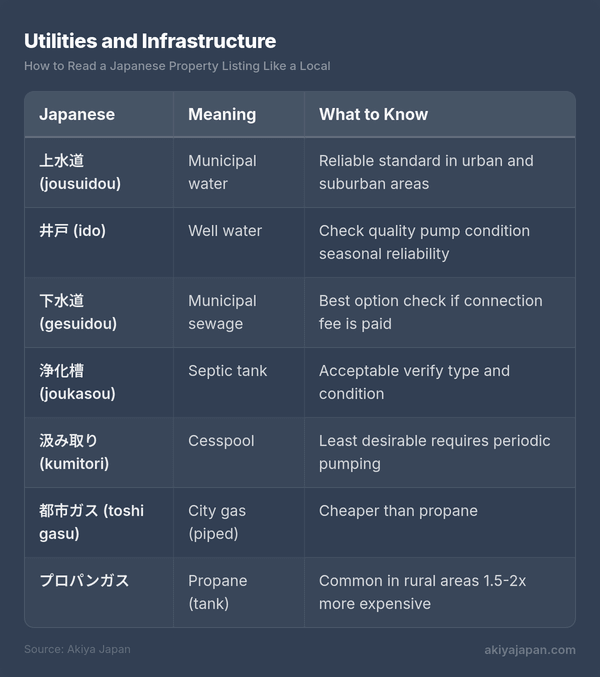
The sewage situation is one of the most important practical details for akiya. A property with 汲み取り (cesspool) sewage will require regular pump-outs. Upgrading to a septic tank can cost 800,000 to 1,500,000 yen, though some municipalities offer generous subsidies.
What Listing Photos Show (and Do Not Show)
Japanese listing photography follows its own conventions that differ from Western real estate photography.
What you will typically see: Exterior shots from multiple angles, often including close-ups of damage or aging. Room-by-room interior photos shot with a standard lens (rooms look smaller than they actually are, the opposite of Western wide-angle techniques). The bathroom, toilet, and kitchen are almost always photographed in detail as they are considered key decision factors.
What you will often not see: Ceiling and roof condition (water stains and sagging are common but rarely photographed). Foundation and underfloor areas. Neighboring properties and their condition. The road and access route, especially if narrow or steep. Interior of storage areas and closets, where mold and pest damage often hide.
A good rule of thumb: if a listing has very few photos for a very cheap property, assume the worst about anything not shown. Conversely, many detailed photos (even showing damage) often indicate a more forthcoming seller.
Using Google Translate on Listing Pages
Google Translate has become an indispensable tool for foreign buyers. Use Chrome's built-in webpage translation rather than copying text, as it preserves page layout and lets you hover to see the original Japanese. Be cautious with numbers, as translation tools sometimes mangle Japanese number formatting. Always verify prices, areas, and dates against the original text.
Common Mistranslation Pitfalls
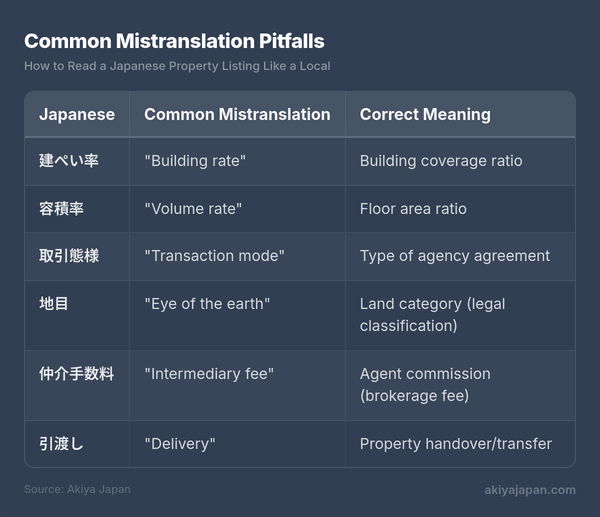
For scanning physical documents at a real estate office, the Google Translate app's camera mode works well with Japanese text, overlaying translations in real time. This is particularly useful for the detailed property specification sheet (重要事項説明書 (jūyō jikō setsumei-sho)) that you receive before purchase.
Putting It All Together: A Sample Listing Decoded
Here is what a typical akiya listing's key fields look like and what they tell you at a glance:
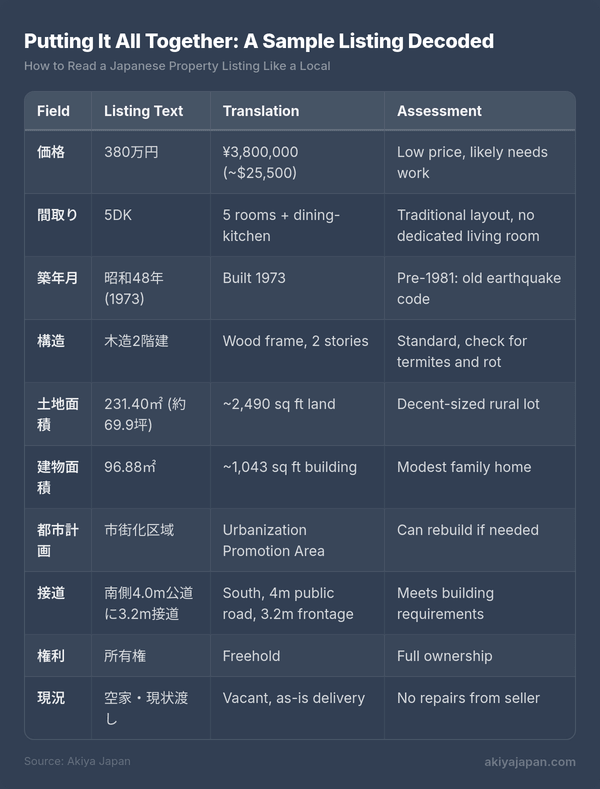
This listing paints a clear picture: an older but rebuildable wooden house on a decent lot, in a developed area with proper road access, sold as-is at a price reflecting its age and condition. The pre-1981 construction flags seismic evaluation as a priority, and the as-is condition means you need to budget for renovation. But the fundamentals are sound: freehold ownership, proper road frontage, urbanization zone, and municipal water.
Additional Terms Worth Knowing
- 管理費 (kanrihi) — Monthly management fee, applies to condominiums.
- 修繕積立金 (shuuzen tsumitatekin) — Building repair reserve fund (condominiums). Low reserves signal deferred maintenance.
- 固定資産税 (kotei shisanzei) — Annual property tax. Some listings include the amount, previewing your ongoing costs.
- 地目 (chimoku) — Land category: 宅地 (residential), 田 (rice paddy), 畑 (farmland), 山林 (forest). Agricultural land has purchase restrictions for non-farmers.
- 私道負担 (shidou futan) — Private road burden. You must maintain a portion of a shared road but cannot build on it.
- 瑕疵担保責任免責 (kashi tanpo sekinin menseki) — Defect warranty waived. Common for akiya sold as-is; the seller is not liable for hidden defects.
Your Listing-Reading Checklist
When evaluating any Japanese property listing, run through these questions in order:
- Can I rebuild? Check for 再建築不可 and verify road access meets the 4m/2m requirement. Check the urban planning zone.
- When was it built? Pre-1981 means old earthquake code. Factor in seismic evaluation and potential retrofit costs.
- What do I actually own? Confirm 所有権 (freehold). If leasehold, understand the terms, remaining duration, and ground rent.
- What can I do with the property? Check zoning against your intended use, especially for business conversions.
- What are the ongoing costs? Look for property tax figures, management fees, and infrastructure costs (propane vs city gas, septic vs sewer).
- What is not being shown? Assess photo quality and quantity. Plan an in-person inspection for anything undocumented.
- Are there any disclosure items? Look for 告知事項あり or hazard zone designations.
With this knowledge, you can approach Japanese property listings as what they are: detailed, legally mandated documents that reveal far more about a property than most listings elsewhere. You just need to know where to look.