Buying property in Japan as a foreigner is exciting — but the growing popularity of akiya (vacant houses) has attracted services that don't always have your best interests at heart. Here's how to protect yourself.
Japan's akiya market has attracted enormous international interest. With it, a cottage industry of English-language services has emerged — some useful, others designed to profit from the information gap between Japanese and foreign buyers.
Red Flag #1: Excessive Referral Fees
Some services charge $4,000–$10,000 USD just to connect you with an English-speaking real estate agent in Japan. This is on top of the agent's own commission, which you'll still have to pay.
To put this in perspective: the maximum commission a Japanese real estate agent can legally charge on a cheap property (under ¥8 million) is approximately ¥330,000 — about $2,200 USD. If a middleman is charging you more than the actual licensed agent, that should raise serious questions about what you're paying for.
How to avoid it
- Ask upfront what fees apply — a legitimate service will be transparent about costs before you commit.
- Understand the commission structure — in Japan, the buyer's agent commission is capped at 3% + ¥60,000 + tax for properties over ¥4 million, with a minimum of about ¥330,000 for cheaper properties.
- Find agents directly — networks like RE/MAX Japan have English-speaking agents across the country. You don't need a middleman.
- Use a search platform, not a broker — search platforms charge a small monthly subscription for search tools, not thousands in referral fees.
Red Flag #2: Paywalling Public Information
Japanese property listings on sites like At Home (athome.co.jp), Suumo (suumo.jp), and Homes.co.jp are free and publicly accessible. No one owns this information.
Some English-language services scrape these listings, translate them, and put them behind a paywall — blocking access to the original Japanese listing link unless you pay. The information itself is freely available; what you're being charged for is the convenience of having it in English.
What to look for
- Does the service link to the original Japanese listing? A transparent platform will always show you where the listing came from. If the source link is hidden or only available to paying members, ask why.
- What are you actually paying for? There's genuine value in search tools, translation, alerts, and map-based search. There's less value in simply gatekeeping a URL.
- Can you verify the listing yourself? Use Google's image search (Google Lens) — take any property photo and search for it. You'll often find the original Japanese listing in seconds.
At Akiya Japan, every property page includes a direct link to the original Japanese listing — free for all users, no subscription required. Our subscription pays for the search tools: interactive map, AI-powered English descriptions, automated alerts, and saved searches.
Red Flag #3: Outdated or Inaccurate Listings
Any site aggregating Japanese property data will have some listings that are already sold or have changed in price. The Japanese market moves fast, and even Japanese portal sites aren't always current.
How to protect yourself
- Always verify with the listing agent — never assume a property is still available based on any website alone, including Japanese portals.
- Check when the listing was last updated — reputable platforms show this information.
- Be skeptical of "too good to be true" prices — an unusually cheap property in a city centre often means it's a leasehold (借地権 (shakuchiken)), has death history (事故物件 (jiko bukken)), or requires significant renovation.
- Request a fresh availability check — Akiya Japan lets you check availability directly from the property page.
Red Flag #4: No Real Estate Licence
In Japan, anyone acting as a real estate intermediary must hold a 宅地建物取引業 (takuchi tatemono torihiki gyō) licence. This licence number should be displayed on their website, typically in the footer.
What to check
- Look for the licence number — it's usually formatted as 〇〇知事(X)第XXXXX号 or 国土交通大臣(X)第XXXXX号.
- Understand the difference between a search platform and an agent — search platforms (like Akiya Japan) aggregate and translate listings. They don't need a real estate licence because they're not brokering transactions. Agents who help you buy do need one.
- Verify through the official registry — you can check licence numbers on the Ministry of Land's official registry.
Red Flag #5: Pressure to Act Fast
Legitimate properties don't disappear overnight. While the market does move — particularly for well-priced rural properties — any service pressuring you to pay immediately or "lock in" a property before you've done due diligence is a red flag.
Take your time
- Visit the property in person if at all possible — photos don't show structural issues, neighbourhood noise, or access problems.
- Get a professional inspection — building inspections (インスペクション) cost ¥50,000–100,000 and can save you millions in unexpected repairs.
- Consult a judicial scrivener (司法書士 (shihō shoshi)) — they handle title transfer and can verify there are no liens, inheritance disputes, or boundary issues.
What Legitimate Costs Look Like
Here's what you should expect to pay when buying property in Japan:
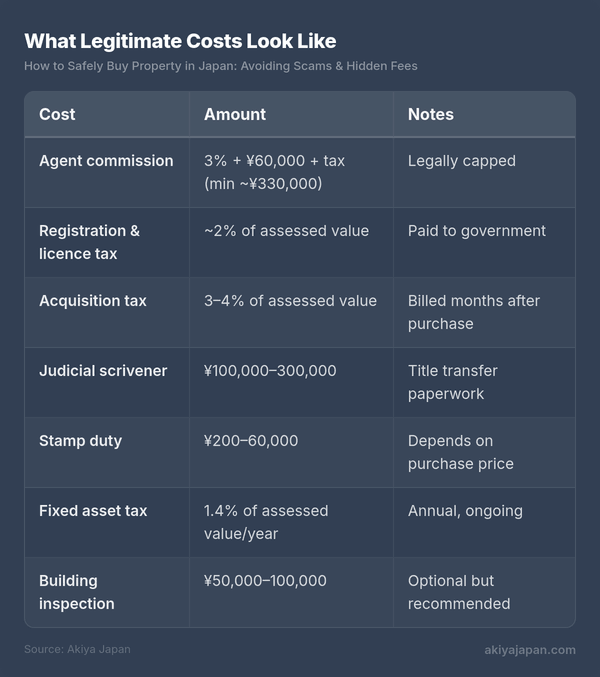
Total closing costs are typically 6–8% of the purchase price. Any service charging you fees significantly beyond this breakdown deserves scrutiny.
How Akiya Japan Is Different
We built Akiya Japan in 2020 as a search engine for Japanese property. Here's what that means in practice:
- No referral fees — our subscription starts at $5/month. That's it. No per-property charges, no finder's fees, no transaction cuts.
- Original listing links on every property — free for all users, not locked behind a paywall.
- Transparent about our data sources — we aggregate from hundreds of Japanese sources across all 47 prefectures.
- Availability checking built in — verify any listing's status directly from the property page.
- Trusted partner for purchases — when you're ready to buy, we recommend Teritoru, a licensed Japanese real estate agency with experience helping international buyers. But you're free to use any agent.
We believe the best way to earn trust is to be transparent. If you have questions about how we operate, get in touch — we're happy to explain.