Can you buy a house in Japan without ever setting foot in the country? Yes — and plenty of people have done exactly that. But roughly half of remote buyers end up owning something they'd never have touched if they'd spent twenty minutes inside it.
Yes, It's Legally Possible
No Japanese law requires foreign buyers to physically visit a property before purchasing. You can grant power of attorney to a representative, sign documents via international courier, and complete everything remotely. No visa or residency needed to own property here.
Some services market this as a selling point — frictionless, streamlined, keys-in-your-inbox-in-90-days. And for a narrow set of buyers purchasing well-documented properties through trusted agents with proper inspection reports, it can work fine.
The problem is that the properties most aggressively marketed for remote purchase tend to be the ones needing the most scrutiny, not the least.
What the Camera Never Captures
Japanese property listings — especially akiya (vacant houses) — are exercises in selective photography. A review of thousands of akiya listings reveals a consistent pattern.
Structural Damage
Termite damage is endemic in Japanese wooden construction, particularly pre-1980s builds before modern treatment standards became widespread. That charming exposed beam in the listing photo? Could be pristine. Could be laced with shiroari (白蟻 (shiroari)) galleries and structurally compromised. You cannot tell from a photograph. Inspectors routinely push their thumbs through beams that looked solid in pictures. Foundation cracks, roof beam deflection, soft spots in flooring — invisible on screen, potentially millions of yen to address.
Mould and Moisture
Japan's humid subtropical climate, particularly during tsuyu (梅雨 (tsuyu), rainy season) from June through July, is brutal on unoccupied buildings. A house vacant for years without ventilation has almost certainly developed mould problems no photograph will reveal. The smell alone would change your mind about many listings. There are akiya where moisture has warped every interior door off its frame — something the listing showed as "traditional character."
The Surrounding Environment
Listings show the property. They don't show the steep, unpaved access road that becomes impassable after snowfall. Or the adjacent abandoned house actively collapsing. Or the wild boar warnings posted at the neighbourhood entrance. Or that the nearest convenience store is a 30-minute drive. Or the designated landslide hazard zone (doshasaigai keikai kuiki) the property sits in. Or the jokaso (浄化槽 (jōkasō)) septic tank requiring regular paid maintenance — assuming there's modern sewage at all.
Legal and Zoning Surprises
Some properties sit on agricultural land (nochi, 農地) requiring special permission from the Agricultural Commission to transfer to a non-farmer. Others fall within urbanisation control areas (shigaika choseiku kuiki) where rebuilding or major renovation is restricted. Boundary surveys may be decades old and wildly inaccurate. These aren't edge cases. In the akiya market, they're Tuesday.
The Renovation Cost Trap
This is where remote buying gets genuinely dangerous. Renovation and transaction costs in Japan routinely exceed the purchase price by 10 to 50 times for cheap akiya. Read that again.
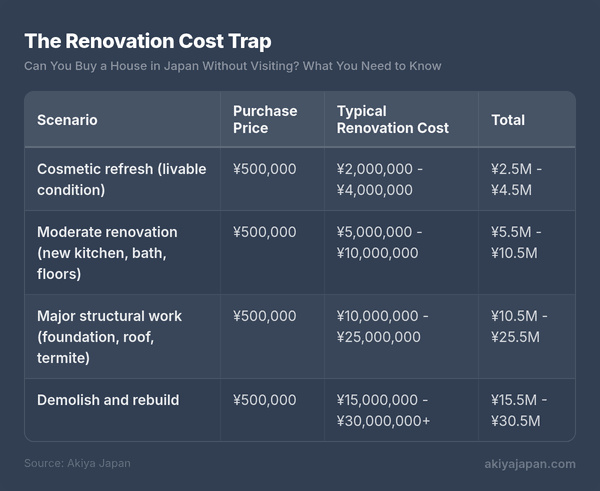
Without an in-person inspection — or at bare minimum a professional building inspection report (tatemono jōkyō chōsa, 建物状況調査) — you're placing a blind bet on which row your property lands in. The spread between ¥3 million and ¥25 million is not something listing photos can resolve.
Community Obligations You Won't Find Online
Rural Japan runs on a system of community participation with no real Western equivalent. Buy a house in a rural area and you inherit social obligations alongside the deed:
- Neighbourhood association dues (jichikai-hi, 自治会 (jichikai)費) — typically ¥3,000–¥12,000 per year
- Community clean-up days (soji, 掃除) — expected participation several times annually
- Shared infrastructure maintenance — some communities require participation in maintaining shared water sources, roads, or drainage channels
- Fire brigade or disaster preparedness duties — in some areas, property owners are expected to participate
None of this appears in listings. If you're buying remotely with no plans to be present, these obligations don't vanish — they create friction with your new neighbours. It has soured relationships before a buyer even visits for the first time.
What "90 Days to Ownership" Actually Looks Like
Speed isn't inherently bad. Speed without due diligence is.
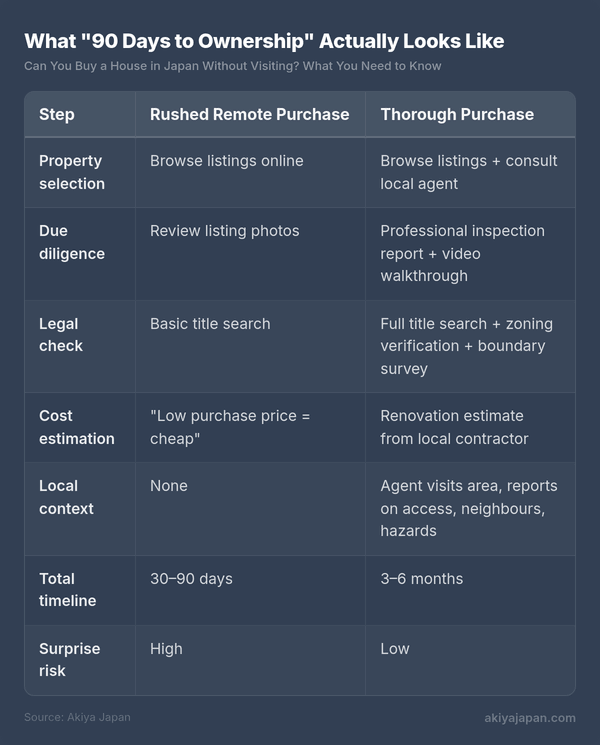
Those extra months aren't wasted. They're the difference between a sound investment and a costly mistake.
If You Genuinely Cannot Visit: Six Ways to Protect Yourself
1. Hire a Licensed Agent Who Works for You
Not every intermediary is on your side. A licensed Japanese real estate agent (takkenshi, 宅建士 (takkenshi)) has legal disclosure obligations including mandatory reporting of known defects. Find one who'll physically visit properties, shoot comprehensive photos and video, and tell you reasons not to buy. Be wary of anyone who only shows you the upside.
2. Get a Professional Building Inspection
A tatemono jōkyō chōsa (建物状況調査) runs ¥50,000–¥100,000 and covers foundation, structure, roof, plumbing, and electrical. Cheap insurance against a multi-million yen surprise. Since April 2018, agents must legally inform buyers whether an inspection has been conducted. If one hasn't — request one before proceeding. Non-negotiable.
3. Request a Live Video Walkthrough
Not a polished marketing clip. A real-time video call where your agent opens closets, checks under floors, walks the access road, and lets you interrupt with questions. Thirty minutes of unscripted video reveals problems that 50 curated listing photos would hide.
4. Get a Renovation Estimate Before Signing
Have your agent arrange a visit from a local contractor (kōmuten, 工務店) for a rough renovation estimate. Even a ballpark figure narrows your risk enormously. If the property is too remote or damaged for a contractor to quote without extensive investigation, that's telling you something.
5. Research the Municipality
Many municipalities offer akiya purchase subsidies, renovation grants, and relocation incentives. Others have strict requirements or limited services. Your agent or a judicial scrivener (shihō shoshi, 司法書士 (shihō shoshi)) can verify zoning, hazard designations, and available support programmes.
6. Budget for the Worst Case
Your mental budget should be: purchase price + agent fees + taxes + renovation at the upper end of estimates + 20% contingency. If that total still makes financial sense, proceed. If you need a best-case renovation to make the numbers work, walk away.
Frequently Asked Questions
Can foreigners buy property in Japan without visiting?
Yes, it is legally possible. Foreigners do not need a visa or residency to own property in Japan, and the entire transaction can be completed remotely via power of attorney. However, buying without an in-person visit or professional inspection significantly increases your risk of hidden structural damage, mold, pest infestations, and unexpected renovation costs.
Is it safe to buy an akiya sight unseen?
It is risky. Akiya listing photos are often selective and cannot show termite damage, mold, foundation cracks, access road conditions, or neighborhood hazards. Renovation costs can exceed the purchase price by 10 to 50 times. If you cannot visit, at minimum get a professional building inspection report, a live video walkthrough with a licensed agent, and a renovation estimate from a local contractor.
How long does it take to buy a house in Japan remotely?
A rushed remote purchase can be completed in 30 to 90 days. However, a thorough purchase with proper due diligence — including professional inspection, legal checks, zoning verification, and renovation estimates — typically takes 3 to 6 months. The extra time significantly reduces your risk of expensive surprises.
What are the hidden costs of buying an akiya?
Beyond the purchase price, expect agent commission (up to ¥330,000 for properties under ¥4 million), registration and stamp taxes, judicial scrivener fees, and potentially ¥2–25 million or more in renovation costs depending on condition. Community association dues, septic tank maintenance, and property taxes are ongoing costs. Budget at least 2–3x the purchase price for renovations as a baseline.
Do I need a real estate agent to buy property in Japan?
While not legally required, working with a licensed Japanese real estate agent (takkenshi, 宅建士 (takkenshi)) is strongly recommended, especially for remote buyers. Agents have legal disclosure obligations, can physically inspect properties, verify zoning and title, and navigate Japanese-language paperwork.
What should I check before buying an akiya remotely?
At minimum: get a professional building inspection report covering foundation, structure, roof, plumbing and electrical; request a live video walkthrough; verify zoning and land designation; obtain a renovation estimate from a local contractor; check for hazard zone designations; and confirm road access, utility connections, and community obligations.
Further Reading
- The Real Cost of Buying an Akiya — every fee, tax, and hidden cost broken down so you can budget accurately
- The Akiya Inspection Checklist — exactly what to check (or have your agent check) before committing
- How to Read a Japanese Property Listing Like a Local — decode the terminology, red flags, and hidden details in Japanese listings
- How to Safely Buy Property in Japan: Avoiding Scams & Hidden Fees — protect yourself from common fraud patterns targeting foreign buyers
- The Foreigner’s Legal Toolkit — visas, residency requirements, and what you legally need to own property in Japan
The Bottom Line
A ¥200,000 return flight to Japan is the cheapest due diligence in real estate. You'll walk through the property, smell the mould (or not), meet the neighbours, drive the access road, and understand the neighbourhood in ways no screen can replicate.
If visiting genuinely isn't possible, remote buying can be done responsibly — with the right agent, proper inspections, honest budgeting, and the discipline to walk away when the numbers don't work. The platforms promising easy, fast, remote purchases are optimising for their conversion rate. Not your outcome.