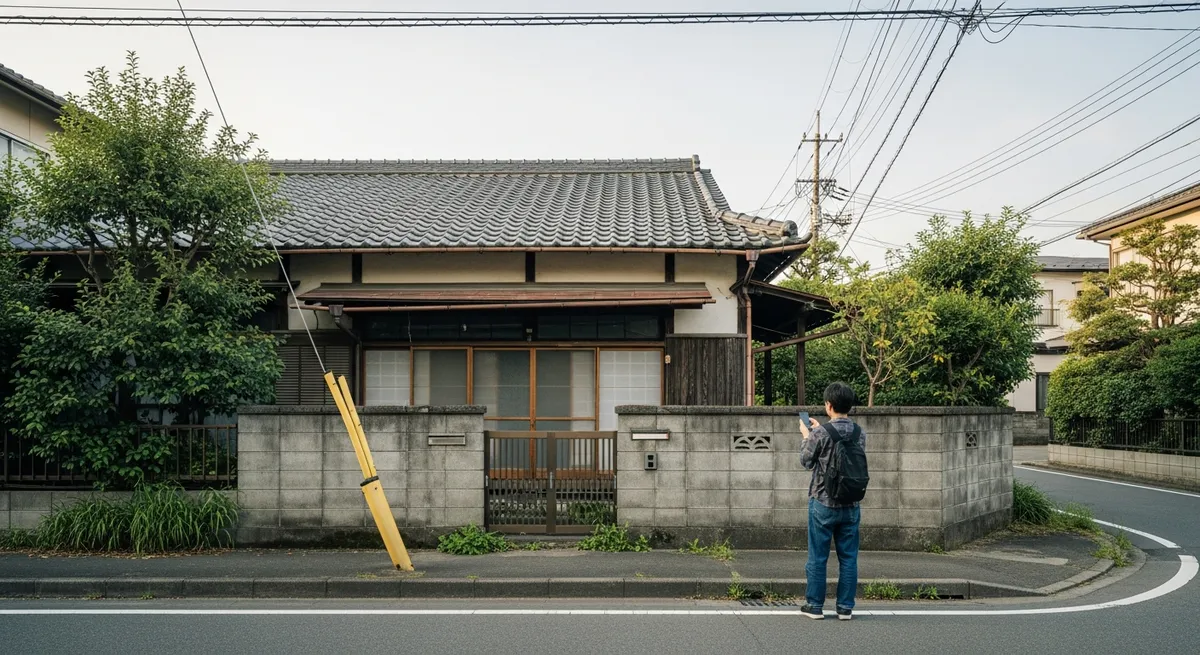
The short answer is yes, but not the way the headlines make it sound. A handful of Japanese towns do hand over houses for ¥0. Most of the country's 9 million empty homes are not free and never will be. Qualifying for one of the free ones takes more than filling out a form, and "free" still comes with real costs once you own the place.
Where the "free houses" story comes from
Japan has 9.002 million vacant homes, per the Ministry of Land, Infrastructure, Transport and Tourism's (MLIT) October 2023 housing survey, which puts the nationwide vacancy rate at 13.8%. About 3.86 million of those fit a narrower category -- not for sale, not for rent, not a second home, just sitting empty (5.9% of all dwellings). That's the number behind every "Japan has a ghost house problem" headline you've seen.
A separate idea gets mixed into the free-house stories. 空き家 (akiya, meaning "empty house") is just the Japanese word for any vacant property. It does not mean free, abandoned, or government-owned. Most akiya are privately owned, often by an heir who inherited a parent's house and has no use for it. The "free" part is a much smaller story sitting inside that bigger one.
So is any of it free?
Yes. Roughly 1,155 municipalities now take part in the national akiya bank (空き家バンク, akiya banku) system, a directory where local governments list vacant homes submitted by their owners. About 750 of those towns currently have live listings, totaling close to 20,000 entries nationwide according to MLIT's most recent count. That figure already folds in some overlap between the two private listing services MLIT aggregates, so treat it as directional rather than an exact inventory. A small slice of that total, concentrated in towns actively trying to stop their population from shrinking further, is priced at literally ¥0.
Okutama, a mountain town two hours from central Tokyo by train, runs two separate programs. Its standard akiya bank has operated since 2010 and targets people committing to settle there permanently, with eligibility brackets that have shifted over the years but commonly run around couples in their 40s or younger, families with a child still in school, or singles under 35; recipients are expected to live in the house. Since 2020 the town has also run a second, looser "0-yen akiya bank" for properties that don't fit that settlement program. It carries no residency requirement at all -- recipients don't have to live there, can use the building as a studio, storage space, or vacation home, and can even demolish it if they choose. The town separately pays owners who hand a vacant house over to either bank in the first place, which is a big part of why Okutama has more free listings than most of its neighbours.
Other towns run similar programs with their own age brackets, family requirements, and minimum stay periods, usually somewhere between five and fifteen years before you can sell or leave without repaying anything. None of it is a lottery or a giveaway to whoever asks first. You apply, the town reviews you, and a resident who plans to live there and contribute to the local economy ranks well above an absentee buyer looking for a bargain.

Why a town gives a house away instead of selling it
A ¥0 listing is not charity. It is a transfer of liability. In Japan, the person who owns land pays fixed asset tax every year whether anyone lives on it or not, and since the 2015 Vacant House Special Measures Act, a structure the municipality labels a "specified vacant house" (特定空き家, tokutei akiya) can lose the tax break that used to make holding an old building cheaper than demolishing it. An heir in Osaka who inherited a parent's falling-down house two prefectures away has no reason to keep paying that bill on a building they will never live in and cannot find a buyer for.
The town has its own reason to want the house occupied. A resident pays local taxes, sends kids to the local school if there is one left, buys groceries at the local store, and is one more name keeping a shrinking town's population count from the threshold where services start to get cut. A 2014 report by the Japan Policy Council, a private panel chaired by former internal affairs minister Hiroya Masuda, projected that 896 of Japan's roughly 1,800 municipalities could effectively disappear by 2040 as their population of women aged 20 to 39 halves. A 2024 update by the Population Strategy Council, using 2050 as its horizon, still put 744 municipalities at the same kind of risk. Giving a house away to a family willing to move in is cheaper, for the town, than losing the resident entirely.
What "free" does not include
The purchase price is the smallest number in the whole transaction. Akiya listed at ¥0 are frequently 30, 40, or 50 years old, built to an earlier seismic code, and sitting empty long enough that wiring, plumbing, and roofing need real work before anyone can safely live inside. Renovation costs for a livable result commonly run ¥2,000,000 till ¥10,000,000, depending on the house's condition and how much of the interior gets replaced. There are four more costs on top of that.
- Registration and transfer costs. Even a ¥0 sale goes through a juridisk registreringsspecialist (司法書士, shihō shoshi) who registers the title change, plus registration tax on the property's assessed value, not its sale price.
- Ongoing fixed asset tax, due annually regardless of what you paid.
- A residency or minimum-stay condition, usually enforced by a contract clause requiring you to repay a portion of any subsidy if you move out early.
- Demolition risk. If the structure turns out to be beyond saving, demolition itself can run into the millions of yen, money a free purchase price does nothing to offset.
None of this makes a ¥0 house a bad deal. It makes "free" the wrong word. A more accurate one is subsidized. The town absorbs part of the cost of getting a house back into use, and you absorb the rest in cash and time.

Can a foreigner get one?
In most towns, yes, with the same residency requirement any Japanese applicant faces for the standard settlement program (Okutama's no-strings "0-yen" track aside). Owning property in Japan carries no citizenship or visa requirement at all; foreigners can buy property in Japan outright, the same as any local buyer. What a ¥0 settlement program requires is that you live there, which is a separate problem from ownership. A tourist visa does not let you register as a resident, and owning a house in Japan does not by itself grant you a visa to live in it. You need a valid status of residence first, whether through work, a spouse, retirement, or another visa category, before a town will register you as an eligible akiya bank applicant.
A smaller number of akiya, not run through the ¥0 schemes but listed at low prices on the regular municipal akiya bank or the open market -- including Japan's well-known ¥1 hus -- carry no residency condition at all and can be bought by a non-resident with no intention of living there. Those are a different category -- inexpensive, not free, and a more realistic route for a buyer who wants a Japan property without relocating.
Var man ska leta
Each participating municipality runs its own akiya bank page, usually only in Japanese, and most only list what residents in that town have chosen to submit, so the pool changes constantly and a given town can go months with nothing available. There is no single national portal that shows every ¥0 listing in the country at once, which is why most of what circulates online is a handful of the same towns mentioned over and over. For a fuller look at how an akiya bank listing compares with buying on the open market, see Akiya-bank eller privat marknad?
For the private market, where houses are inexpensive rather than free but come without a residency requirement, browsing current listings gets you a faster, English-language view of what's for sale right now, prefecture by prefecture, with photos and pricing upfront. If you're weighing a specific listing, want a second opinion on a property's condition before flying out, or need someone to make first contact with a seller in Japanese, Akiya Japan köparstöd, our own licensed brokerage, handles exactly that. A 30-minute consultation is US$25, booked through the booking page or the green Buyer Support button on any property listing.

The conditions behind the free houses
Japan is giving away houses, in specific towns, under specific conditions, to a specific kind of buyer. That buyer is prepared to move in, stay for years, and spend real money making the place livable. It is not giving away houses to tourists, investors, or anyone hoping to flip a free property for profit, and the number of towns doing it is a tiny fraction of the thousands of municipalities with empty houses on their books.
If the appeal is a cheap way into Japanese property and you don't want a residency requirement attached to it, the private market and the regular (non-zero) municipal akiya bank listings are the more realistic route. Prices there commonly start in the low hundreds of thousands of yen for a house that needs work, without the strings attached to a ¥0 giveaway. The conversions throughout this article use live exchange rates and update automatically; switch currency with the globe control at the top of the page.