Japan has built its post-war reputation on something rare. It makes complexity look effortless. Bullet trains that run to the second. Convenience stores with better food than they have any right to. Consumer electronics that still set global benchmarks. Now that same national discipline is being applied to two problems at once -- its 9 million vacant homes 空き家 (akiya) and its drive to lead the global AI revolution. For property buyers paying attention, the overlap is significant.
Japan's government has committed over ¥1 trillion to smart city infrastructure as of fiscal year 2025. Energy laws changed in April 2025 to mandate solar and efficiency standards on new construction. A ¥1.1 million government rebate programme exists for qualifying smart energy systems. And AI-powered satellite technology is now identifying vacant homes across entire prefectures, reducing the information gap that once made akiya purchases feel like a gamble.
Whether you're looking at a historic kominka 古民家 (kominka) in Kyoto, a detached house near a Kanagawa train station, or a coastal property in Shizuoka, Japan's AI and smart home revolution changes the investment calculus in a concrete, measurable way.
Society 5.0: Japan's Blueprint for a Smarter Nation
Japan introduced Society 5.0 in its Fifth Science and Technology Basic Plan in 2016 -- a decade-long national strategy to fuse physical and digital space into a "human-centred society." The concept is more ambitious than most national tech strategies. Rather than using AI simply to grow GDP, Society 5.0 aims to deploy it to solve specific social problems, including rural depopulation, an ageing population, and the growing stock of vacant housing.
The numbers show this isn't rhetoric. Across all levels of government, Japan has committed over ¥1 trillion to smart city projects. At the federal level, $225 million was allocated specifically to advanced smart city technologies in fiscal year 2025. Fukuoka has piloted AI-powered cameras at Hakata Station since September 2025 to flag platform anomalies in real time, and its police have separately explored AI tools to help anticipate organised-crime activity. Hundreds of municipalities are piloting IoT-based public services.
Japan's Cabinet approved the country's first dedicated AI bill in February 2025, and the Diet passed it that May as the AI Promotion Act, in force since June 2025 -- a soft-law, innovation-oriented framework with no penalties for noncompliance. Japan's AI sector, worth an estimated $6.6 billion in 2024, is projected by IMARC Group to reach $35.2 billion by 2033. Adoption is accelerating too. Generative AI usage among Japanese adults, per a GMO Research tracking survey, rose from 33.5% in February 2024 to 42.5% by February 2025 -- a 9 percentage point jump in twelve months.
For property buyers, the practical consequence is simple. The digital infrastructure that makes smart home installations cheaper, more reliable, and more valuable is arriving in cities, towns, and suburbs across Japan at the same time, and it is already under construction.
AI Enters the Vacant Home Problem
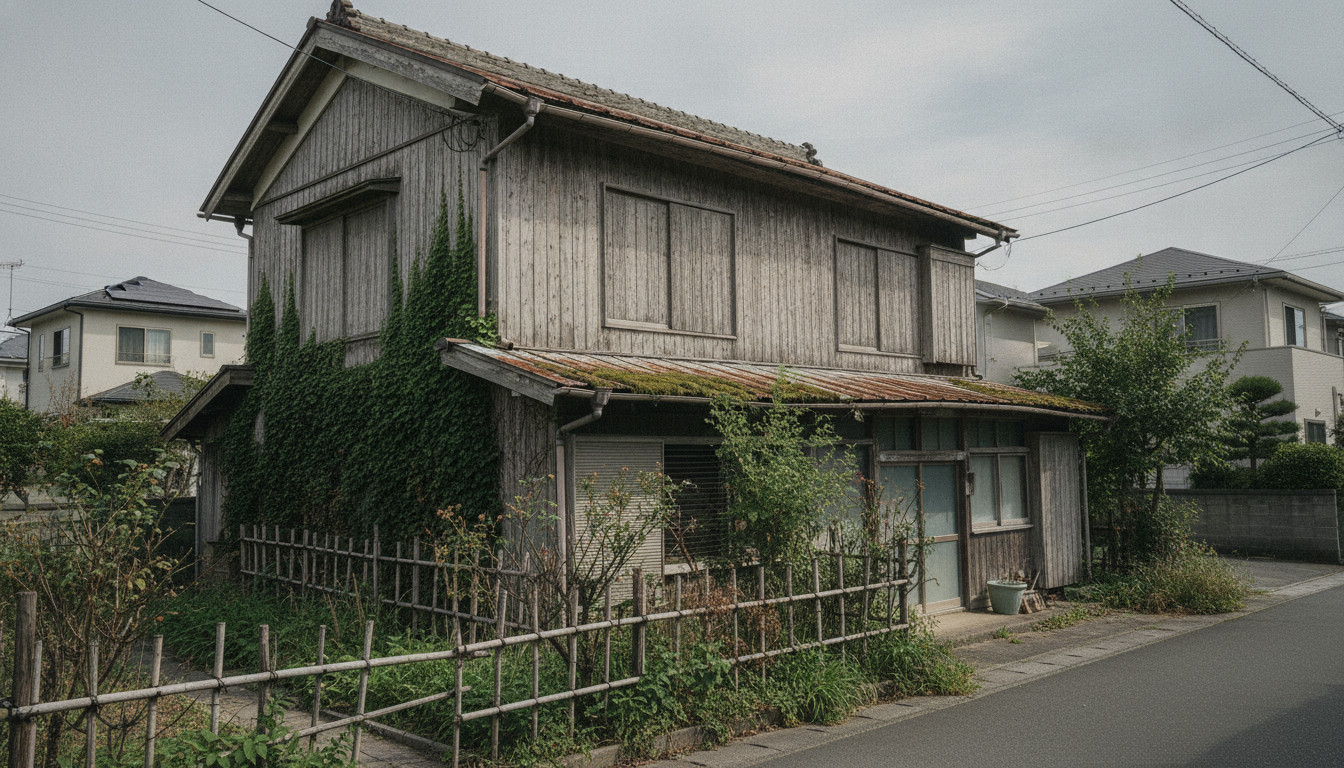
The 9 million vacant homes 空き家 (akiya) in Japan -- 13.8% of all residential properties -- have long been a policy headache. The homes sit empty, deteriorate, and in many cases were never formally registered with any government database. The traditional model of finding them required local knowledge, word of mouth, and a tolerance for dead ends.
AI is dismantling that model with unexpected speed.
In January 2025, the Japanese government announced a new AI-based detection system for vacant homes, combining water service activation data with satellite imagery analysis to identify properties that have ceased being actively occupied. Where Inc. (known as Penetrator until an August 2025 rebrand), a Tokyo-based startup founded in 2022, took a more direct approach. It trained AI on satellite mapping algorithms originally developed by JAXA (Japan Aerospace Exploration Agency) for analysing lunar craters, then applied the same pattern recognition to residential rooftops. The system flags rust, structural decay, discoloration, and roof damage at scale -- building a real-time map of deteriorating properties across entire prefectures. One early user, a rental company in Gifu Prefecture, reportedly used the platform to purchase a neglected two-story house for just 1 yen.
The AKI2ALL framework, published in a 2025 academic paper, proposes going further, with a smart contract and data-driven workflow system that automates the circular repurposing of vacant homes into community assets. Under the framework, AI matches property characteristics with optimal reuse cases -- guesthouses, co-working spaces, elderly care facilities, urban farming centres -- and streamlines the legal paperwork that has historically slowed repurposing significantly.
What this means for buyers is that the database of available akiya is becoming more complete and more searchable every year. Properties that were previously invisible due to absent owners or unregistered status are being surfaced by satellite. The information asymmetry that discouraged risk-averse foreign buyers is shrinking. And -- importantly -- properties with documented condition data and smart home installations will increasingly command a premium over neighbouring akiya that remain in analogue obscurity.
The Smart Home Market in Japan
Japan's smart home market is not a niche enthusiasm. Statista projects revenue reaching US$11.0 billion in 2025, growing at 12.23% a year through 2029, when the market is forecast to reach US$17.5 billion. Security systems, energy management platforms, and intelligent appliance integration dominate the category.
Critically for akiya buyers, the retrofit segment holds the largest market share. This means supply chains for retrofit-grade devices are mature, installation teams are widely available across most prefectures, and costs have been driven down by competition. The concern that a traditional Japanese house is inherently incompatible with modern smart systems is outdated.
Older properties carry genuine challenges, among them undersized electrical panels, an absence of structured cabling, and in some cases, wiring that predates modern standards entirely. A pre-purchase electrical survey (available through any licensed 電気工事士 (denkikōjishi, electrical contractor)) will identify these gaps. Budget ¥300,000 to ¥700,000 for panel upgrades in a typical older single-family home before smart device installations begin. This is a one-time cost that unlocks the full range of smart home hardware.
Property developers across Japan already treat smart home features as marketing differentiators, with pre-installed video doorbells, smart lock integration, and pre-wired connections for telecom service activation now standard in newly built condominiums in Tokyo, Osaka, and Nagoya. Buyers of second-hand properties and akiya can replicate these features for a fraction of new-build pricing.
The Government Money Actually Available
The financial case for smart home investment in Japan is materially strengthened by three overlapping government programmes. Understanding all three before budgeting is essential.
Zero Energy House (ZEH) Rebates
The ZEH ゼッチ (Zero Energy House) programme pays a base rebate of ¥550,000 for newly built ZEH-certified homes, rising to ¥900,000 for ZEH+ certification, with up to ¥200,000 more available for a storage battery add-on. A dedicated LCCM (Life Cycle Carbon Minus) tier ran through fiscal 2023 at up to ¥1.4 million per dwelling before folding into the Sustainable Building Pioneer Project; the live FY2026 top tier is the Mirai Eco House 2026 scheme's GX-oriented housing rebate, worth up to ¥1.1 million per dwelling and open to every household, not only those with children. Properties meeting energy conservation standards also qualify for housing loan tax deductions, which reduce the effective cost of financing a renovation.
Akiya Renovation Grants
Most prefectures and municipalities operate renovation grant schemes alongside their 空き家バンク (akiya banku, vacant house banks), and the national renovation loan programme layers on top of those for qualifying buyers. Grants typically cover up to 50% of renovation costs, ranging from ¥500,000 to ¥3,000,000 depending on the municipality and the nature of the work. Some prefectures layer on additional incentives too, among them relocation subsidies for buyers moving from urban centres, earthquake retrofitting support, and cultural preservation funding for historic kominka. Smart home installations that reduce energy consumption generally qualify under the energy efficiency components of these renovation schemes.
Municipal Digital Infrastructure Grants
The government's Startup Development Five-Year Plan (2022) targets ¥10 trillion in startup investment by March 2028, with strong emphasis on regional digital infrastructure. Areas receiving investment under this plan will see faster connectivity rollout -- fibre, 5G -- and increasingly, locally subsidised smart home subscriptions and device programmes. Buyers in participating prefectures can access both national and local grant streams simultaneously.
Key figures to remember. Municipal grants cover up to 50% of renovation costs (¥500K to ¥3M). The top GX-oriented housing tier under the FY2026 Mirai Eco House scheme adds up to ¥1.1 million in energy-system rebates, and energy-efficient properties also qualify for housing loan tax deductions. Yen figures on this page convert to your own currency at live exchange rates -- use the globe icon at the top of the site to switch. A well-structured renovation can draw ¥2 to 4 million in grants altogether.
Energy Laws That Changed in April 2025
Two regulatory shifts in April 2025 reshaped the economics of Japanese property ownership -- one national, one city-level -- and both reward buyers who move into energy-efficient renovations now rather than later.
Mandatory Energy Conservation Standards (Nationwide)
From April 2025, compliance with energy conservation standards became mandatory for all newly built homes in Japan -- a requirement that had previously been voluntary. The standards cover thermal insulation performance and minimum renewable energy use. Properties meeting the standards access ZEH subsidies and housing loan tax deductions; properties below them are likely to face lower appraisal values over time as lenders incorporate energy ratings into assessments.
For buyers renovating an akiya, meeting these standards through insulation upgrades and solar installation is eligible for grants -- and it directly improves the long-term value of the asset. A renovated akiya meeting 2025 energy standards is structurally comparable to a newly built home in energy performance terms.
Tokyo and Kawasaki Solar Mandate
Tokyo became the first Japanese municipality to require solar panels on new homes, effective April 1, 2025. The mandate doesn't fall on individual homeowners -- it applies to roughly 50 major housebuilders who supply 20,000 square metres or more of floor space in Tokyo each year, who must fit at least 2 kW of panels on the new homes they build, with exemptions for small or north-facing roofs. Kawasaki introduced an equivalent mandate on the same timeline. The downstream effects are already visible regardless of who the obligation technically sits with. Installation costs are falling, panel inventory is deeper, and contractors experienced in rooftop retrofits are more widely available across the Tokyo metropolitan area and adjacent prefectures.
The signal is clear. Two of Japan's largest urban markets now treat solar as infrastructure. Buyers fitting akiya with solar today are ahead of a standard that will be normalised nationally within a decade.
Residential Battery Trading -- Fiscal 2026
Japan opened its balancing market to household-level flexibility resources, including home batteries, in April 2026. For homeowners with solar panels and battery storage working through an aggregator, this creates a direct revenue stream. Excess energy stored during off-peak periods can be sold back to the grid at market rates. ITOCHU Corporation's GridShare programme, now covering more than 40,000 Smart Star home batteries, has documented an average additional savings of 14% for participants.
An akiya purchased today and retrofitted with solar and battery storage can already be generating electricity trading income, stacking on top of any rental income or capital appreciation.
Smart Home Features That Add Quantifiable Value
Not all smart home upgrades deliver equal return in Japan's market. Three categories show consistent, measurable value uplift.
Security Systems
Smart security -- combining smart locks with biometric entry, AI-powered doorbells, and networked cameras -- is the primary driver of smart home adoption in Japan, with roughly 70% of consumers citing security as their main motivation. The financial return is concrete in a specific case. Insurers including Secom Sonpo offer fire-insurance discounts for homes enrolled in a monitored security service, with Secom's own published schedule listing discounts of roughly 8% to 40%, depending on the home's construction type, for homes under its monitoring. A standalone smart lock and camera with no monitoring contract will not unlock that scale of discount, but for a property run as a rental or vacation home, documented security infrastructure still supports higher nightly and monthly rates, and reduces friction when working with property management companies.
Energy Management Systems
AI-driven energy management systems monitor consumption patterns, optimise heating and cooling schedules, and integrate with solar and battery storage for maximum efficiency. Systems qualifying for the top GX-oriented housing tier can draw government support of up to ¥1.1 million, with the standard ZEH/ZEH+ rebate (¥550,000 to ¥900,000) applying to most energy management retrofits. In Japan's climate -- hot and humid summers, cold winters in many inland and northern regions -- energy management reduces running costs from day one. In older Japanese homes with poor insulation, combining energy management with insulation upgrades can cut utility bills by 30 to 50%.
Smart Locks and Remote Access Infrastructure
For foreign buyers managing properties from abroad, remote access systems are not a convenience -- they are operationally essential. Smart locks programmable with temporary access codes for guests, cleaners, and contractors, combined with remote video monitoring, allow effective property management without a physical presence on the ground. This functionality is directly relevant to buyers seeking short-term rental income under Japan's minpaku 民泊 (minpaku, home-sharing) regulations. A fully remotely manageable property is a market-differentiating asset on minpaku platforms.
Building the Investment Case
The convergence of factors described here represents something that appears rarely in developed-market real estate, a structural opportunity with government tailwinds at its back, across a wide range of property types and price points.
Japan's akiya are cheap by global standards. Entry prices in many well-connected prefectures -- within commuting range of major cities, or in secondary cities with strong local economies -- range from ¥1 million to ¥10 million. Even after renovation budgets of ¥5 to ¥15 million, total acquisition and fit-out costs sit well below comparable second-home markets in Europe, Southeast Asia, or North America.
The historical barrier for foreign buyers has been complexity, among them language gaps, opaque title processes, and uncertainty about actual renovation costs. AI is reducing each of these barriers in a measurable way. Satellite-based property condition assessment, AI-powered listing platforms, and government-backed vacancy databases are making the market more transparent every year. The information gap that once made akiya feel like a gamble is closing.
Layer in the available grants (up to 50% of renovation costs), ZEH and GX-oriented housing energy-system rebates (¥550,000 to ¥1.1 million depending on tier), and the newly opened fiscal 2026 battery trading market, and the effective net cost of a fully renovated, smart-home-equipped akiya drops substantially. A property purchased at ¥3 million, renovated with ¥8 million in works (with ¥3 to 4 million covered by municipal grants), and fitted with smart security and energy systems eligible for a further ¥550,000 to ¥1.1 million in ZEH-tier rebates, costs the buyer significantly less than the headline renovation figure suggests.
Japan's AI sector is projected to reach $35.2 billion by 2033. The connectivity and digital infrastructure investment embedded in that figure flows directly into property values in the cities and regions where it lands first. Properties in smart city pilot areas, in municipalities with active fibre and 5G rollout, and in prefectures where AI-driven revitalization programmes are underway will see the sharpest appreciation. Buyers entering those markets now -- rather than after the valuations adjust -- capture the full trajectory.
How to Navigate the Purchase
The practical steps of buying an akiya have been covered in detail elsewhere on this site, including a full pre-purchase inspection checklist. What the AI and smart home dimension adds is primarily a due diligence layer, understanding which municipality grants are available for smart home components, verifying the property's electrical infrastructure before committing to a smart home budget, and factoring ZEH rebate eligibility into the financial model from the outset.
For foreign buyers, the legal complexity of purchasing Japanese property -- title verification, scrivener 司法書士 (shihō shoshi) engagement, municipal registration requirements -- is unchanged by the AI revolution. It remains the part of the process where professional guidance delivers the clearest return on cost. Working with a licensed agent who specialises in foreign buyer transactions -- such as Akiya Japan Buyer Support, our licensed partner brokerage, whose team is fluent in English and Japanese and provides support from purchase through to property management -- prevents the kinds of legal oversights that can make a bargain property expensive to untangle. A consultation at the research stage, before committing to a specific property, typically pays for itself in avoided errors alone.
Smart home technology and AI have narrowed the gap that once made buying property in Japan feel opaque from abroad. Transparent condition data, government-backed renovation incentives, and a maturing smart home ecosystem mean an akiya investment today buys a house, and buys into a country that is actively spending billions to make that house worth more over time.
Sources
- Japan Times -- Government Announces AI-Based Vacant Home Detection System (January 2025)
- MDPI Buildings -- AKI2ALL: AI and Blockchain Framework for Akiya Repurposing (2025)
- Parameter -- Japan's Lunar-Inspired AI for Vacant Home Detection (Where Inc.)
- PV Know How -- Tokyo Solar Panel Mandate for New Buildings (April 2025)
- UNESCO -- Japan's Society 5.0 Strategy
- Nippon.com -- Japan FY2025 Budget ¥115.5 Trillion
- JETRO -- Japan AI Startups Landscape
- Statista -- Japan Smart Home Market Outlook 2025 to 2029