Japan has roughly 9 million vacant houses — akiya (空き家 (akiya)) — and the number grows every year. They range from traditional thatched-roof farmhouses to 1990s suburban builds, priced from free to a few million yen. Structurally sound houses in rural Japan regularly sell for less than a secondhand car. This guide covers what akiya are, why they exist, where to find them, what they actually cost, and how to buy one — whether you’re already in Japan or on the other side of the world.
What Is an Akiya?
In the simplest terms, an akiya is any residential property that sits unoccupied. But that clinical definition doesn’t capture what you actually encounter when you start exploring them.
Some are traditional thatched-roof farmhouses (kominka, 古民家 (kominka)) with massive timber beams blackened by centuries of cooking smoke. Others are postwar suburban homes with aluminium-framed windows and tiny gardens. A few are relatively modern houses — built in the 1990s, perfectly functional — that simply have no one living in them. What they share is abandonment: the owner has passed away, moved into a care facility, or relocated to a city, and their heirs have no interest in maintaining a property hours from anywhere they want to live.
Akiya exist in every prefecture, including Tokyo and Osaka, but they’re concentrated in rural and semi-rural Japan — the villages and small towns where Japan’s demographic shift hits hardest. Walk through any countryside settlement and you’ll spot them: the sagging roofline, the garden gone wild, the postbox taped shut.
The Japanese government treats the growing akiya problem as a national policy issue, and rightly so. Vacant houses create fire hazards, attract pests, depress surrounding property values, and burden municipalities with maintenance costs they can ill afford. This is why local and national governments actively promote their sale — often with generous subsidies that can transform the economics of a purchase entirely.
Why Are Akiya So Cheap?
Several forces combine to push prices far below anything you’d encounter in any other developed nation:
- Depopulation: Japan’s population has been declining since 2008, and rural areas are losing residents fastest. More houses, fewer people — the maths is unforgiving.
- House depreciation: This is the one that shocks most Westerners. Unlike in Britain, Australia, or North America, Japanese houses lose value over time. A standard wooden house is typically assessed at zero after 20–25 years. Only the land retains taxable value.
- Tax burden on vacant property: Owners of empty houses still pay property tax with no income to offset it. Many are motivated to sell at any price — or simply give the house away — to escape this ongoing cost.
- Cultural preference for new: Japanese buyers have historically preferred newly built homes. The market for used houses (chūko jūtaku) is growing, particularly among younger buyers, but it’s still considerably smaller than the secondhand market in most Western countries.
- No capital gains incentive: Because houses depreciate rather than appreciate, there’s no speculative motive to hold property the way there is in London, Sydney, or Vancouver. Property hoarding simply doesn’t make sense here.
What Do Akiya Houses Actually Cost?
It depends entirely on what you’re willing to take on. Habitable houses can go for under a million yen; ruins have been listed at ten times that because the land happened to face Mount Fuji. To give a concrete sense of the range:
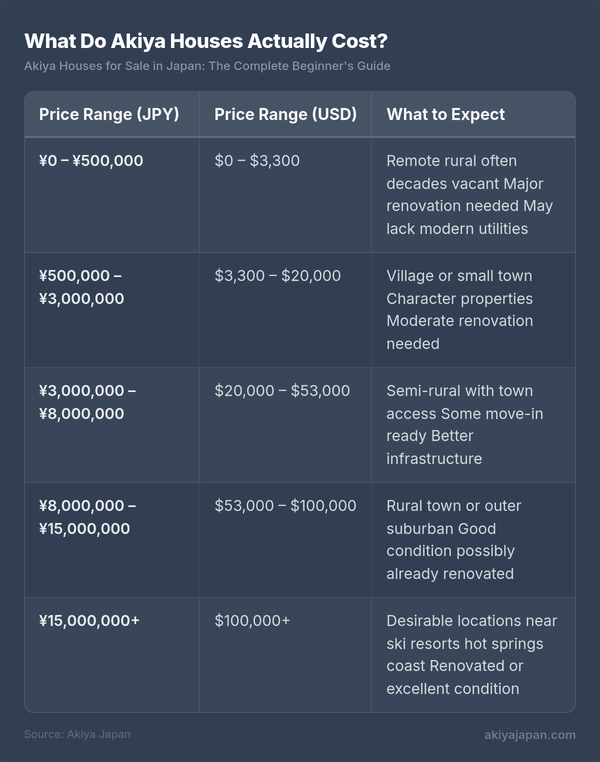
A critical point that bears repeating: the purchase price is only part of the story. Transaction fees — agent commission, legal fees, registration tax — add ¥300,000–¥700,000 regardless of what you pay for the property itself. Renovation for a typical akiya runs ¥2–15 million depending on condition. Buyers regularly fall in love with ¥1-million houses and then blanch when the renovation quote comes back at twelve times the purchase price. Our complete fee breakdown covers every cost in detail.
Where to Find Akiya for Sale
Property Aggregators
If you’re starting from scratch — especially from outside Japan — an aggregator is the sanest place to begin. Akiya Japan pulls listings from nearly 500 Japanese real estate sources, including municipal akiya banks, private agents, and property portals, into a single searchable database with English translations, map view, and price filters. With 945,000+ listings across all 47 prefectures, it’s the largest English-language database of Japanese property — the obvious starting point for anyone approaching the market from outside Japan.
Municipal Akiya Banks (空き家 (akiya)バンク (akiya bank))
Nearly every municipality in Japan runs its own database of vacant properties available for sale or rent. These often have the cheapest listings — including free ones — and may come with purchase subsidies and renovation grants that aren’t available through private channels. The catch is that each municipality maintains its own bank, listings are entirely in Japanese, and navigating the local bureaucracy requires patience and, ideally, some language ability. The national akiya bank portal (fudousan.or.jp/akiya) aggregates some of these, though it’s Japanese-only.
Local Real Estate Agents
This is the route that requires the most effort but can yield the most interesting results. In rural areas, local agents often know of unlisted properties whose owners might be persuaded to sell. These conversations don’t happen on websites. They require Japanese language ability or a bilingual intermediary, but they can uncover properties that never appear on any listing platform — a farmhouse whose owner is quietly considering letting it go, a village house that hasn’t yet been formally listed.
Akiya by Region: Where to Look
The Deep Bargains
If your budget is genuinely tiny and you’re prepared for remoteness, Japan’s most depopulated prefectures offer astonishing value. Akita and Yamagata in the north — deep snow country, onsen everywhere, some of the most beautiful rice terraces in Japan. Shimane and Tottori on the Sea of Japan coast — quiet, moody, culturally rich, and almost entirely overlooked by tourists. Kochi and Tokushima on Shikoku — consistently overlooked by outsiders: wild coastline, river valleys, and communities that have welcomed newcomers with genuine openness. Properties under ¥1 million are common across all of these. The trade-off is distance from major cities, fewer services, and — in the northern prefectures — winters that will test your commitment.
Best Value for Accessibility
Niigata stands out for this balance — the Jōetsu Shinkansen puts you in Tokyo in under two hours, the food is nationally renowned — Niigata rice, sake, and seafood, and the property market is staggeringly affordable. Nagano offers mountains, ski resorts, and a growing international community, also with bullet train access. Okayama has arguably the best climate in Japan — mild, sunny, rarely hit by typhoons — and sits on the Sanyō Shinkansen line. Fukuoka and Oita in Kyushu combine warmth, hot springs, excellent airports, and a cost of living well below most Western cities. All of these offer sub-¥5-million properties with genuine access to urban amenities.
Popular with Foreign Buyers
Nagano draws the ski-lifestyle crowd — Hakuba and Nozawa Onsen have well-established international communities. Chiba attracts buyers who want countryside within commuting distance of Tokyo. Shizuoka offers Mount Fuji views, Pacific coastline, and green tea as far as the eye can see. Niigata is increasingly on the radar, particularly the Echigo-Tsumari area with its art festivals and creative community. Okinawa offers subtropical island living — though prices there are noticeably higher than mainland rural areas, and it’s a different Japan in many ways. What these prefectures share is growing international communities and local agents who have at least some experience working with foreign buyers.
Akiya in Tokyo and Osaka
Urban akiya exist, but they’re a different animal entirely. Don’t expect the countryside dream house with a garden and mountain views. Urban akiya are typically small, on tiny plots in dense residential neighbourhoods, and priced at ¥10–30 million ($66,000–$200,000) — cheap by Tokyo standards, but not by akiya standards. That said, they can be excellent investments: the land retains real value, rental demand exists, and the right renovation can transform a cramped postwar house into something genuinely desirable.
Can Foreigners Buy Akiya?
Yes. Japan places no restrictions on foreign property ownership. You do not need:
- Japanese citizenship
- A visa or residency status
- A Japanese bank account (though having one makes life considerably easier)
- To be physically present in Japan (power of attorney is accepted)
The process is identical whether you hold a Japanese passport or a British one. You will need a judicial scrivener (shihō shoshi, 司法書士 (shihō shoshi)) for title registration, and either a registered hanko (seal) or a signature certificate from your home country’s embassy or consulate in Japan. Buyers from Canada, France, Australia, and the United States have completed purchases without any more difficulty than a Japanese buyer would face — the paperwork is the same, the process is the same, and the rights of ownership are identical.
The Buying Process: Step by Step
The process is more straightforward than most people expect. The hardest part is usually not the bureaucracy — it’s choosing which property to commit to.
- Search and shortlist: Browse listings, filter by price, location, and type, and save properties that genuinely interest you. Resist the urge to enquire about twenty at once — narrow it to five or six serious candidates.
- Engage an agent: Contact a licensed Japanese real estate agent (takkenshi, 宅建士 (takkenshi)) who can investigate properties, arrange viewings, and handle negotiations. For international buyers, a bilingual agent isn’t a luxury — it’s essential.
- Property inspection: Visit in person if at all possible, or arrange a professional building inspection (tatemono jōkyō chōsa, 建物状況調査). Our inspection checklist covers exactly what to look for. Pay particular attention to the roof, the foundations, and any signs of damp — these are the expensive problems.
- Offer and negotiation: Make an offer through your agent. Akiya sellers are often motivated and willing to negotiate, especially for properties that have been sitting on the market for months. Accepted offers at 40–60% of the listed price are not uncommon, though this varies enormously.
- Contract signing: The baibai keiyaku (売買契約, sales contract) is signed with a deposit, typically 5–10% of the price. An Important Matters Explanation (jūyō jikō setsumei) must be delivered by a licensed agent — this document details everything about the property, the land, and any restrictions.
- Settlement and registration: Final payment, key handover, and title registration at the Legal Affairs Bureau through your judicial scrivener. This is the moment you officially become the owner.
Timeline: expect 1–3 months from offer to ownership for a straightforward transaction. Properties with complications — agricultural land designation, unclear boundaries, inheritance tangles — can stretch to 3–6 months or longer.
Are Free Akiya Really Free?
Some municipalities do offer properties at ¥0 — literally free houses. In practice, a few are surprisingly decent; most need significant work. But “free” refers only to the acquisition cost of the building. You still pay:
- Transaction fees: ¥300,000–¥600,000 (agent, legal, registration)
- Property tax: an ongoing annual obligation that never goes away
- Renovation: typically ¥2–15 million to make the house genuinely livable
Free akiya are absolutely worth investigating — especially when the municipality also offers renovation subsidies that can cover half or more of the repair costs. But the word “free” can create expectations that reality quickly corrects. Our guide to ultra-cheap akiya purchases breaks down the real numbers.
Common Mistakes Foreign Buyers Make
1. Budgeting Only for the Purchase Price
A common pattern: a farmhouse in Gifu lists for ¥1.5 million and seems like a bargain — until the renovation quotes start arriving. The roof alone can be ¥3 million. New plumbing, another ¥2 million. The final spend is often ten times the purchase price. The listing price is typically 10–40% of your total investment. Always budget: purchase + fees + inspection + renovation + first year of ownership costs.
2. Buying Sight Unseen
Listing photos are curated — they show the best room from the best angle on the sunniest day. They don’t show the black mould behind the wardrobe, the termite damage under the bathroom floor, the access road that turns to mud every rainy season, or the fact that the nearest neighbour runs a very enthusiastic cockerel operation. If you genuinely cannot visit, there are specific precautions you should take to protect yourself.
3. Ignoring Location Practicalities
A beautiful house means nothing if the nearest hospital is ninety minutes away, the road is impassable in winter, or the only shop in town closed last year. Buyers have discovered that “heavy snowfall area” can mean three metres on the roof and a daily shovelling commitment that borders on a full-time job. Research the area as thoroughly as the house — visit in different seasons if you can.
4. Underestimating Community Expectations
Rural Japan runs on social reciprocity. Neighbourhood association membership (chōnaikai), community clean-up days, festival preparation, road maintenance — these are not optional in any meaningful sense. A neighbour bringing mikan to welcome you will likely also explain, very politely, which Sundays are for clearing the drainage channels and which are for weeding the communal paths. It isn’t a suggestion. Our community integration guide explains what to expect. Approached with the right spirit, these obligations become one of the most rewarding parts of rural life. Approached as an inconvenience, they’ll make you miserable.
5. Skipping Professional Help
Trying to buy property in Japan without a licensed agent and judicial scrivener — thinking you’ll save a few hundred thousand yen — is a false economy of the most spectacular kind. Legal documents are in Japanese, the process has specific procedural requirements, and the cost of professional help (¥300,000–¥500,000) is trivial compared to the cost of a boundary dispute, an undisclosed lien, or a registration error. Pay the professionals. Sleep well.
Municipal Subsidies and Incentives
This is where the economics of akiya buying can shift dramatically in your favour. Many municipalities — particularly those losing population fastest — offer substantial financial incentives to encourage purchases:
- Purchase subsidies: ¥500,000–¥2,000,000 toward the purchase price
- Renovation grants: ¥1,000,000–¥5,000,000, sometimes covering 50–75% of renovation costs
- Relocation incentives: Cash grants for moving from urban to rural areas
- Child-rearing bonuses: Additional grants for families with children
In the best cases, subsidies have covered nearly the entire renovation cost — turning a ¥1-million purchase into a fully habitable home for under ¥3 million total. The catch, and there is always a catch: most programmes require you to live in the property full-time, commit to a minimum residency period (often 5–10 years), and participate in community life. These aren’t holiday home grants — they’re population recovery measures, and the municipalities take them seriously. Your agent can help identify available programmes in your target area.
Frequently Asked Questions
How many akiya are there in Japan?
Japan’s 2023 Housing and Land Survey counted approximately 9 million vacant residential properties nationwide, up from 8.5 million in 2018. The number is projected to continue rising as the population declines and ages.
Can I buy an akiya as an investment property?
Yes. There are no restrictions on using akiya as rental properties, guesthouses (minpaku), or holiday homes. However, some municipal subsidy programmes require owner-occupancy, so check the conditions carefully. Rental yields in rural areas tend to be low, but renovation-and-rent or renovation-and-Airbnb strategies can work well in tourist-adjacent locations — near onsen towns, pilgrimage routes, or ski resorts.
What is the difference between an akiya bank and a regular listing?
Akiya banks are run by municipal governments and list only vacant properties within their jurisdiction. Regular listings come from licensed real estate agents and private sellers. Akiya bank properties are often cheaper and may come with government subsidies, but the selection is smaller and the entire process is conducted in Japanese.
Do akiya come with land?
Most akiya include both the building and the land it sits on. Rural akiya often come with substantial plots — 200–2,000 sqm is common, with some including even more. The land is often the most valuable part of the purchase, as the building itself may have zero assessed value.
What is a kominka?
A kominka (古民家 (kominka)) is a traditional Japanese house, typically built before the mid-20th century using timber-frame construction with features like exposed beams, tatami rooms, engawa (covered verandas), and sometimes thatched roofs. Kominka are a subset of akiya that are prized for their architectural character and increasingly popular for renovation projects — both among Japanese buyers rediscovering traditional craftsmanship and foreign buyers drawn to their beauty.
How long does it take to buy an akiya?
A straightforward purchase takes 1–3 months from accepted offer to key handover. Properties with complications (agricultural land designation, unclear boundaries, inheritance issues) can take 3–6 months or longer. Renovation adds weeks to months depending on scope.
Further Reading
- Can You Really Buy a House in Japan for $5,000? — what ultra-cheap properties actually cost end to end
- Cheap Houses in the Japanese Countryside — regional guide to the best-value rural areas
- The Real Cost of Buying an Akiya — every fee, tax, and hidden cost itemised
- The Akiya Inspection Checklist — what to check before committing
- How to Read a Japanese Property Listing — decode Japanese listing terminology
- The Foreigner’s Legal Toolkit — visas, residency, and ownership rules
Where to Start
Akiya have gone from niche curiosity to regular features in international media. The houses are real. The prices are real. And the opportunity — for the right person, with the right expectations — is worth serious consideration.
What most coverage tends to leave out is everything that happens after the purchase: the renovation costs that dwarf the listing price, the community obligations that shape your daily life, the importance of professional help at every stage, and the gap between the dream of a cheap Japanese house and the reality of owning one. None of these things are reasons not to buy. They’re reasons to buy well.
The buyers who are happiest with their akiya — the ones who light up when they talk about it, who know their neighbours and show up for community events — are the ones who went in with open eyes, realistic budgets, and genuine respect for the communities they were joining. They didn’t just buy a cheap house. They chose a place, and then they committed to it. If you’re prepared to do the same, it’s a market worth taking seriously.