The short version
- Japan counted 9.00 million empty dwellings in 2023. Only 326,000 of them, 3.6%, are being marketed for sale.
- Buyer attention per listing swings nineteen to one across the country. Gifu indexes 410, Miyagi 21.
- Okinawa carries one of our largest inventories and the third-lowest attention score of the 47. Low scores are where the negotiating room is.
- The median listing asks ¥23,500,000. The median listing buyers save asks ¥8,550,000, about a third of that.
- It is not a rural market. Median straight-line distance to a station is 1.06 km, and Tokyo carries more of our for-sale listings than any other prefecture.
Only one of Japan's 47 prefectures gained population between the 2020 and 2025 censuses: Tokyo, up 1.3%. Okinawa came closest of the other 46 to holding steady, down just 0.1% in the final count. On our own listings, Tokyo and Okinawa rank 44th and 45th of 47 for buyer attention per property.
We scored every prefecture on how often buyers save a listing there against how many we published there in the twelve months to 26 July 2026. Gifu scores 410. Miyagi scores 21. Nineteen times the attention per listing, in the same country, in the same year.
Low scores are where the negotiating room is. Okinawa holds the fourth-largest inventory of any prefecture we cover and the third-lowest attention score on the board.
The backdrop is the number everyone starts with. Japan has nine million empty houses, and fewer than 4% of them are being marketed for sale, which is why this market feels thinner than the headlines promise. "Empty houses for sale" is a survey category, though, not the size of Japan's property market. A Japanese home is normally lived in until the day it changes hands, so a house on the market with the owner still in it is never counted as vacant at all.
What the nine million actually are
The 2023 Housing and Land Survey counted 9.00 million vacant dwellings out of 65.05 million, a vacancy rate of 13.8%. Both are records. The count has doubled since 1993. Break it apart, though, and the buyable share collapses:
- 4.44 million are vacant rentals sitting in a landlord's portfolio (賃貸用の空き家)
- 384,000 are second homes and holiday properties (二次的住宅)
- 326,000 are empty and on the market (売却用の空き家, baikyaku-yō no akiya)
- 3.86 million are 「賃貸・売却用及び二次的住宅を除く空き家」, the survey's catch-all for vacant homes with no plan for rent or sale at all
Every line there is a vacant dwelling. The survey puts the for-sale bucket at 3.6% of the vacant total and defines it as a home, new or used, standing empty because it is being sold. That's why the ordinary resale market sits outside this table completely. "New or used" also means the 326,000 includes finished new-build units nobody has bought yet. Of the 740,667 new dwellings Japan started in 2025, 208,169 were built for sale, and almost all of those sell and get lived in, which takes them out of the vacancy tables entirely. Treat 326,000 as the answer to "how much of Japan's empty stock is on the market" and it's sound. Treat it as the answer to "how many properties are for sale in Japan" and it's badly wrong.
The last bucket is the real problem, and it's the one growing. It's up 369,000 since 2018, 72% of the entire increase. These are inherited houses nobody has made a decision about. They aren't listed or priced, and no website can sell you one. Our explainer on what an akiya actually is goes into why they stay stuck.
What's actually for sale
Of the live for-sale listings we carry, houses are 51.3%, land 25.0%, apartments 21.5%, and commercial premises 1.2%. The median asking price is ¥23,500,000. That's the middle of what we list, not the tail everyone writes about, which we covered separately in whether Japanese houses are ever really free, and the band-by-band version of what each bracket buys.
The median listed house was built in 1997 and has about 105 m² of floor area on 184 m² of land, with four bedrooms. Japanese houses are not small. Suburban and regional ones are routinely bigger than what the same money buys in Europe or coastal North America.
Just under a quarter of the housing stock we list (22.8%) predates June 1981, when the 新耐震基準 (shin taishin kijun, new seismic standard) took effect. That code was rewritten after the 1978 Miyagi earthquake exposed how badly the old one performed, and the permit date is a harder line than any other field on a listing. Our guide to what a house's era tells you unpacks what each decade means in practice.
It isn't a rural market

We measure straight-line distance to the nearest station on every listing. The median is 1.06 km. Nearly half of what we list (48.0%) is within a kilometre of a station, 72.5% within two, 88.6% within five. Only 3.6% sit further than 20 km from a train.
Tokyo carries more of our live for-sale listings than any other prefecture, with Kanagawa and Hokkaido close behind. Empty Japanese housing runs straight through the commuter belt.
What buyers want instead

The median saved listing is priced at ¥8,550,000, against ¥23,500,000 for the median listing we carry. Buyers shop at roughly a third of the midpoint, and the mismatch widens the cheaper you go.
| Asking price | Share of listings | Share of saves | Saved vs listed |
|---|---|---|---|
| Under ¥1m | 1.8% | 12.3% | 6.7x |
| ¥1m to ¥3m | 6.1% | 14.2% | 2.3x |
| ¥3m to ¥5m | 6.3% | 11.1% | 1.8x |
| ¥5m to ¥10m | 12.8% | 17.0% | 1.3x |
| ¥10m to ¥20m | 18.6% | 19.3% | 1.0x |
| ¥20m to ¥50m | 35.6% | 22.8% | 0.6x |
| Above ¥50m | 18.7% | 3.2% | 0.2x |
Fewer than two listings in a hundred are the cheap house the internet promised you, and that sliver absorbs an eighth of everything our buyers save. More than half of what we publish sits above ¥20 million, where almost nobody is looking.
Property type splits just as hard. Houses take 86.3% of saves against 51.3% of listings, land 3.9% against 25.0%, apartments 8.4% against 21.5%. A quarter of what we publish is bare land, and buyers walk straight past it. If your plot listing is getting no enquiries, that's why.
Age runs the same way. The median saved listing was built in 1985, twelve years older than our median live listing, and pre-1981 stock is 23.2% of what we list against 40.0% of what gets saved. Buyers pick the weaker seismic cohort on purpose, because that's where the low prices are. Saved listings also sit further from stations, a median 1.36 km against 1.06 km.
The akiya bank trade
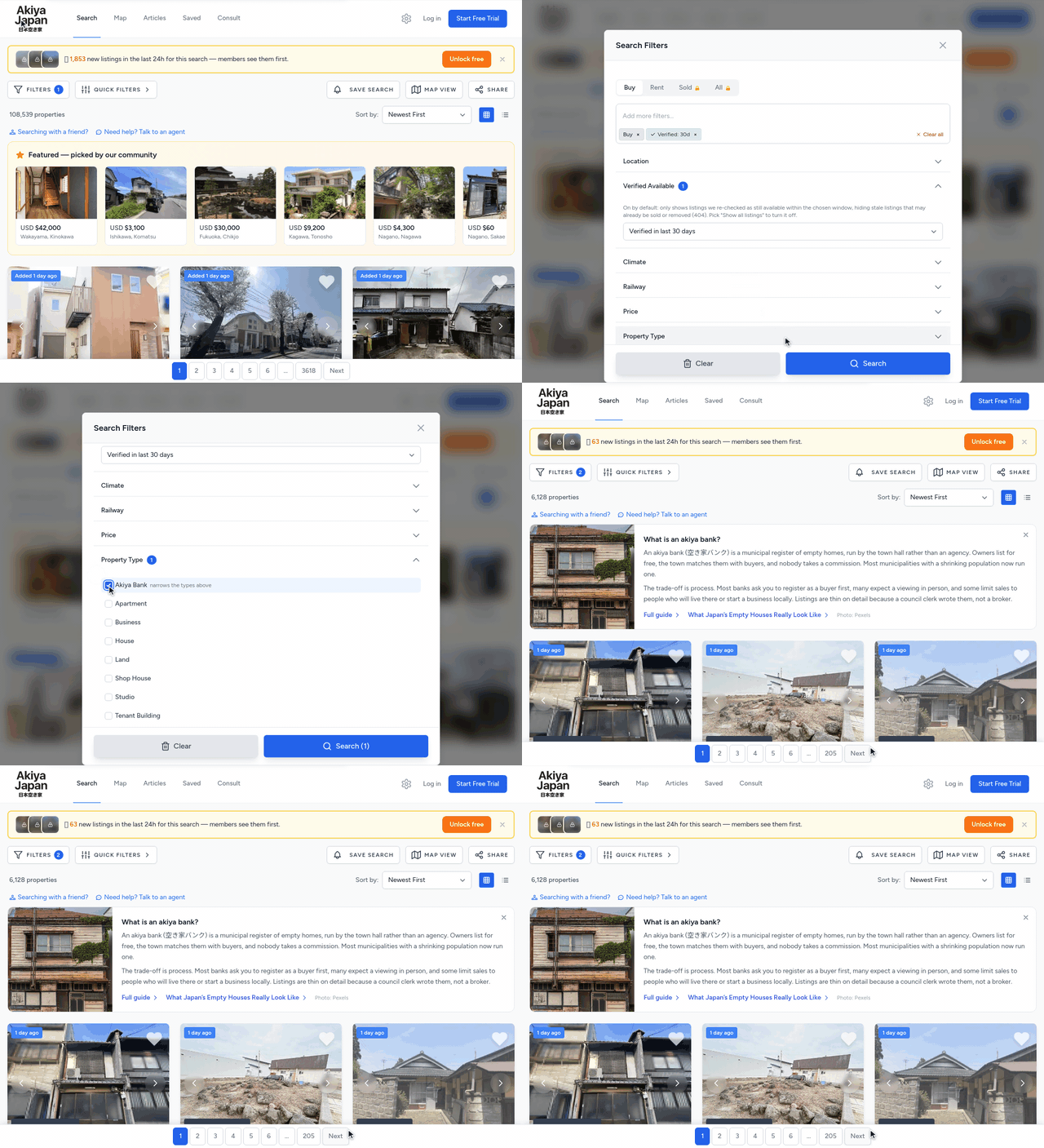
Municipal akiya bank listings are 5.8% of our live inventory and 18.7% of saves. Restrict to houses and the two channels barely look like the same market:
- Akiya bank: median asking ¥5,000,000, median build year 1976, median floor area 119 m²
- Private market: median asking ¥25,800,000, median build year 1998, median floor area 104 m²
A fifth of the price, twenty-two years older, and bigger. That's the trade. Floor area and land, in exchange for a build predating the seismic code and, usually, no insulation in the walls.
Supply varies enormously by prefecture. Toyama leads at 26.0% of the listings we carry there, then Akita (21.8%), Fukui (21.1%), Kumamoto (20.7%), Shimane (20.2%) and Gifu (19.8%). In Tokyo it's 0.15%, which is to say none. Our directory of every akiya bank in Japan maps the schemes prefecture by prefecture.
Fewer people, more households
Japan's 2025 census, taken on 1 October 2025, put the confirmed population at 122,972,528, down 3,173,571 in five years. That's a 2.5% fall, the steepest on record, against 0.7% for the previous five years. The confirmed count, released 29 September 2026, revised the picture the preliminary count had given four months earlier: 1,568 of Japan's 1,719 municipalities lost people (91.2%), and among the 47 prefectures only Tokyo grew, up 1.3% to 14,236,627. Okinawa, which the preliminary count had shown growing, came out essentially flat once duplicate counting was removed, down 932 people, 0.1%. Seven prefectures that had grown between 2015 and 2020 flipped to decline: Saitama, Chiba, Kanagawa, Aichi, Shiga, Fukuoka and Okinawa. The steepest percentage falls were Akita (−8.1%), Aomori (−8.0%) and Iwate (−7.1%); Hokkaido lost the most people in absolute terms, down 244,342.
And yet, over the same five years, the number of households rose 2.7%, to 57,181,619. Average household size fell to 2.10 people, the lowest ever recorded. Fewer Japanese people are living in more, smaller homes, so demand for dwellings is nowhere near collapsing at the rate the population line implies.
The median house we list has four bedrooms. The average Japanese household has 2.10 people. The mismatch isn't people against houses. It's household size against house size.
That mismatch is the mechanism behind the vacancy figures, and it's why the empty stock is so lopsidedly large detached family houses in towns that lost their employers. Age compounds it. The 2025 census counted 36.142 million people, 29.4% of the population, aged 65 or older, up from 28.5% in 2020. That cohort owns a disproportionate share of the detached-house stock, and inheritance will keep feeding it onto the market for the next two decades.
Where buyer attention goes

The attention index takes every for-sale listing we added in the twelve months to 26 July 2026, counts the saves those same listings drew, and sets each prefecture's share of the saves against its share of the listings, times 100. An index of 100 means buyers save a prefecture exactly in proportion to how much of it we publish.
| Most attention per listing | Index | Least attention per listing | Index |
|---|---|---|---|
| Gifu | 410 | Miyagi | 21 |
| Shizuoka | 337 | Kochi | 26 |
| Shiga | 331 | Okinawa | 32 |
| Yamanashi | 320 | Tokyo | 34 |
| Nagano | 276 | Hokkaido | 45 |
| Wakayama | 274 | Fukushima | 47 |
Cross that with the census and a tilt appears. The six prefectures that lost less than 1% of their population average an index of 71. The fourteen that lost 5% or more average 158. Buyers save the emptying places at about 2.2 times the rate they save the stable ones.
It's a looser signal than those group averages make it look. Kochi and Fukushima are shrinking fast and sit near the bottom of the table. Wakayama is sixth from top while losing 6.3% of its people. Population decline does not predict buyer interest prefecture by prefecture.
What people say they want doesn't match it either. Across the prefecture selections in active saved-search alerts, Tokyo takes 20.3% and Osaka 10.3%. Tokyo's attention index from actual saves is 34, fourth from the bottom. One alert in five points at a prefecture those same users almost never save anything in.
Outside our data, MLIT's land price publication (公示地価, kōji chika), released 18 March 2026 and priced as of 1 January, put nationwide land values up 2.8% and residential land up 2.1%, a fifth straight annual rise. The fastest-rising commercial point in the country was in Chitose, Hokkaido, up 44.1% on the Rapidus semiconductor build. The fastest-rising residential point was Hakuba, Nagano, up 33.0% on international ski demand. Nagano sits near the top of our attention table and holds the country's top residential riser. Those two facts are not unrelated.
What comes off the market

We track 985,000+ listings that have come off the market. A delisting isn't a confirmed sale, since sellers withdraw and listings expire, so read this as direction rather than transaction data. Houses are 82.1% of the delisted stock we can classify, against 53.7% of the live for-sale stock on the same basis. Land is 3.9% against 23.9%. Houses leave. Land mostly sits.
Listings also move faster than the "abandoned for decades" framing suggests. The median live listing has been in our index 51 days, 26.3% arrived in the last 30 days, and 9.9% have been sitting more than a year. Attention is brutally concentrated. The top 10% of listings absorb 34.8% of all views, and 2.4% have never been viewed at all. If you're hunting for something overlooked, the overlooked pile is enormous.
What this means for your search
Shop where the index is low if you want negotiating room. Miyagi, Okinawa, Fukushima, Kochi and Hokkaido carry large inventories that other buyers scroll past, and five of the six lowest attention scores on the board. Less competition on the same listing, and agents who aren't fielding five overseas enquiries a week.
Assume company in Gifu, Shizuoka, Shiga, Yamanashi, Nagano and Wakayama. The top six on the attention table, and in Nagano's case our data and MLIT's agree that money is arriving. Move on viewings quickly and expect less give on price.
Check the build year before anything else. Two in five of the listings buyers save predate the 1981 seismic standard, against fewer than a quarter of what we list. That's a legitimate purchase, but 耐震補強 (taishin hokyō, seismic reinforcement) and insulation turn a ¥5,000,000 house into a much larger project. Price the work, not the house.
Don't buy a cheap house and leave it standing empty. Under the amended 空家等対策特別措置法 (Vacant Houses Special Measures Act, Act No. 50 of 2023, in force since December 2023) a municipality can designate a neglected property a 管理不全空家 (kanri fuzen akiya, "poorly managed vacant house"). Once it issues a formal 勧告 (kankoku, advisory) and you haven't fixed the problem by the next 1 January assessment date, the property loses the residential-land reduction that cuts taxable value to one sixth on the first 200 m². An overgrown plot or broken windows are enough to start it.
Expect the nationality question at registration. The amended Real Property Registration Rules (法務省令第23号, gazetted 31 March 2026) took effect 5 October 2026: any individual becoming a newly registered owner now declares their nationality with a supporting document. It applies to Japanese buyers too, the information stays internal rather than printed on the registry, and it restricts nobody from buying. We covered the misreadings in what actually changed for foreign buyers in 2026.
For the transaction itself, a licensed brokerage used to overseas buyers will save you more than it costs, especially around registration and the 重要事項説明 (jūyō jikō setsumei, explanation of important matters). Akiya Japan Buyer Support, our licensed partner agent, works with foreign purchasers and takes initial consultations by web conference; you can book one directly.
How we counted
Listing figures snapshot our index on 26 July 2026, 2.03 million+ properties indexed in total, and every share above is of the live for-sale subset. These are asking prices. Japan's transaction record, MLIT's 不動産取引価格情報 survey, is anonymised and rounded to neighbourhood level, so nothing like the UK Land Registry's address-by-address sold-price record exists here. The currency figure beside every yen amount is indicative and updates from live exchange rates; change your display currency with the globe control at the top of the page.
We're an English-language index built on 3,522 sources, not a national register, so every percentage above describes our inventory rather than the whole of Japan. Our users also skew international, so this is foreign buyer interest rather than the Japanese domestic market. The survey's vacancy categories are not listing counts and don't divide into ours. Census and vacancy figures are the Statistics Bureau's: the 2025 counts are still preliminary, the 2023 vacancy figures the confirmed September 2024 tabulation.
Every filter behind these numbers is live on the site; our power user's guide to the data walks through the ones most people miss.
Sources
- Statistics Bureau of Japan: 2025 Population Census, Basic Complete Tabulation on Population and Households, confirmed count released 29 September 2026. Tables I-1-1, I-2-1, I-2-2, I-4-1 and II-1-1: total population, prefecture-by-prefecture change, household counts and age structure
- Statistics Bureau of Japan: 2025 Population Census, results and release schedule
- Statistics Bureau of Japan: 2025 Population Census, preliminary counts (29 May 2026), superseded by the confirmed count above
- Nippon.com: Japan's Population Falls by Three Million in Five Years (preliminary prefecture-level 2025 census figures, superseded by the confirmed count above)
- Nippon.com: Number of Vacant Homes in Japan Reaches Record 9 Million (2023 Housing and Land Survey)
- Statistics Bureau of Japan: 2023 Housing and Land Survey, Housing and Household Basic Tabulation (25 September 2024). Table 2-1: 9,002,000 vacant, 326,000 of them for sale. Confirmed tabulation, not the April 2024 preliminary set
- Statistics Bureau of Japan: 2023 Housing and Land Survey, glossary. 「売却用の空き家」 was renamed from the 2018 survey's 「売却用の住宅」
- MLIT: Building Starts Statistics, calendar 2025 (published 30 January 2026)
- The Japan Times: Japan's 2025 census reflects steepest fall in population on record (preliminary count)
- The Japan Times: Japan aims to require nationality declaration to register property from fiscal 2026
- MLIT: 令和8年地価公示 (2026 official land price publication, released 18 March 2026)
- Summary of 法務省令第23号: nationality declaration at property registration, in force 5 October 2026
- All Japan Real Estate Association: the 管理不全空家 designation and the fixed-asset tax reduction
- e-Stat: 2023 Housing and Land Survey, dwellings by tenure