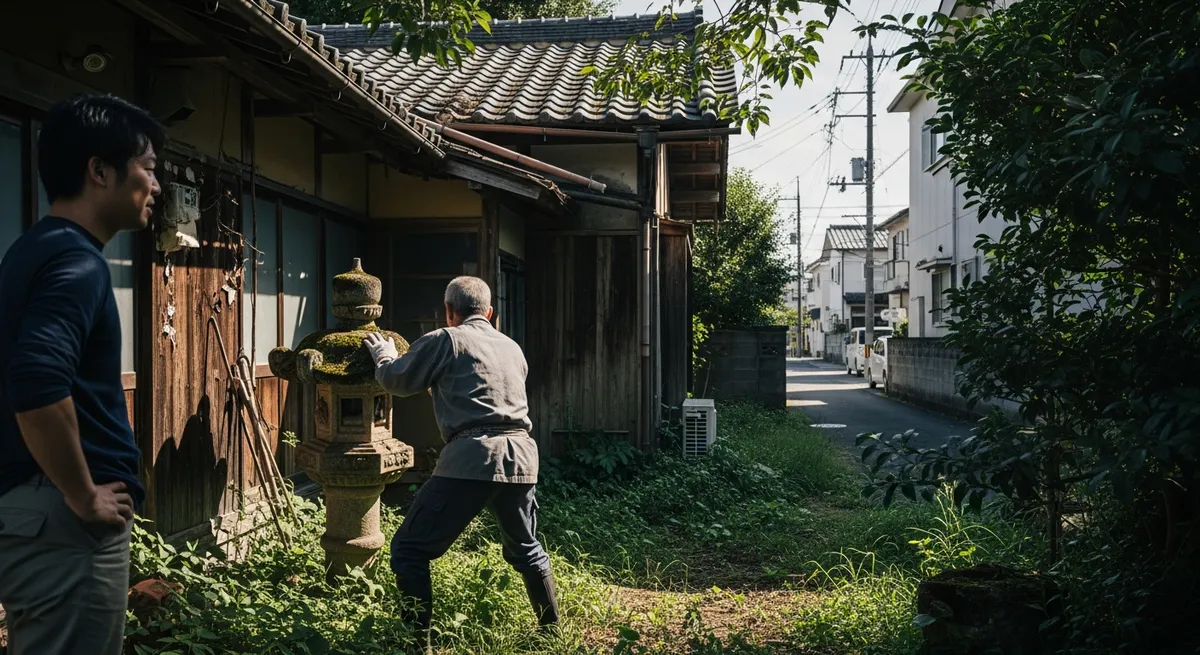
You found a house in rural Japan listed for ¥1,000,000. You start imagining weekend renovations, tatami rooms, a garden with persimmon trees. Between that listing price and the keys in your hand sits a stack of taxes and professional fees that can add 20-40% to your total outlay. Some of it arrives months after you thought the deal was done. This guide breaks down every line so you can budget with your eyes open.
Why the Purchase Price Is Just the Beginning
In most countries, the sticker price of a property is the main event. In Japan, it is more like the opening act. The Japanese real estate transaction system involves a distinct set of government taxes, professional fees, and registration costs that are largely unavoidable. Unlike some markets where closing costs are negotiable or bundled into financing, Japanese transaction costs are codified in law with specific calculation methods.
The gap between the listing price and total cost is proportionally larger for cheap properties. On a ¥50,000,000 house, transaction costs might add 6-8%. On a ¥1,000,000 akiya, they can add 30-50%. This is the key thing to understand about budget akiya purchases: the cheaper the property, the higher the percentage overhead.
Here is every cost you will encounter, in roughly the order they appear.
Agent Commission (仲介手数料 (chūkai tesūryō))
Japanese real estate agent commissions are not market-rate. They are legally capped by the Building Lots and Buildings Transaction Business Act, and the cap runs per side: the seller’s broker and the buyer’s broker each get their own, and a single broker acting for both can collect it twice. The maximum is set by a sliding scale on the sale price:
| Sale Price Bracket | Maximum Commission Rate |
|---|---|
| Up to ¥2,000,000 | 5% + consumption tax |
| ¥2,000,000-¥4,000,000 | 4% + consumption tax |
| Over ¥4,000,000 | 3% + consumption tax |
For properties over ¥4,000,000, the simplified formula works out to:
(Sale price × 3% + ¥60,000) × 1.10 (the 1.10 accounts for 10% consumption tax)
So on a ¥10,000,000 property, the maximum commission is (300,000 + 60,000) × 1.10 = ¥396,000.
The Low-Price Property Exception
For cheap akiya there is a special provision, introduced in January 2018 and rewritten by MLIT notification No. 949 of 2024, in force from 1 July 2024. When the sale price is ¥8,000,000 or below excluding consumption tax, the agent can charge a flat maximum of ¥300,000 plus consumption tax, so ¥330,000 all in, to cover the disproportionate work a low-value transaction involves. It is known as the low-price property mediation fee special rule (低廉な空家等の媒介特例 (teirenka akiya-tō no baikai tokurei)).
Two things changed in July 2024 and both matter to a buyer. The ceiling doubled, from ¥4,000,000 of sale price to ¥8,000,000, and the cap itself went from ¥180,000 plus tax to ¥300,000 plus tax. More to the point, the old rule let only the seller be charged it. The 2024 rewrite is what first allowed a broker to bill the buyer this fee at all. The trade-off written into the same notification is that the broker has to explain the figure and agree it with you before the brokerage contract is signed. If nobody raised it before you signed, it cannot appear on the invoice afterwards.
This means a ¥500,000 property and an ¥8,000,000 property can have the same agent fee. On the ¥500,000 house, that ¥330,000 commission is 66% of the purchase price. Budget accordingly.
Note: not all agents charge the maximum. Some charge less, especially if they are representing both buyer and seller. But most do charge the cap, and you should budget for it.
If you want the fee quoted in writing before you commit to anything, our licensed brokerage partner Akiya Japan Buyer Support handles the transaction side for buyers who find a property through Akiya Japan.
Registration and Licence Tax (登録免許税 (tōroku menkyo-zei))
When you buy property in Japan, the ownership transfer must be registered with the Legal Affairs Bureau (法務局 (hōmu kyoku)). This registration incurs two distinct taxes:
Ownership Transfer Registration Tax
This is calculated on the assessed value (固定資産評価額 (hyōka-gaku)) of the property, not the purchase price. That distinction trips up a lot of buyers. The assessed value is set by the local government for tax purposes and is typically 50-70% of the actual market value for land, and often much lower for buildings (especially old ones).
- Land: 1.5% of assessed value. That is a reduced rate against a standard 2%, and the FY2026 tax reform rolled it forward another three years, to 31 March 2029.
- Buildings: 2.0% of assessed value (standard rate; 0.3% if it qualifies as your primary residence and meets certain conditions)
Example: You buy a property for ¥5,000,000. The land's assessed value is ¥2,000,000 and the building's assessed value is ¥800,000. Your registration tax would be:
- Land: ¥2,000,000 × 1.5% = ¥30,000
- Building: ¥800,000 × 2.0% = ¥16,000
- Total: ¥46,000
On older akiya where the building has been heavily depreciated, the building's assessed value might be close to zero, which actually works in your favor here.
Mortgage Registration Tax
If you are financing with a mortgage, which is hard but not impossible for a foreign buyer, there is an additional registration tax of 0.4% of the loan amount, cut to 0.1% on a qualifying primary residence.
Stamp Duty (印紙税 (inshi-zei))
The purchase contract itself requires revenue stamps (収入印紙) affixed to it. The amount depends on the stated contract price:
| Contract Price | Stamp Duty (Reduced Rate) |
|---|---|
| ¥100,001 to ¥500,000 | ¥200 |
| ¥500,001 to ¥1,000,000 | ¥500 |
| ¥1,000,001 to ¥5,000,000 | ¥1,000 |
| ¥5,000,001 to ¥10,000,000 | ¥5,000 |
| ¥10,000,001 to ¥50,000,000 | ¥10,000 |
| ¥50,000,001 to ¥100,000,000 | ¥30,000 |
| ¥100,000,001 to ¥500,000,000 | ¥60,000 |
The reduced rates apply to real estate transfer contracts drawn up between 1 April 2014 and 31 March 2027, and they have been rolled forward every few years since 2014. For most akiya purchases stamp duty is a rounding error, ¥200 to ¥10,000 in the typical range. The brackets run on the stated contract price, so a house sold at exactly ¥1,000,000 pays ¥500 and one sold at a yen more pays double that.
Judicial Scrivener Fees (司法書士 (shihō shoshi)報酬)
A judicial scrivener (司法書士 (shihō shoshi)) is a licensed professional who handles the legal registration of property transfers. Think of them as a specialized conveyancer. Their role includes:
- Conducting title searches and verifying ownership
- Preparing registration applications
- Filing documents with the Legal Affairs Bureau
- Ensuring the transfer is properly recorded
Scrivener fees were deregulated in 2003, so unlike agent commissions there is no cap and quotes for identical work vary a lot. Typical ranges:
- Simple ownership transfer: ¥50,000 to ¥150,000, with a clean single-parcel file usually in the lower half of that
- Transfer with mortgage registration: ¥150,000 to ¥200,000
- Complex cases (multiple parcels, inheritance issues, address corrections): ¥200,000 to ¥300,000
Rural akiya often fall into the "complex" category. The land may be split across multiple parcels (it is not unusual for a single property to sit on 3-5 separate registered lots). The seller's registered address may not match their current address, requiring additional filings. And if the property was inherited, the chain of title may need to be established through multiple generations.
Budget ¥150,000 as a baseline, and up to ¥300,000 if there are complications. One thing to expect on the invoice: the scrivener normally collects the registration tax from you and pays it in on your behalf, so the bill you receive is their fee and the tax combined, not the fee alone.
Real Estate Acquisition Tax (不動産 (fudōsan)取得税 (fudōsan shutoku-zei))
This is the tax that catches people off guard. It arrives 3-6 months after the purchase, by mail, with a payment deadline. By that point, many buyers have already spent their "buffer" budget on initial repairs or furnishing.
The rate is:
- Land: 3% of assessed value, and residential land is assessed at half its value for this calculation until 31 March 2027
- Residential buildings: 3% of assessed value
- Non-residential buildings: 4% of assessed value
Again, this runs on the assessed value, not the purchase price. Two sets of relief can wipe it out entirely, and both are worth knowing before the notice lands.
The first is the used-home deduction. If the house will be your own home, has a floor area between 40 m² and 240 m², and was built on or after 1 January 1982, a fixed sum comes off the building's assessed value before the 3% is applied:
- Built January 1982 to June 1985: ¥4,200,000
- July 1985 to March 1989: ¥4,500,000
- April 1989 to March 1997: ¥10,000,000
- April 1997 onward: ¥12,000,000
Every one of those numbers is larger than the assessed value of a typical akiya building, so for a qualifying house the building tax goes to zero. Land bought alongside a qualifying house gets its own reduction, the higher of ¥45,000 or the land's per-square-metre value multiplied by twice the house's floor area, capped at 200 m², times 3%. That 40 m² floor is new. It was 50 m² for anything acquired up to 31 March 2026, and the FY2026 reform dropped it, which brought a lot of small rural houses into scope for the first time. Houses built before 1982 qualify only if you hold a seismic compliance certificate for them, which most akiya sellers do not.
The second is the exemption floor, and it is the one that quietly covers cheap akiya. If the taxable value is below the threshold, no tax is levied at all. From 1 April 2026 those floors are ¥160,000 for land and ¥340,000 for a building bought secondhand, up sharply from ¥100,000 and ¥120,000. A rural house assessed at ¥300,000 now pays nothing on the building, certificate or no certificate.
For a typical akiya with a land assessed value of ¥2,000,000 and building assessed value of ¥500,000:
- Land: (¥2,000,000 × 50%) × 3% = ¥30,000
- Building: ¥500,000 × 3% = ¥15,000
- Total: ¥45,000
That worked example assumes the common rural case: a pre-1982 house with no seismic certificate, so no deduction applies and the building is assessed above the exemption floor. Buy a post-1982 house to live in and both lines usually collapse to zero. On newer or well-located properties where assessed values are higher, the bill can still be meaningful. Either way, set the money aside at the time of purchase rather than when the notice arrives.
Summary of Transaction Costs
| Cost Item | Typical Range | When You Pay |
|---|---|---|
| Agent commission | ¥330,000 - 3%+¥66,000 | At closing |
| Registration tax | ¥20,000 - ¥200,000 | At registration |
| Stamp duty | ¥200 - ¥60,000 | At contract signing |
| Judicial scrivener | ¥100,000 - ¥300,000 | At registration |
| Acquisition tax | ¥10,000 - ¥300,000+ | 3-6 months later |
Annual Ongoing Costs
Owning property in Japan means ongoing annual tax obligations, regardless of whether you live in the property, rent it out, or leave it vacant.
Fixed Asset Tax (固定資産税 (kotei shisan-zei)), 1.4%
Every January 1st, the owner of record is assessed fixed asset tax at 1.4% of the assessed value. This is the universal property tax that applies everywhere in Japan.
There is an important residential land exemption: if a residential structure stands on the land, the taxable assessed value of the land is reduced to 1/6th for lots up to 200 m² (and 1/3rd for the portion exceeding 200 m²). This exemption is one reason people keep dilapidated houses standing rather than demolishing them, tearing down the house can cause the land tax to increase six-fold.
Example: Land assessed at ¥3,000,000 with a house on it:
- With house: (¥3,000,000 ÷ 6) × 1.4% = ¥7,000/year
- Without house: ¥3,000,000 × 1.4% = ¥42,000/year
That six-fold jump is the main reason Japan has so many deteriorating vacant houses nobody pulls down. Since 13 December 2023 the shelter is no longer unconditional: the revised vacant-house law created a "poorly managed vacant house" category, and once a municipality has formally issued a recommendation on one, the reduction goes while the building is still standing. Letting an akiya rot is now a way to get the six-fold bill without demolishing anything.
There is also a floor. If the land's assessed value is under ¥300,000, or the building's is under ¥200,000, no fixed asset tax is charged on that portion at all. On remote akiya, some owners never receive a bill at all. The annual tax side is worth reading in full before you own anything here.
City Planning Tax (都市計画税 (toshi keikaku-zei)), 0.3%
Properties within urbanization promotion areas (市街化区域) are subject to an additional city planning tax of up to 0.3% of assessed value. Rural properties outside these zones are exempt. If you are buying an akiya in a mountain village or remote coastal town, you likely will not pay this. If you are buying in a suburban area near a regional city, you probably will.
The residential land exemption applies here too, but at different fractions: 1/3rd (not 1/6th) for lots up to 200 m², and 2/3rds for the portion above that.
What Annual Taxes Actually Look Like
For a typical rural akiya with land assessed at ¥2,000,000 and building assessed near zero:
- Fixed asset tax: (¥2,000,000 ÷ 6) × 1.4% = approximately ¥4,700
- City planning tax: ¥0 (rural, outside urbanization area)
- Total annual tax: roughly ¥5,000 to ¥15,000
For a suburban property near a regional city with land assessed at ¥8,000,000:
- Fixed asset tax: (¥8,000,000 ÷ 6) × 1.4% = approximately ¥18,700
- City planning tax: (¥8,000,000 ÷ 3) × 0.3% = approximately ¥8,000
- Total annual tax: roughly ¥27,000 to ¥40,000
Annual property taxes in Japan are remarkably low by international standards. For most akiya, you are looking at less than ¥50,000 per year, sometimes far less.
The Hidden Surprises
Here is where budgets unravel. The costs above are predictable and calculable. The costs below depend on the specific property, and they are where the real financial risk sits. Most of them are visible on a careful viewing, which is why what you check before you buy matters more here than in almost any other market.
Demolition Costs
If the existing structure is beyond saving, you face demolition costs that can exceed the purchase price several times over:
| Structure Type | Typical Demolition Cost |
|---|---|
| Wooden house (木造) | ¥1,000,000 - ¥3,000,000 |
| Steel-frame building (鉄骨造) | ¥2,000,000 - ¥4,000,000 |
| Reinforced concrete (RC造) | ¥3,000,000 - ¥5,000,000 |
The trade quotes wooden demolition by the tsubo, roughly ¥30,000 to ¥50,000 per tsubo (3.3 m²), so a 30-tsubo farmhouse works out around ¥1,000,000 to ¥1,500,000 before extras. Quotes have risen about 16% since 2020. Costs vary by size, access difficulty (a site a truck cannot reach means everything comes out by hand), and region. Remote locations may actually be cheaper for the demolition itself but more expensive for waste disposal and transport. And remember the tax implication: demolishing the structure removes the residential land tax exemption, potentially increasing your annual property tax six-fold.

Asbestos Removal
Buildings constructed between the 1950s and 1990s may contain asbestos in insulation, ceiling tiles, siding, or roof materials. Japan banned asbestos-containing building products in 2006, with the last exemptions closed in 2012. If your property contains asbestos and you plan to demolish or significantly renovate, professional removal is required by law.
Costs depend heavily on the extent of contamination, but budget ¥200,000 to ¥1,000,000+ for asbestos survey and removal. A survey alone is ¥30,000 to ¥50,000. Since April 2022 the results have to be reported to the authorities for any demolition or renovation above a size threshold, and since October 2023 the survey itself has to be carried out by a certified surveyor, so this is no longer something a builder can eyeball for you. Some municipalities offer subsidies for asbestos surveys and removal, check with the local government before proceeding.
Boundary Surveys (境界確定測量)
In Japan, it is shockingly common for property boundaries to be unclear. Many rural properties have boundaries based on decades-old surveys, verbal agreements with neighbors, or vague references to natural features that have since changed. The boundary stakes (境界杭) may have been removed, buried, or destroyed.
If boundary confirmation is needed (and your agent or scrivener will advise), a licensed surveyor (土地 (tochi)家屋調査士) must be hired. This involves:
- Researching historical records at the Legal Affairs Bureau
- On-site measurement
- Agreement from all adjacent landowners (which can take months if they are deceased, absent, or uncooperative)
- Filing new boundary records
Cost: ¥300,000 to ¥500,000 for a standard residential lot where every neighbour is a private owner. If the plot also abuts a road, a river or other public land, the municipality has to sign off as well and the figure runs ¥500,000 to ¥800,000. It is avoidable if the seller already holds a confirmed survey, but for akiya, inherited ones especially, it usually has not been done.
If a neighbour refuses to co-operate, there is a fallback most guides skip. Under the Real Property Registration Act you can ask the Legal Affairs Bureau to run a boundary determination, in which a registrar fixes the legal boundary without needing the neighbour to agree. It is slower than a private survey and it settles the legal line rather than a negotiated one, but it exists, and knowing it exists changes the conversation.
Water and Sewage Connection
Rural akiya may rely on well water (井戸水) rather than municipal supply. If the well has gone dry, been contaminated, or you want to connect to municipal water:
- Municipal water connection: ¥100,000 to ¥500,000 depending on distance to the nearest main
- Well rehabilitation: ¥200,000 to ¥500,000
- New well drilling: ¥500,000 to ¥1,500,000
For sewage, many rural properties use a septic tank (浄化槽, jōkasō) rather than a municipal sewer. If the existing system is dead:
- New septic tank installation: ¥800,000 to ¥1,500,000 (municipal subsidies of up to 50-60% are available in many areas)
- Septic tank maintenance: ¥30,000 to ¥60,000/year for mandatory inspections and pumping

Road Access Issues (接道義務)
Under Article 43 of Japan's Building Standards Act, to rebuild or significantly alter a structure the site must touch a legally recognised road at least 4 metres wide along at least 2 metres of its own boundary. This is the setsudō gimu (接道義務), the road access obligation.
Many old akiya, particularly in historic neighborhoods, do not meet this requirement. The implications are severe:
- You cannot obtain a building permit for new construction
- You can renovate the existing structure but cannot rebuild if it is demolished or destroyed
- The property's value and resale potential are significantly limited
There are workarounds. A 2018 amendment turned the old discretionary escape clause into two formal routes under Article 43(2): a certification for sites meeting published criteria, and a permission that needs the building authority's sign-off plus the consent of its building council. Neither is a formality and neither is quick.
The market prices this honestly. A plot that cannot be rebuilt on trades at roughly 50% to 70% of an equivalent rebuildable plot, and most lenders decline them outright. That discount is exactly why some of the cheapest listings you will see are cheap. Verify road access before you offer, not after.

Inherited Property Complications
Many akiya are sold by heirs who inherited the property. Common complications include:
- Unregistered inheritance: the deceased owner is still the registered owner. The heirs must complete inheritance registration before selling, which takes time and needs every heir to agree. Since 1 April 2024 that registration is compulsory, within three years of an heir learning of the inheritance, with a fine of up to ¥100,000 for missing it; inheritances that predate the rule have until 1 April 2027. Clearing title is the seller's legal duty now, not a favour to you, and that deadline is the strongest card a buyer holds in this situation.
- Multiple heirs: Grandparents' property may have been inherited by 4 children, who each have 3 children, meaning 12+ people may need to agree to the sale.
- Outstanding municipal taxes: If the previous owner stopped paying fixed asset tax, the accumulated liability may need to be settled.
- Abandoned personal property: The house may be full of the previous occupant's belongings. Disposal is the buyer's problem unless negotiated otherwise. Budget ¥200,000 to ¥500,000 for professional clearance of a fully furnished house.
Renovation vs. Demolition: The Decision Matrix
One of the biggest decisions akiya buyers face is whether to renovate the existing structure or demolish and rebuild (assuming road access permits it). Here are the key factors:
| Factor | Favors Renovation | Favors Demolition |
|---|---|---|
| Foundation | Solid, no settling or cracks | Cracked, shifted, or no modern foundation |
| Structure | Sound framing, minor decay | Significant rot or termite damage to load-bearing members |
| Roof | Intact; any leaks recent and minor | Long-term leaks causing widespread water damage |
| Character | Traditional features worth keeping | No architectural merit |
| Layout | Workable floor plan | Layout incompatible with intended use |
| Cost estimate | Renovation under ¥10M | Renovation approaching or exceeding new build cost |
| Earthquake resistance | Post-1981 (新耐震基準) or retrofittable | Pre-1981 and retrofit impractical |
| Road access | N/A (renovation allowed either way) | Must confirm 接道義務 compliance before choosing demolition |
The dividing line is 1 June 1981, and it is tested on the date the building confirmation was issued, not the date the house was finished. A house advertised as "built 1982" can still sit under the old code if its paperwork went in the year before, so ask for the confirmation date rather than the completion year. Buildings under the pre-1981 code (旧耐震 (kyū taishin)基準) lack modern earthquake resistance. Retrofitting one costs ¥1,000,000 to ¥3,000,000 and some frames cannot be brought up properly at any price. Many municipalities offer retrofit subsidies of ¥500,000 to ¥1,000,000, so check before paying out of pocket, and treat the retrofit as part of the purchase, not a later project.
There is a second date almost nobody quotes. On 1 June 2000 the timber rules were rewritten again: ground surveys became effectively compulsory, joint hardware was specified, and wall placement had to be balanced across the plan. A 1985 house is post-1981 and still well short of a 2001 house. If you are choosing between two similar akiya, that gap is worth more than most of the cosmetic differences.
General renovation costs for akiya, and what a ¥5 million budget actually buys is worth a look before you commit to a band:
- Cosmetic refresh (paint, flooring, fixtures): ¥1,000,000 to ¥3,000,000
- Moderate renovation (kitchen, bathroom, electrical, plumbing): ¥3,000,000 to ¥8,000,000
- Full renovation (gut and rebuild interior while keeping structure): ¥8,000,000 to ¥15,000,000
- New construction (after demolition): ¥15,000,000 to ¥30,000,000+ depending on size and specification
Insurance
Property insurance in Japan is segmented in ways that can surprise foreign buyers.
Fire Insurance (火災保険)
This is the basic property insurance covering fire, lightning, windstorm, hail, snow damage, water damage from plumbing failures, theft, and vandalism. Despite the name, it covers far more than fire. Premiums depend on:
- Construction type (wooden costs more than RC)
- Location (typhoon-prone areas cost more)
- Building age and condition
- Coverage amount and deductible
Typical annual premiums for a wooden akiya: ¥20,000 to ¥80,000. Policies are now sold in maximum 5-year terms (reduced from 10 years in 2022).
Earthquake Insurance (地震保険)
Earthquake damage is explicitly excluded from fire insurance. Earthquake insurance must be purchased separately and can only be bought as a rider to an existing fire insurance policy, you cannot buy it standalone. Key limitations:
- You cannot insure it for what it is worth. The sum is set at 30% to 50% of the fire policy's sum insured, capped at ¥50,000,000 on the building and ¥10,000,000 on contents
- Damage is graded into four bands with fixed payouts: total loss 100%, major partial 60%, minor partial 30%, partial 5%. There is no assessment of your actual repair bill, only which band you fall into
- Rates are calculated by the General Insurance Rating Organization of Japan and are the same at every insurer, with the government reinsuring the top of the risk. Shopping around changes the service, not the price
Annual earthquake premiums: ¥10,000 to ¥50,000 depending on region and structure. The 30-to-50% ceiling means it was never designed to rebuild your house. It was designed to keep you solvent while you work out what to do next, which is a different product from the one most foreign buyers assume they are buying.
Liability Insurance
If you own a vacant property and someone is injured on it, a child playing in the yard, a delivery person tripping on a broken step, a neighbor's property damaged by your collapsing wall, you are liable. Personal liability insurance (個人賠償責任保険) can be added to your fire insurance policy for a modest additional premium, typically ¥1,000 to ¥3,000/year. This is particularly important for absentee owners who cannot monitor the property's condition.
Currency Exchange Costs
If you are buying from outside Japan, converting your home currency to yen is itself a cost center. The spread between buy and sell rates, transfer fees, and timing can materially affect your total outlay.
Every yen figure in this guide carries a conversion into whichever currency you have selected, worked out from that day’s rate, so treat those numbers as indicative. The rate that counts is the one on the day your money actually moves, and on a purchase this size the gap between the two can run to thousands. Set it from the globe control at the top of the page and every figure below follows.
Transfer Methods Compared
| Method | Typical Cost | Speed |
|---|---|---|
| Bank wire transfer | 1.5 - 3% exchange margin + ¥2,000 - ¥5,000 fees | 2-5 business days |
| Wise (TransferWise) | 0.4 - 0.7% total cost | 1-2 business days |
| OFX / WorldRemit | 0.5 - 1.0% total cost | 1-3 business days |
| Revolut | 0 - 0.5% (depends on plan/timing) | Instant to 1 day |
On a ¥5,000,000 transfer, the difference between a bank wire (2% margin) and Wise (0.5%) is approximately ¥75,000, more than many of the taxes listed above.
Timing Strategies
The JPY/USD and JPY/EUR rates fluctuate significantly. Between 2022 and 2024, the yen weakened dramatically against the dollar, making Japanese property exceptionally cheap for USD buyers. A few practical approaches:
- Dollar-cost averaging: Convert fixed amounts weekly or monthly in the lead-up to your purchase to smooth out rate fluctuations
- Rate alerts: Set target rate alerts on Wise or XE.com and convert when favorable rates hit
- Forward contracts: Some providers (OFX, Moneycorp) offer forward contracts that lock in today's rate for a future transfer, useful if you have a known closing date
Do not try to time the market perfectly. The goal is to avoid converting a large sum at a single unfavorable moment.
Putting It All Together: Three Budget Examples
These examples show realistic all-in costs for three common akiya purchase scenarios. Renovation costs are excluded, these are purely acquisition costs.
Scenario 1: Rural Wooden House, ¥1,000,000 Purchase Price
A small wooden house in a rural mountain village, 40+ years old, liveable but dated. Simple title, single parcel.
| Cost Item | Amount |
|---|---|
| Purchase price | ¥1,000,000 |
| Agent commission (low-price special rule) | ¥330,000 |
| Registration tax (land + building) | ¥25,000 |
| Stamp duty | ¥1,000 |
| Judicial scrivener | ¥120,000 |
| Acquisition tax (arrives later) | ¥25,000 |
| Fire + earthquake insurance (first year) | ¥40,000 |
| Total acquisition cost | ¥1,541,000 |
| Overhead as % of purchase price | 54% |
Annual ongoing costs: fixed asset tax ¥5,000 to ¥10,000, insurance ¥30,000 to ¥40,000.
The ¥1,000,000 house actually costs ¥1,541,000 before you spend a single yen on renovation. If you need to clear out the previous owner's belongings (¥200,000+), fix the plumbing (¥300,000+), and do basic cosmetic work (¥1,000,000+), your realistic budget is ¥3,000,000 to ¥4,000,000 all in.
Scenario 2: Small-Town House, ¥5,000,000 Purchase Price
A two-story house in a small city, 25 years old, near a train station. Two parcels of land, clean title, needs moderate updating.
| Cost Item | Amount |
|---|---|
| Purchase price | ¥5,000,000 |
| Agent commission ((5M × 3% + 60,000) × 1.10) | ¥231,000 |
| Registration tax | ¥55,000 |
| Stamp duty | ¥5,000 |
| Judicial scrivener | ¥160,000 |
| Acquisition tax | ¥60,000 |
| Fire + earthquake insurance (first year) | ¥50,000 |
| Total acquisition cost | ¥5,561,000 |
| Overhead as % of purchase price | 11% |
Annual ongoing costs: fixed asset tax ¥15,000 to ¥30,000, city planning tax ¥0 to ¥8,000, insurance ¥40,000 to ¥50,000.
Scenario 3: Suburban House, ¥15,000,000 Purchase Price
A well-maintained house in a suburban area near a regional capital, 15 years old, move-in ready. Proper boundaries confirmed, single large parcel.
| Cost Item | Amount |
|---|---|
| Purchase price | ¥15,000,000 |
| Agent commission ((15M × 3% + 60,000) × 1.10) | ¥561,000 |
| Registration tax | ¥140,000 |
| Stamp duty | ¥10,000 |
| Judicial scrivener | ¥150,000 |
| Acquisition tax | ¥150,000 |
| Fire + earthquake insurance (first year) | ¥65,000 |
| Total acquisition cost | ¥16,076,000 |
| Overhead as % of purchase price | 7% |
Annual ongoing costs: fixed asset tax ¥40,000 to ¥70,000, city planning tax ¥8,000 to ¥15,000, insurance ¥50,000 to ¥65,000.
The Pattern
Notice how the overhead percentage drops sharply as the purchase price rises: 54% on a ¥1M property, 11% on ¥5M, 7% on ¥15M. This is because many costs (scrivener, agent minimum, registration) are semi-fixed or have floors. The ¥1M akiya is a listing at a listed price. Your budget for one just has to start at ¥1,500,000 for acquisition alone.
Costs That Are Often Overlooked
Beyond the main categories above, several smaller costs tend to slip through budget planning:
- Travel costs: At least one trip to Japan for property viewing and closing. International flights, domestic transport, accommodation, and meals during the property search phase can easily reach ¥200,000 to ¥500,000.
- Translation and interpretation: If your agent does not provide bilingual service, independent translation of contracts and documents costs ¥30,000 to ¥100,000.
- Utility connection fees: Reconnecting electricity, gas, and water to a long-vacant property may involve inspection fees or reconnection charges of ¥10,000 to ¥50,000.
- Property management: If you are an absentee owner, a local property management service to check the property monthly, ventilate it, manage mail, and handle emergencies costs ¥5,000 to ¥20,000/month.
- Vegetation management: Overgrown properties must be maintained. Neighbors and municipalities can and do complain (and in some cases, municipalities can order maintenance at the owner's expense). Annual garden maintenance: ¥30,000 to ¥100,000.
- Capital gains tax on sale: sell at a profit and the rate is 30.63% short-term (held under five years as at 1 January of the year you sell) or 15.315% long-term. Non-residents pay the same rates, but the buyer must withhold 10.21% of the sale price, not of the gain, and remit it, unless the buyer is an individual paying ¥100,000,000 or less for their own or a relative's home. You reclaim the difference on your return, which can mean a long wait for your own money.
Income Tax for Non-Resident Owners
If you rent out your property while living outside Japan, the rent is Japanese-source income and taxable here. A tax agent (納税管理人 (nōzei kanri-nin)) has to be appointed in Japan to handle the filings. The tenant, or the manager paying you, generally withholds 20.42% of the gross rent and remits it. You then file an annual return to claim deductions (depreciation, repairs, management fees, insurance) and reconcile the withholding.
One exception is worth knowing because it covers a lot of akiya lettings and almost no English guide mentions it: if your tenant is an individual renting the house as a home for themselves or a relative, they do not withhold anything. Rent to a company, for any purpose at all, and the 20.42% applies. The identity of the tenant, not the use of the building, is what decides it.
This is manageable but requires either a Japanese tax accountant (¥50,000 to ¥150,000/year) or sufficient Japanese language and tax knowledge to self-file.
Municipal Subsidies and Grants
The silver lining in all of this: many Japanese municipalities are actively trying to reduce their akiya count and attract new residents, especially to rural areas. Available subsidies vary enormously by location but commonly include:
- Renovation subsidies: ¥500,000 to ¥5,000,000 toward qualifying repair work (most common)
- Seismic retrofit subsidies: ¥500,000 to ¥1,000,000 for earthquake-proofing older homes
- Demolition subsidies: ¥200,000 to ¥1,000,000 for removing dangerous structures
- Moving incentives: Cash grants for relocating to the municipality, sometimes ¥1,000,000+ for families with children
- Septic system subsidies: Up to 50-60% of installation cost in areas without municipal sewer
These usually require you to live in the property rather than use it as a holiday house, and many carry a minimum stay with full clawback if you leave early. Terms change every fiscal year and budgets run out mid-year, so confirm with the municipal office directly before you count on anything. Eligibility is also narrower than it looks from outside: the headline relocation grant is restricted by residence status, while a lot of municipal renovation money is not, and the difference between the two is where most applications fall over.
A Realistic Approach to Budgeting
Based on the breakdown above, here is a practical budgeting framework:
- Transaction costs: Add 10-15% to the purchase price (20-50% for properties under ¥3,000,000)
- Contingency for hidden issues: Reserve an additional 10-20% of the purchase price for unexpected costs discovered after purchase
- Renovation (if planned): Get multiple quotes before purchasing and add 20% buffer, renovation in rural Japan frequently costs more than initial estimates due to material transport, specialist availability, and scope creep once walls are opened
- First-year operating costs: Budget ¥100,000 to ¥200,000 for taxes, insurance, utilities, and basic maintenance even if you are not yet living in the property
The most common mistake foreign akiya buyers make is budgeting only for the purchase price and a vague "renovation fund." The transaction costs, delayed taxes, and hidden physical issues can collectively exceed the purchase price on cheap properties. Know the numbers, build in margins, and you will be far better positioned than most buyers entering this market.
Annual property taxes that come in under a monthly utility bill, no restriction on foreign ownership, and freehold title are advantages most developed markets cannot match. They only work for you if you have counted every line between the listed price and the keys in your hand, and now you have.