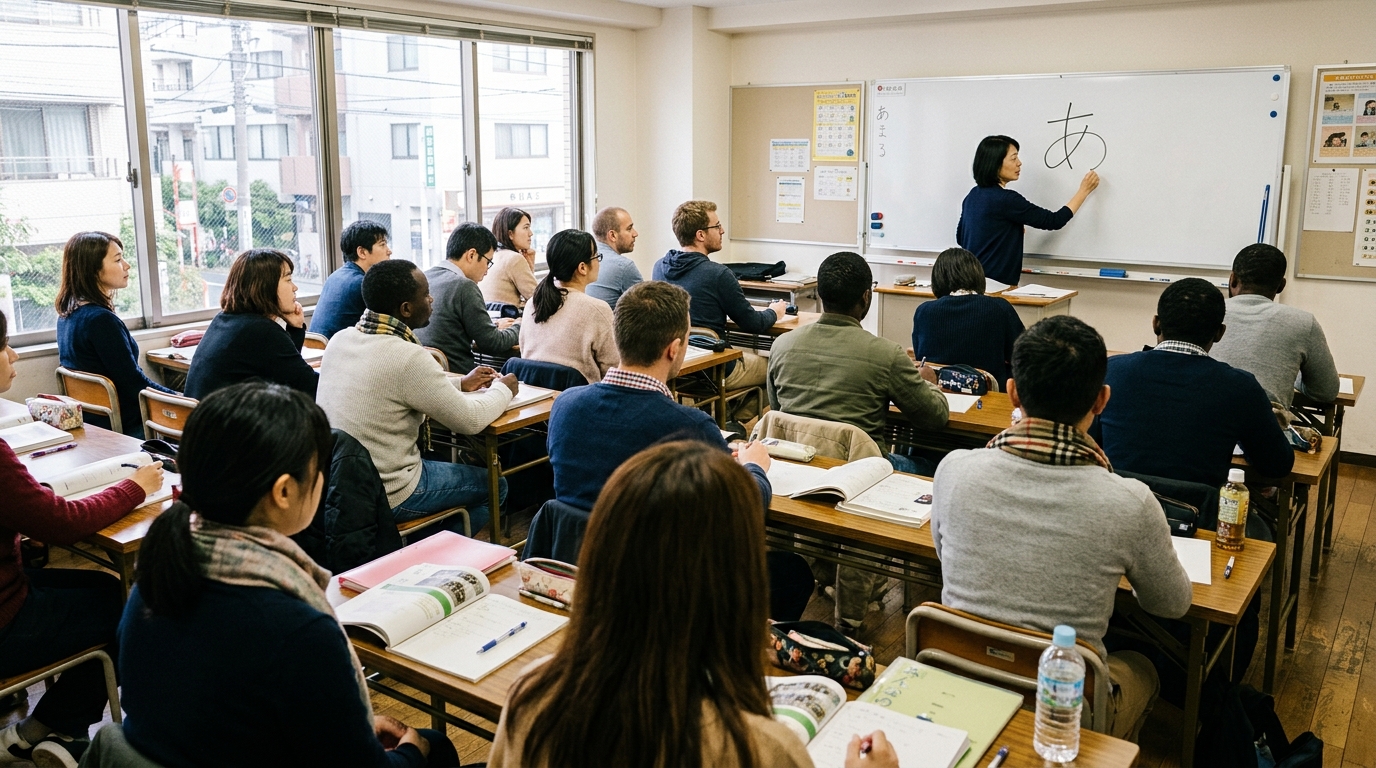
The most common question under every "should I move to Japan" video is not about money or language. It is some version of "am I too old for this?" The people asking are usually between 28 and 50, often with a career behind them and savings in the bank, and they have half-convinced themselves the door closed a decade ago. It didn't. Walk into most Japanese language schools and you'll find classrooms that mix a 22-year-old on a gap year with a 44-year-old former nurse and a 38-year-old software engineer working remotely from the back row. Age is not the barrier. The visa is the barrier, and the language-school student visa is the most accessible way over it.
This is the route that lets you actually live in Japan for a year or two, not visit for three weeks. Long enough to learn enough Japanese to talk to an estate agent without an interpreter, to spend real time in three or four regions before deciding where you want to be, and to buy an akiya because you know the neighbourhood, not because a listing photo looked nice. Here is how the visa works, what it costs in 2026, what you're allowed to do for money while you hold it, and why a year on the ground is the best possible preparation for buying a house here.
How the student visa actually works
The mechanism is simple. You enrol in an accredited Japanese language school, the school sponsors your application, and the Immigration Services Agency (ISA) issues a "Student" (留学, ryūgaku) status of residence. The length depends on your course. Language-school visas run from a minimum of six months up to a maximum of two years, usually granted in increments you renew as you progress.
The word "student" is doing real work here. This is not a visa you buy and forget. To keep it valid you have to actually study full-time, which schools define as at least 20 lessons a week, normally mornings Monday to Friday. Miss too many and the visa is at risk: fall below roughly 80% attendance and the school is obliged to flag it, and your renewal or extension can be refused. Courses are built in three-month levels with exams at the end of each, so there is genuine homework and genuine progress measured against the JLPT scale. People who treat it as a paid tourist visa get found out. People who show up learn a surprising amount of Japanese in a year.
That structure is the point, not the price you pay for the visa. Twenty hours of class a week for a year, in the country, surrounded by the language, is the fastest most adults will ever move from "I know a few phrases" to "I can hold a conversation and read a contract with a dictionary." That is the skill that changes what kind of house you can buy and how confidently you can buy it.

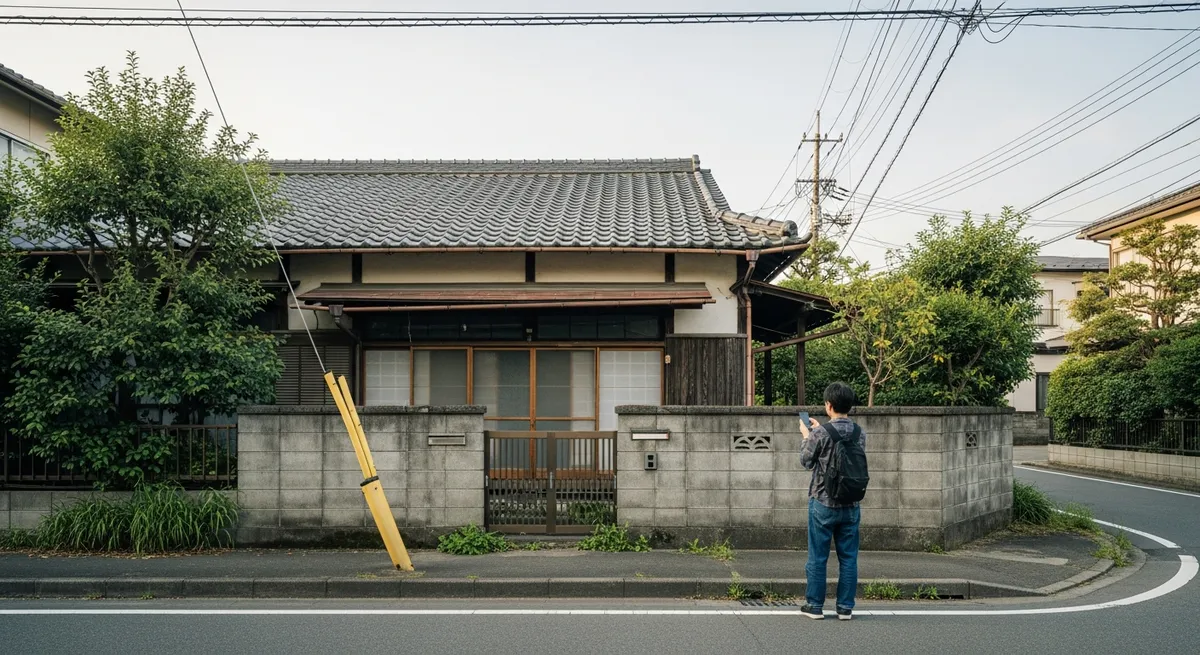
The ordinary Tokyo backstreet you walk home down after class. A year of this is the immersion. -- Photo on Pexels
What it costs in 2026
A student visa is cheap next to a degree and roughly comparable to, or cheaper than, a working-holiday year once you factor in what you get. Tuition at a language school runs about ¥700,000 to ¥900,000 a year for a standard intensive course, once the first-year admission and registration fees are counted. Schools in Tokyo and specialised programmes sit higher, up to ¥1,000,000 to ¥1,300,000, while schools in Fukuoka, Nagoya and regional cities tend to be cheaper.
To find schools in the region and price band you want, use GaijinPot Study, which runs a searchable directory of accredited language schools across Japan. Filter by city and budget, shortlist a few, and email them directly to compare start dates, class sizes and JLPT results before you commit.
Then there is the money you have to show, which is separate from the money you spend. To grant the visa, immigration wants proof you can support yourself. For a one-year programme in 2026 that generally means demonstrating access to around ¥1,500,000 to ¥2,000,000 (roughly ¥1,000,000 for a six-month course). This is a bank-balance test, not a fee. It stays your money.
Living costs land at about ¥100,000 to ¥150,000 a month in Osaka or Tokyo, less in smaller cities. Roughly, that breaks down to ¥40,000 to ¥80,000 for a room, ¥30,000 to ¥50,000 for food and transport, and national health insurance at about ¥20,000 to ¥30,000 a year once you're enrolled as a resident. Most people budget ¥2,000,000 to ¥3,000,000 for a full year of study plus living.
The weak yen is quietly the best thing about the timing. If you earn or hold savings in dollars, euros, pounds or Australian dollars, every one of those yen figures is cheaper for you than it was a few years ago. The conversions shown next to each figure here update from live rates, and you can switch your own currency with the globe control at the top of the page, so treat them as indicative rather than fixed. A year that felt out of reach on a 2019 exchange rate is materially more affordable now.
Working while you study
A student visa does not include the right to work. It includes the right to apply for the right to work, which is a different thing and easy to get. The permission is called 資格外活動許可 (shikakugai katsudō kyoka), the "Permission to Engage in Activity Other Than That Permitted Under the Status of Residence Previously Granted." Once you hold it, you can take paid part-time work up to 28 hours a week during term, and up to 8 hours a day (about 40 hours a week) during the school's official long breaks.
Getting the stamp is straightforward. If you arrive at a major airport, you can request it at the immigration desk on entry and have it added to your residence card the same day. If you miss that window, you file a one-page application at your local immigration office, and it typically comes back within a couple of weeks. There is no fee. The one rule people trip over: the permission covers general part-time work but not the adult entertainment industry, and it does not cover running a business.
Twenty-eight hours a week at a normal part-time wage will not cover Tokyo rent and tuition on its own, so do not plan to fund the whole year from a konbini (convenience store) job. Treat part-time work as a top-up and a language-practice tool, not a salary.
The 2026 rule changes you need to know
On 10 April 2026 the ISA published a significant update to how the student status is monitored, and it matters if you're applying now. Two things changed. First, from the October 2026 intake onward, schools must verify a baseline of Japanese-language ability before enrolling you, either with a language-test certificate or a short interview, tightening up on applicants who were using language school purely as a visa vehicle with no intention of studying. Second, schools now check in with students every three months to confirm where they are working and how many hours, students must supply the names of all their employers, and if a student breaks the hour cap, or an employer pressures them to work over it, the school reports it straight to Immigration.
None of this is a problem if you're doing what the visa is for. It is a problem if your plan was to enrol, never attend, and work 40 hours a week off the books. The route rewards people who actually want to learn the language and live here, which, if you're reading this to prepare for buying a home, is you.

The working city you're allowed 28 hours a week of. An Akihabara street at the end of the day. -- Photo on Pexels
The remote-work question
This is where the comment threads get heated, and where a lot of bad advice circulates. Plenty of people on student visas keep a remote job for a foreign employer, paid into a foreign bank account, and assume that because the money never touches Japan, Japan has no say. That reading is comforting and wrong.
Working remotely from Japan for an overseas company sits in a grey area that is rarely enforced but is not the same as permitted. "Rarely policed" is not "allowed," and if it surfaces during a visa renewal, it can put your status at risk. There are two clean ways to do it properly. The first is to get the same shikakugai katsudō permission described above, which legalises the activity within the 28-hour cap. The second, for people who want a real income while they study, is an Employer of Record (EOR), a company that formally employs you in Japan on your foreign employer's behalf and handles payroll, tax and social insurance so nothing is off the books.
Tax is the part people forget. Once you have a home in Japan, a domicile or a place you live in for a continuous year or more, you generally count as a Japanese tax resident, which brings your income into the Japanese system regardless of where it's paid. (The "183 days" figure people repeat is a treaty rule for short work postings, not how Japan sets residency, so don't lean on it.) For your first five years here as a non-national, you're taxed on Japan-source income plus any foreign income you actually bring into Japan. And the days of assuming a foreign account is invisible are over: Japan takes part in the Common Reporting Standard and swaps account data with more than 100 jurisdictions. The United States is the exception, because it runs its own system, FATCA, so US-Japan account reporting flows through that instead. So the right frame is not "how do I sneak a remote job past immigration." It's "how do I keep my remote income and stay fully legal," and the answer is the katsudō permission and, if you're earning real money, an EOR plus honest tax filing.
What you'll actually earn if you teach
English teaching is the default part-time and post-study income path, and you should go in with clear eyes. Entry-level pay has been frozen at around ¥250,000 a month for over two decades. Smaller schools sometimes advertise as low as ¥180,000. Assistant Language Teacher (ALT) roles have a low ceiling too: even direct-hire Board of Education positions rarely pass ¥320,000 to ¥350,000 a month, because an ALT is an assistant, not the lead teacher. Wages have gone sideways in nominal terms and fallen in real terms since the 1990s.
That is not a reason to avoid it. Teaching is a reliable way to keep the lights on, meet people and practise Japanese daily. It is a reason not to build a financial plan on the assumption that teaching income will grow, or that it will fund a house purchase on its own. If you have a remote career already, keep it (legally, per the section above). If you don't, teaching bridges you while your Japanese improves and better-paid options open up.
What happens when the visa ends
Two years of language school is not a dead end, it's a runway. The most common onward routes are a work visa, once your Japanese is good enough that an employer will sponsor you (and the year in-country is often what gets you hireable), further study at a vocational school (専門学校, senmon gakkō) or university, or, for some, a path that eventually leads toward long-term residency. Japan has real shortages in several sectors, and time on the ground plus functional Japanese moves you from "unhireable from abroad" to "worth sponsoring." We've written separately about the industries actually hiring foreigners and about whether Japan wants you to stay, both worth reading before you plan the exit from the student status.
The alternative if you're well funded and don't want to study
Studying isn't the only long-stay route, though the alternatives ask for serious money. The Designated Activities (特定活動, tokutei katsudō) status includes a long-term stay category aimed at people who want to spend an extended period on hobbies, cultural pursuits or leisure rather than work or study. It grants an initial six months, extendable to about a year, and it is built for the comfortably retired or independently wealthy: the headline requirement is liquid savings of at least ¥30,000,000 (about ¥60,000,000 for a couple who each hold the status), plus travel and medical insurance covering the whole stay, and no paid work of any kind is allowed. If you can clear that bar and don't need or want the structure of school, it's an option. For most people weighing the move, the language-school route costs a fraction of it and gives you a skill at the end.
Why a year here is the best thing you can do before buying
Here is the part that ties all of this back to a house. You do not need any visa to buy property in Japan. Foreigners can purchase freehold land and buildings outright, with no residency or citizenship requirement, no special permission, and the same ownership rights as a Japanese national. We've covered that in detail in Yes, Foreigners Can Buy Property in Japan, and the distinction between owning and living here in Owning a Home Is Not a Visa.

The kind of neighbourhood you can only judge by living near it for a season. -- Photo on Pexels
So the student visa is not a prerequisite for ownership. It's something better: the ideal window to become the buyer you want to be. A year or two in the country buys you three things money alone can't. You learn enough Japanese to sit across from an agent and understand the answers, which changes every negotiation. You spend real seasons in real places, so you learn that the ski-town cottage you loved in February is snowed in for five months, or that the coastal town you dismissed is 40 minutes from a bullet-train stop. And you build the local footing, a bank account, a residence card, a network, that makes the actual purchase smoother.
Read the listing like a local, work with agents in their language, and scout in person, and you buy a house you understand instead of a photo you liked. Our guide to working with Japanese estate agents and the akiya buying guide are good next reads once you're on the ground. If you'd rather have a licensed professional handle the legal side in English, our partner brokerage Akiya Japan Buyer Support, founded by Ai Hioki and focused on foreign-buyer support, can walk you through a purchase while you concentrate on the language.
The video that prompted this piece, Exjapter's "Would I move to Japan in 2026?", spends a whole chapter on property ownership rules for exactly this reason: the ownership door is already open. The visa question is really about how long you get to live here, learn the place and choose well before you walk through it. The language-school student visa is the most accessible way to buy yourself that time, and nobody at the front of the classroom is going to tell you you're too old to be there.
Sources
- GaijinPot: New Rules for Language Students in Japan From 2026
- GaijinPot Study: Student visa 28-hour work limit
- Migaku: How to Work Part-Time in Japan on a Student Visa (2026 Rules)
- GaijinPot Study: Cost of a Japanese language school
- Migaku: Japan Student Visa Financial Requirements 2026
- RSM Japan: The 183-Day Rule and Residency Determination
- EFL Magazine: Teaching English in Japan Salary 2025-2026
- Japan Visa: Designated Activities (特定活動) 2026