Every decade or so, the Japan–South Korea undersea tunnel resurfaces in the headlines. Engineers dust off the blueprints. Officials give cautiously optimistic statements. Infrastructure blogs run dramatic renders of bullet trains speeding under the Korea Strait. And then it quietly disappears again.
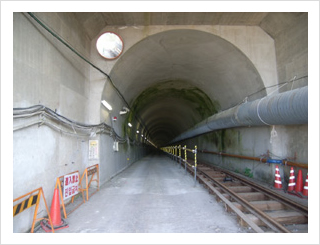
That cycle has now repeated for over 40 years. A 500-metre test tunnel has been excavated near Karatsu. Land has been purchased on three islands. Geological surveys have been conducted at depth. The project is not merely theoretical — it is the most committed non-built megaproject in modern Asia. Understanding why it keeps returning, and why it has never progressed beyond groundwork, is one of the stranger stories in contemporary infrastructure.
The Tunnel's Three Routes — and Why They All End at Karatsu
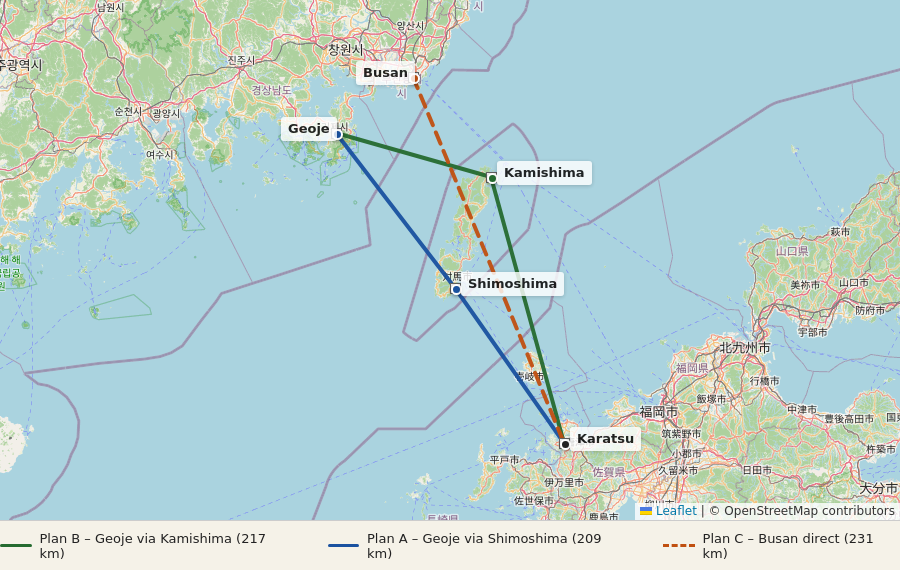
The Japan–Korea Undersea Tunnel (日韓海底トンネル, nikkan kaitei tonneru) has three proposed alignments, each studied by the Japan-Korea Tunnel Research Institute Society:
- Plan A: Geoje Island → Tsushima Shimoshima → Karatsu City — 209 km total, 145 km undersea
- Plan B: Geoje Island → Tsushima Kamishima → Karatsu City — 217 km total, 141 km undersea
- Plan C: Busan directly to Karatsu City — 231 km total, 128 km undersea
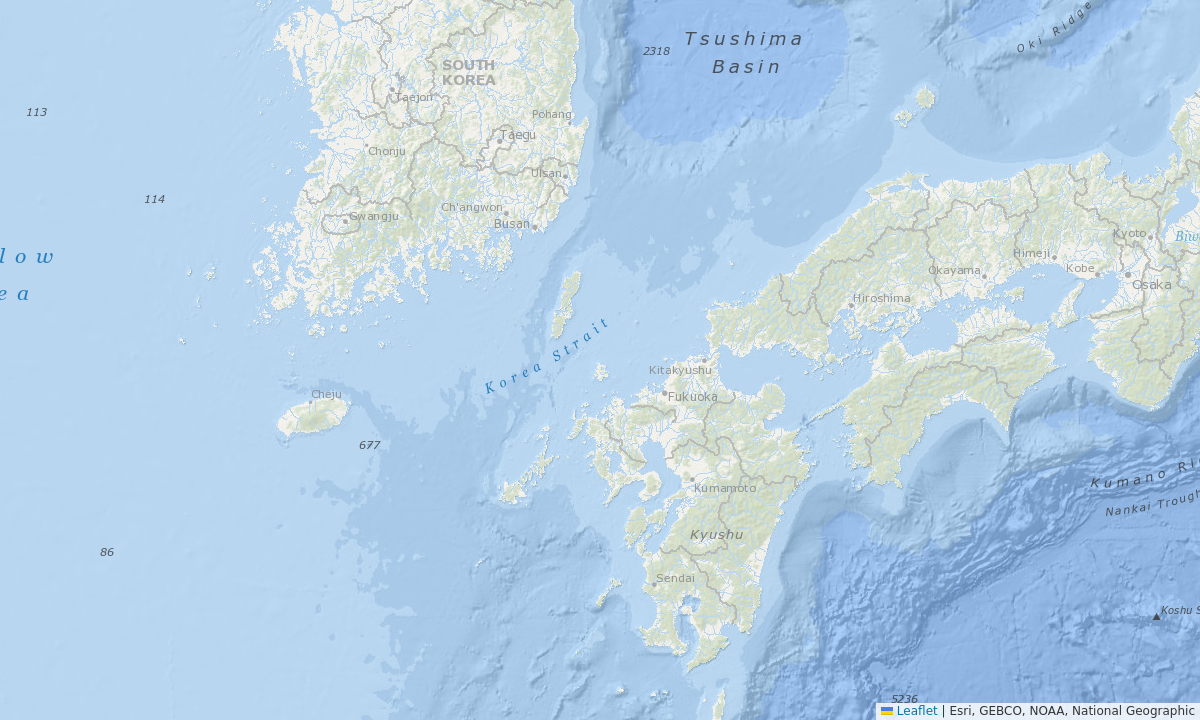
All three routes converge on Karatsu, a city of 115,000 in Saga Prefecture. That convergence is partly geographical and partly historical: Karatsu sits on Kyushu's northwestern coast closest to the Korean Peninsula, and is the site of the only physical tunnelling work ever completed. The city already has an unusual relationship with the project — locals have watched survey teams come and go, and the 500-metre incline shaft near Karatsu remains the sole concrete artefact of 40 years of planning.
Karatsu itself is worth understanding beyond its role as a proposed terminus. The city holds Karatsu Castle (唐津城), a reconstructed 17th-century fortress overlooking Matsuura Bay. Karatsu-yaki pottery — earthy, asymmetric, valued by tea ceremony practitioners — has been made here since Korean potters arrived in the late 16th century. Every November, the Karatsu Kunchi festival carries 14 massive lacquered floats through the streets. And the Yobuko Morning Market, 20 minutes north, is one of Japan's most celebrated seafood markets — squid caught overnight, sliced to order, still moving on the plate.

Engineering: What Makes This Harder Than Any Tunnel Ever Built
The Channel Tunnel between England and France is the natural comparison point. It is 50 km long, cost approximately ¥2.5 trillion in today's money, and took seven years to build. The Korea Strait tunnel would be 209–231 km long depending on alignment — four times longer. But raw distance understates the challenge.
The English Channel has a maximum depth of 75 metres. The Korea Strait reaches 210 metres in places. Tunnel construction at that depth means building under dramatically greater water pressure, with limited precedent for similar work. The tunnelling techniques, emergency ventilation systems, and geological risks involved would be fundamentally different from those used in Europe — not merely scaled up.
The International Highway Foundation (IHF), which has promoted the project since the early 1980s, estimates construction costs at ¥10 trillion (approximately $65–70 billion USD at 2026 exchange rates) and a build time of at least 15 years. Other estimates run as high as ¥100 trillion when lifetime operating costs and associated rail infrastructure are factored in. A 2011 South Korean Transport Institute study found the project's benefit-cost ratio fell "far below" the 0.8 threshold Korea uses to justify major public infrastructure. The 2016 Busan Development Institute estimate placed costs at 116 trillion won against projected production value of 54.53 trillion won.
The IHF has conducted real work regardless. Following a groundbreaking ceremony in Karatsu in 1986, crews excavated the incline shaft near Karatsu and opened a test section to the public in 2009. Survey teams have worked Tsushima and Iki islands. The organisation owns land at the proposed Japanese terminus points. This is not a desk exercise — but it is also very far from a funded, politically committed infrastructure project.
A 1930s Idea Resurrected by a Religious Movement
The tunnel's history predates the Unification Church. Japan's Ministry of Railways studied a Korea Strait tunnel in the 1930s as part of its expansion during the colonial period — a fixed link between Kyushu, Tsushima, Iki, and Busan was part of longer-range planning for a pan-Asian rail network. The war ended that discussion.
It was revived in 1980 by Obayashi Corporation, one of Japan's major construction firms, in a straightforward infrastructure proposal. Then in 1981, something stranger happened. The Reverend Sun Myung Moon — founder of the Unification Church, known in Japan as the Family Federation for World Peace and Unification — proposed the tunnel concept at the 10th International Conference on the Unity of Science in Seoul. Moon framed it not merely as a transport link but as a component of a global vision: an international highway connecting Tokyo to London.
That framing changed the project's character permanently. In 1982, the International Highway Construction Corporation was established. In 1983, the Japan-Korea Tunnel Study Group was formed. Both organisations had deep ties to the Unification Church. The groundbreaking at Karatsu followed in 1986. The IHF has been the project's primary technical and political advocate ever since — and the Church connection has haunted it at every step.
In December 2025, a South Korean special counsel's report named former Oceans Minister Chun Jae-soo among politicians who allegedly received financial support from the Church in exchange for advancing the tunnel project between 2018 and 2020. The revelations came as Japan's courts were dissolving the Unification Church domestically: the Tokyo District Court ordered the organisation's dissolution in March 2025. The project enters 2026 carrying more political toxicity than at any point in its history.
Tsushima: What Cross-Strait Connectivity Actually Looks Like

Tsushima Island (対馬市) is the clearest window into what Japan–Korea connectivity means in practice. The island of 28,000 people sits 50 km from South Korea's southern coast and 130 km from Fukuoka — closer to Korea than to the Japanese mainland by a significant margin. That geography defined its 20th-century history, and then its 21st.
A high-speed ferry from Busan launched in 1999 transformed the island. By 2018, South Korean tourists accounted for 90% of all arrivals and generated an estimated ¥2.1 billion in annual revenue. Car rentals, bicycle hire, duty-free retail — entire business models built around Korean spending patterns. Then in 2019, bilateral trade tensions triggered an 88% collapse in arrivals. Roughly 1.7 million fewer Korean visitors arrived in a single year. Businesses that had no revenue diversification failed within months.
That collapse might have been the end of the story. Instead, Tsushima became the subject of one of the more unlikely tourism revivals in recent history. Sony Interactive Entertainment's 2020 game Ghost of Tsushima — set on the island, depicting its Mongol invasion in 1274 — sold millions of copies globally. The game's creative directors, Nate Fox and Jason Connell, were appointed Tsushima tourism ambassadors by Nagasaki Prefecture in 2021. Players who had toured the island digitally began arriving physically: European, North American, and Australian visitors who had never considered Japan's remote western islands.
The lesson that emerges from Tsushima is not straightforwardly positive for the tunnel thesis. Yes, connectivity to Korea created genuine economic value. But it created fragile, concentrated value — 90% dependence on one market, with no structural hedge. The Ghost of Tsushima revival demonstrated that the island has real appeal beyond the Korean day-tripper economy. Whether a fixed tunnel connection would deepen or further concentrate that dynamic is genuinely unclear.
Why Neither Government Has Ever Said Yes

The economics don't work — and both governments know it. The 2016 Busan Development Institute estimate projected that the tunnel would cost more than twice what it would generate over its lifetime. Benefit-cost ratios that far below viability thresholds don't pass ministerial review in either country, regardless of political will.
Beyond the economics, the diplomatic relationship between Tokyo and Seoul has been one of the most volatile among major economies in living memory. Historical grievances over the colonial period, disputes over the Dokdo/Takeshima islands, tensions over Korean court rulings on wartime labour — these frictions have repeatedly interrupted trade and cultural cooperation. Building a 200km joint infrastructure project requires levels of bilateral trust that have repeatedly proved elusive.
Japan's government has never formally committed to the project. South Korea's government has never formally committed. Every political mention has come from individual politicians, often those with demonstrated Unification Church connections, or from opposition figures using the project as a wedge issue. There is no joint technical commission. There is no shared feasibility study. There is no construction tender.
The project's most active period was the 1980s. Its strongest advocacy today comes from an organisation (the IHF) whose parent movement is being dissolved by Japanese courts.
Signals to Watch
The tunnel belongs in a category of megaprojects worth monitoring without betting on. The meaningful signals — in roughly ascending order of significance — would be:
- Any bilateral working group or joint feasibility study commissioned by both governments simultaneously (has never occurred)
- Budget allocation in Japan's Kyushu infrastructure planning documents
- Expansion of ferry or air capacity between Tsushima or Iki and the Korean mainland — lower-cost signals of growing cross-strait demand
- A formal construction announcement with a committed timeline from both governments
None of these indicators are active in early 2026. The next several years in western Kyushu are far more likely to be shaped by the Nagasaki Shinkansen's regional integration, Fukuoka's continued commercial expansion, and whether Tsushima builds on its international tourism momentum than by any cross-strait tunnel development.
For buyers looking at western Kyushu properties and wondering whether tunnel speculation should factor into their decision: the project is real, fascinating, and has more physical history than most people realise. It is also politically toxic, economically marginal, and diplomatically stranded. It is worth understanding — not worth pricing in.
Sources
- Japan–Korea Undersea Tunnel — Wikipedia
- Korea–Japan tunnel proposals emerge in Unification Church scandal — The Korea Herald
- Why Unification Church is so desperate for Korea-Japan undersea tunnel — The Korea Times
- Japan-South Korea undersea tunnel project hits dead end over Unification Church ties — South China Morning Post
- What is the Japan-Korea Undersea Tunnel? — International Highway Foundation
- Tsushima Island — Wikipedia
- The Unification Church dissolution and Japan's evolving religious governance — East Asia Forum